Argument Map
Accountability Without Identification
Accountability Without Identification — Argument Map (v2)
Democratic accountability is a consequential condition, not a precondition. When unmasking power is distributed among multiple parties, conditions are pre-specified, and the process is auditable, cryptographic pseudonymity is sufficient to simultaneously satisfy both anonymity and accountability.
Democratic accountability is a consequential condition, not a precondition.
A ⇐ P[U]   where   U valid ⇔ V₁ ∧ V₂ ∧ V₃ ∧ V₄ ∧ V₅ ∧ V₆

∀x : citizen(x) → permitted(P, x)
∀y : power_holder(y) → ¬permitted(P, y)
Accountability A is derivable from "pseudonym P composed with conditional unmasking U"; the validity of U requires simultaneously satisfying six procedural firewalls V₁..V₆. Power and pseudonym space are inversely proportional.
A- Accountability — democratic accountability
I- Identification — real-name identification (binding legal name prior to participation)
P[U]- Pseudonym composed with conditional Unmasking — pseudonym plus conditional unmasking
V₁..V₆- Six procedural firewalls (specific attack vector / symmetric cost-benefit / cryptographic alternative / sunset clause / multi-party custody / post-hoc audit)
⇐- Sufficient ground for
⇔- If and only if
∧- Conjunction (simultaneously satisfied)
The formula states the position, but for the position to hold, the first step is to distinguish two conflated paths. Real-name identification and pseudonymity are often treated as "two ends of the same spectrum"; this map opposes that classification — they are different categories of accountability configuration.
Real-name identification
Binding legal name prior to participation. Treating "identifiability" as a prerequisite threshold for participation; no real name → no qualification. This structure places accountability "before" participation, effectively requiring citizens to relinquish anonymity before entering public discourse.
A ⇐ I (treating I as the necessary precondition of A) Pseudonymous identification + conditional unmasking
A trackable identifier that does not disclose real identity by default; unmasked ex post through due process only when a violation occurs. Accountability falls "after the fact," not "before the fact" — this corresponds to the well-established legal templates of search warrants, sealed indictments, witness protection, and John Doe lawsuits.
A ⇐ P[U] where U valid ⇔ V₁ ∧ V₂ ∧ V₃ ∧ V₄ ∧ V₅ ∧ V₆ The distinction is merely a declaration. To prove that the "pseudonym + conditional unmasking" path holds, four independent sources of support are needed — political philosophy provides the normative basis, cryptographic engineering provides technical feasibility, institutional paradigms provide historical precedent, and counter-evidence provides a failure comparison. Without any one of these, the position reverts to a slogan.
§2 — Political Philosophy
Accountability is structurally ex post
whyProvides the normative basis — if mainstream accountability theory already treats accountability as an ex post condition, the "pre-participation real-name identification" path loses its philosophical priority.
Schedler and Bovens' contemporary accountability theory both require answerability and enforceability "after the fact." US case law (NAACP v. Alabama, McIntyre v. Ohio) has repeatedly struck down pre-participation real-name requirements, demonstrating that law has long distinguished "pseudonymous traceability" from "real-name binding."
∀ accountability event e: occurs(e) ⇒ ex_post(e) §3 — Cryptographic Engineering
The mathematics has long been ready
whyProvides technical feasibility — if P[U] is not cryptographically implementable, the entire path is merely a slogan. The L1–L4 classification is used to precisely identify the bottleneck.
Group signatures, anonymous credentials, and threshold cryptography (BBS+, TAPS) can already provide pseudonymity with "privacy by default, conditional unmasking." L1 theory is complete; L2 standards are partially in place; L3 deployment is uneven; L4 governance is the bottleneck. Cryptography is necessary but not sufficient.
∃ crypto primitives π : provides(π, P[U] ∧ V₅ ∧ V₆) §4 — Institutional Paradigm
Democracy has already been doing this
whyProvides historical precedent — if pseudonymity plus conditional unmasking is a "wholly new design," it must be defended from scratch; if it is a generalization of existing constitutional democratic institutions, the burden of proof is greatly reduced.
Search warrants, sealed indictments, witness protection, John Doe lawsuits — four mature institutions all follow the "pseudonym by default + conditional unmasking + multi-party custody + auditable record + pre-specified trigger" structure. Three asymmetric constraints are directly transplanted — sovereign scope, stakeholder structure, enforcement basis — but the structural template can be borrowed.
∃ institutions {𝓘₁..𝓘ₙ} : ∀ 𝓘ᵢ, structure(𝓘ᵢ) ≅ P[U] §5 — Counter-Evidence
Centralized unmasking power will inevitably degrade
whyProvides reverse support — without being able to prove "not adopting P[U] will lead to failure," the affirmative support remains merely an option; negative evidence is what elevates it to necessity.
The Aadhaar (India) case provides a seven-step causal chain from "single-party custody design" to "135 million records leaked + chilling effect." South Korea's real-name law was struck down by the Constitutional Court — suppressing speech without reducing abuse. Five independent cases consistently point in the same direction — centralized unmasking → scope creep → systemic leakage.
¬V₅(U) ⇒ Pr(degradation | t→∞) → 1 The four pillars above are affirmative arguments. But the claim that "centralized unmasking power will inevitably degrade" must be supported by a specific causal chain — otherwise it is merely rhetoric. Aadhaar from the 2009 design to subsequent post-2023 abuse provides a seven-step sequence that can be mechanically traced; the first three steps are structural necessities and the latter three are probabilistic events — this distinction itself is part of the argument.
Aadhaar seven-step causal chain — centralized unmasking power → systemic degradation
⇒ Mechanistically necessary (structural, does not depend on external trigger) ◊⇒ Probabilistic (requires an external trigger to materialize, but probability is non-negligible) Once the position and causal chain are established, counterarguments pose a genuine threat. AML, electoral fraud, and weapons control are the three counterarguments most commonly cited as reasons "real-name identification is still necessary"; but carefully examining the empirical strength of each counterargument reveals that they not only fail to support real-name identification, but actually flip to support pseudonymity plus conditional unmasking — that is, the evidential structure of the counterarguments themselves is precisely the second layer of support for the map.
Counterargument 1
AML / KYC anti-money laundering
pivotThe counterargument claims that "real-name identification can intercept criminal funds." But empirical evidence shows interception rates below 0.1%, compliance costs exceeding recovered amounts by 100 times, and the burden falling on the unbanked population — in other words, "real-name identification" as a tool itself fails the V₂ symmetric cost-benefit test. Attribute proofs (age proof / residency proof) + conditional unmasking can achieve equivalent regulatory effect.
AML not only fails to support real-name identification, but actually provides the strongest cost-benefit argument for "P[U] + attribute proofs" — under the same regulatory objective, the pseudonymous path costs less and covers more broadly.
Counterargument 2
Electoral fraud
pivotThe counterargument claims that "voter ID can prevent impersonation voting." But the US impersonation voting rate is approximately 0.0003%, and voter ID laws measurably suppress minority voting rates (5–15%) — meaning that "real-name identification" as a tool suppresses far more legitimate exercise than the illegitimate exercise it intercepts, violating the V₁ specific attack vector test (the attack vector itself is nearly nonexistent).
Pre-participation real-name identification solves a nearly nonexistent problem while causing real harm. This outcome inversely supports placing pressure on "V₆ post-hoc audit" rather than pre-participation identification.
Counterargument 3
Weapons / WMD
pivotA genuine exception — but the counterargument is overextended. "Weapons require real-name identification" only holds for specific category holders (operators, handlers), not necessarily for ordinary purchasers. This distinction corresponds to V₁ — specific(threat) ∧ ¬general(threat).
Even in this narrow domain, universal real-name registration cannot be defended. The exception is narrow and cannot be expanded into a general rule — this precisely demonstrates how V₁ constrains the expansionary impulse of special circumstances.
Once counterarguments are absorbed, what remains are design implications — under what conditions can "unmasking" be considered a legitimate exception? These six procedural firewalls translate the abstract "consequential condition" into verifiable engineering obligations. They are simultaneously the concrete instantiation of V₁..V₆ in the core formula.
The legitimacy of any exception to pseudonymity must first pass six procedural firewalls
U valid ⇔ V₁ ∧ V₂ ∧ V₃ ∧ V₄ ∧ V₅ ∧ V₆The threat must be specifically identifiable, not general or speculative. Rhetorical-level threats such as "deteriorating public order" or "proliferating misinformation" do not qualify.
V₁: ∃ specific(threat) ∧ ¬general(threat) Privacy loss must be quantitatively assessed alongside identification benefits. One-directional value claims such as "for the sake of security" do not qualify — both sides of the equation must be symmetrically enumerated.
V₂: cost(privacy_loss) ≤ benefit(identification) Before proceeding to unmasking, it must first be verified whether alternatives such as ZK proof / attribute proofs / threshold disclosure can achieve the same regulatory objective.
V₃: ¬∃ zk_alt(goal) ∨ rejected(zk_alt, justified) Explicit review triggers and time limits must be stated; emergency powers must have expiration dates. Clauses without sunsets will gradually become normalized (Aadhaar §33's history has already proven this).
V₄: ∃ sunset_date ∧ ∃ review_trigger No single institution independently holds unmasking power. At minimum, an m-of-n threshold (m ≥ 2) cryptographic mechanism + cross-branch political checks and balances are required.
V₅: ∀ unmask u : holders(u) ≥ 2 ∧ cross_branch(holders) Unmasking records, initiating parties, and reasons must be publicly reviewable. Closed-door unmasking, unrecorded processes, and unchallengeable procedures hollow out the structural protection of V₅.
V₆: ∀ unmask u : public_record(u) ∧ challengeable(u) Bringing together the normative, engineering, institutional, counter-evidence, and conditions layers, what the map ultimately argues is a political-economy achievement (cryptography is merely one necessary condition among several), and an asymmetric principle running through all levels.
"Accountable pseudonymity" is a political-economy achievement; cryptography is merely one necessary condition layer within it. The L1–L3 engineering substrate is ready; L4 governance is what determines whether the commitment can be fulfilled.
The debate should shift from "real-name vs anonymity" to "the governance quality of unmasking power." The bottleneck lies in the combination of V₅ multi-party custody and V₆ post-hoc audit — who holds the keys, under what conditions, and with what oversight.
An asymmetric principle runs through the entire text — citizens may be pseudonymous; holders of institutional power may not. The greater the power, the smaller the permitted anonymity space — this gradient is itself the necessary extension of the P[U] formula.
Final form:
  ∀x : citizen(x) → permitted(P[U], x)
  ∀y : power_holder(y) → ¬permitted(P[U], y)
  A ⇐ P[U]   where   U valid ⇔ ⋀ᵢ Vᵢ  (i ∈ 1..6)
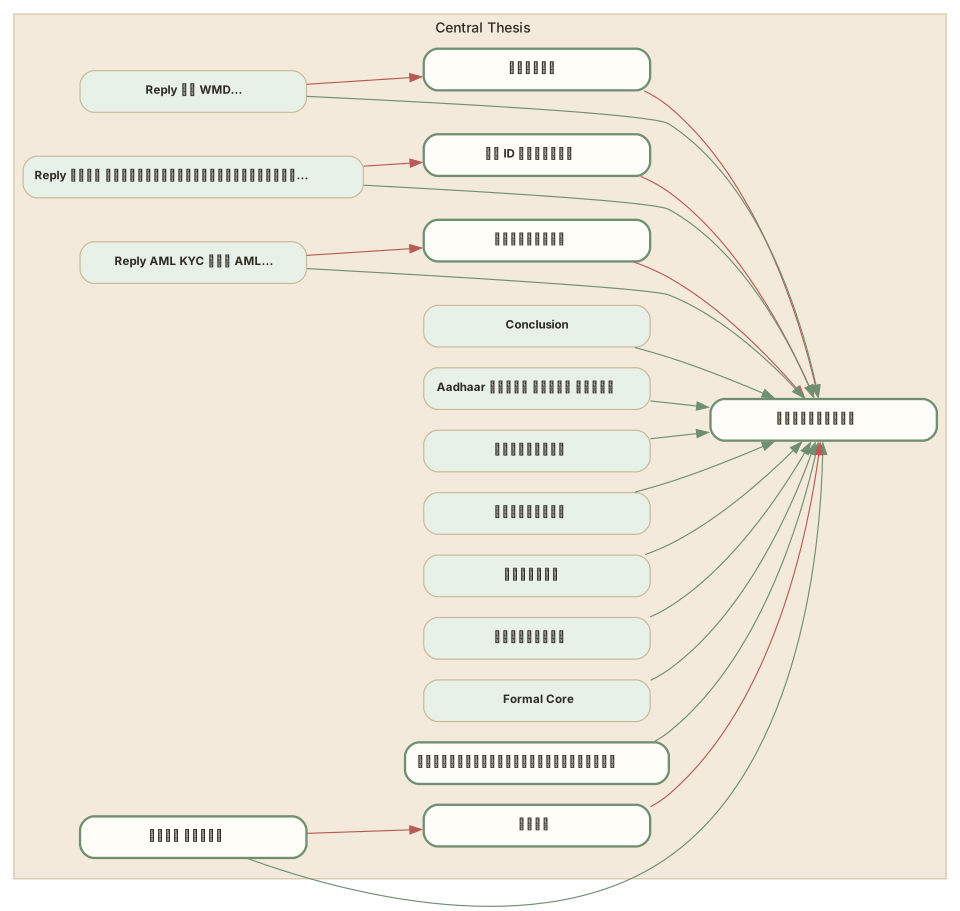
Source
===
title: 可問責不以實名為前提
subTitle: Accountability Without Identification — Argument Map (v2)
slug: 2026-05-02-accountability-without-identification
author: research-article-pipeline argdown export
model:
  removeTagsFromText: true
===

# Central Thesis

[Core Thesis]
  + <Formal Core>
  + [Accepted]
  + <P1>
  + <P2>
  + <P3>
  + <P4>
  + <Causal Chain>
  + [Deployment Conditions]
  + <Conclusion>
  - [Rejected]
    - [Accepted]
  + [Accepted]
  - [Objection 1]
    - <Reply 1>
  + <Reply 1>
  - [Objection 2]
    - <Reply 2>
  + <Reply 2>
  - [Objection 3]
    - <Reply 3>
  + <Reply 3>

[Core Thesis]: 民主問責性是「結果性條件」而非「前置性條件」。當啟封權力分散於多方、條件預先明定、過程可被審計,密碼學假名足以同時滿足匿名性與問責性。 #thesis

<Formal Core>: Formula A P U where U valid V₁ V₂ V₃ V₄ V₅ V₆ x citizen(x) permitted(P, x) y power holder(y) permitted(P, y) Caption 問責性 A 的成立由「假名 P 加上條件性啟封 U」推得 U 的有效性需同時滿足六道程序防火牆 V₁..V₆。權力與假名空間呈反比。 #formal

[Accepted]: 假名識別 條件性啟封. 一個可追蹤的代號,預設不揭示真實身分 只在違規發生時透過正當程序事後啟封。問責落在「事後」,而非「事前」——這對應到法律早已成熟的搜索票、密封起訴書、John Doe 訴訟等模板。 #accepted

[Rejected]: 實名識別. 在參與前綁定法定姓名。把「能識別」當作參與資格的前置門檻 無實名 無資格。這個結構把問責放在參與「之前」,等於要求公民先放棄匿名才能進入公共討論。 #rejected

<P1>: Title 問責結構上是事後的 Section 2 — 政治哲學 Role 提供規範性根據——若主流問責理論本來就把問責視為事後條件,「事前實名」這條路徑就失去了哲學上的優先性。 Schedler 與 Bovens 的當代問責理論皆要求「事件之後」的可回答性與可執行性。美國判例(NAACP v. Alabama, McIntyre v. Ohio)反覆推翻參與前實名要求,顯示法律早已區分「假名可追蹤性」與「實名綁定」。 Finding 法律與哲學早已建立 A 的事後性質——P U 是這個事後結構的密碼學對應。 Formal accountability event e occurs(e) ex post(e) #pillar

<P2>: Title 數學早就齊備了 Section 3 — 密碼學工程 Role 提供技術可行性——若 P U 在密碼學上不可實作,整條路徑就只是口號。L1-L4 分級用來精確指出瓶頸。 群簽名、anonymous credentials、threshold cryptography(BBS 、TAPS)已能提供「預設隱私、條件啟封」的假名。L1 理論完備、L2 標準部分到位、L3 部署不均、L4 治理才是瓶頸。密碼學是 necessary but not sufficient。 Finding 工程實作能達成 P U ,但 V₅(多方持鑰) V₆(事後審計)需要治理層配合,不是純密碼學議題。 Formal crypto primitives π provides(π, P U V₅ V₆) #pillar

<P3>: Title 民主早就在做這件事 Section 4 — 制度範式 Role 提供歷史先例——若假名加條件啟封是「全新設計」,需要從零辯護 若它是民主憲政既有制度的一般化,辯護負擔大幅降低。 搜索票、密封起訴書、證人保護、John Doe 訴訟——四條成熟制度都遵循「預設假名 條件啟封 多方持鑰 可審計記錄 明定 trigger」結構。三個不對稱限制直接移植 主權範圍、利害關係人結構、執行基礎,但結構模板可借。 Finding P U 不是發明,是從四條既有制度抽象出來的模板。立法新規範時,可以在這個模板上做修補。 Formal institutions 𝓘₁..𝓘ₙ 𝓘ᵢ, structure(𝓘ᵢ) P U #pillar

<P4>: Title 集中啟封權必然退化 Section 5 — 反向證據 Role 提供反向支撐——若無法證明「不採 P U 會出錯」,正向支撐還只是一個選項 負面證據才能把它推上必然性。 Aadhaar(印度)案例提供從「單方持鑰設計」到「1.35 億筆資料外洩 寒蟬效應」的七步因果鏈。南韓實名法被憲法法庭推翻——壓制言論卻未減少濫用。5 個獨立案例方向一致 集中啟封 範圍蠕變 系統性外洩。 Finding T0 T2 是機制必然(結構性),T2 T5 是概率性但持續被觀察到——這個區分本身就決定了論證強度。 Formal V₅(U) Pr(degradation t ) 1 #pillar

<Causal Chain>: Title Aadhaar 七步因果鏈 集中啟封權 系統性退化 T0 (deterministic) 2009 — UIDAI 設計 啟封權從一開始就集中於單一行政機關(違反 V₅ 多方持鑰) T1 (deterministic) 2012 16 — Aadhaar Act 33 緊急啟封範圍持續擴張(違反 V₄ 日落條款) T2 (deterministic) 2017 — 1.35 億筆紀錄外洩。The Tribune 500 盧比 10 分鐘可取得任何 Aadhaar 紀錄 T3 (probabilistic) 2017 — Puttaswamy v. Union of India 最高法院確認隱私為基本權(外部 trigger) T4 (probabilistic) 2018 19 — 33(2) 修正,但實務執行未隨之改變 T5 (probabilistic) 2023 — Pegasus 用於監控記者 33 執行紀錄持續累積 #chain

[Deployment Conditions]: 任何例外於假名性的合法性,必須先通過六道程序防火牆. U valid V₁ V₂ V₃ V₄ V₅ V₆ #conditions

<C1>: Title 具體的攻擊向量 威脅必須是具體可識別的,不能是一般性或推測性的。「治安惡化」「假訊息流竄」這類修辭級威脅不及格。 Formal V₁ specific(threat) general(threat) #condition

<C2>: Title 對稱的成本-效益測試 隱私損失必須與識別效益並列量化評估。「為了安全」這類單向價值宣稱不及格——必須對稱列出兩邊的數字。 Formal V₂ cost(privacy loss) benefit(identification) #condition

<C3>: Title 密碼學替代測試 在採取啟封之前,必須先驗證 ZK proof 屬性證明 threshold disclosure 等替代方案能否達成同樣的監管目標。 Formal V₃ zk alt(goal) rejected(zk alt, justified) #condition

<C4>: Title 強制日落條款 明示複審 trigger 與時間上限 緊急權力必須有期限。沒有日落的條款會逐步常態化(Aadhaar 33 的歷史已證明)。 Formal V₄ sunset date review trigger #condition

<C5>: Title 多方持鑰 沒有任何單一機構獨自持有啟封權。最少需要 m-of-n threshold(m 2)的密碼學機制 跨機關政治制衡。 Formal V₅ unmask u holders(u) 2 cross branch(holders) #condition

<C6>: Title 事後公開審計 啟封紀錄、發起方、理由必須可被公開審查。閉門啟封、不留紀錄、不可挑戰的程序,會把 V₅ 的結構性保障掏空。 Formal V₆ unmask u public record(u) challengeable(u) #condition

<Conclusion>: 「可問責的假名性」是政治經濟成就,密碼學僅為其中的必要條件層。 L1-L3 工程基底已就緒,L4 治理才決定承諾能否兌現。 辯論應從「實名 vs 匿名」轉向 「啟封權的治理品質」 。瓶頸落在 V₅ 多方持鑰加 V₆ 事後審計這對組合——誰持鑰、在什麼條件下、有什麼監督。 一條不對稱貫穿全文 公民可以假名,制度權力持有者不可以。 權力越大,被允許的匿名空間越小——這個梯度本身就是 P U 公式的必然延伸。 Formal Coda Final form x citizen(x) permitted(P U , x) y power holder(y) permitted(P U , y) A P U where U valid ᵢ Vᵢ (i 1..6) #conclusion

# Deployment Conditions

[Deployment Conditions]
  + <C1>
  + <C2>
  + <C3>
  + <C4>
  + <C5>
  + <C6>

# Objections And Replies

[Objection 1]: AML KYC 反洗錢. 反論訴求是「實名能攔截犯罪資金」。但實證顯示攔截率 0.1%、合規成本超過追回金額 100 倍,且負擔落在無銀行帳戶人口——換言之,「實名」這個工具自己就違反 V₂ 對稱成本-效益測試。屬性證明(age proof residency proof) 條件啟封可達同等監管效果。 #objection

<Reply 1>: Title AML KYC 反洗錢 AML 不僅不支持實名,反而給「P U 屬性證明」提供了最強的成本-效益論證——同樣監管目標下,假名路徑代價更低、覆蓋更廣。 #reply

[Objection 2]: 選舉舞弊. 反論訴求是「選民 ID 能防止冒名投票」。但美國冒名投票率約 0.0003%,Voter ID 法可量測地壓制少數族裔投票率(5-15%)——亦即「實名」這個工具壓制的合法行使遠超它攔截的非法行使,違反 V₁ 具體攻擊向量測試(攻擊向量本身近乎不存在)。 #objection

<Reply 2>: Title 選舉舞弊 事前實名解決一個近乎不存在的問題,卻造成真實傷害。這個結果反向支持「壓力應放在 V₆ 事後審計」,而非事前識別。 #reply

[Objection 3]: 武器 WMD. 真正的例外——但反論訴求過度延伸。「武器需要實名」只對特定角色持有者(操作員、處理員)成立,對一般購買者並不必然成立。這個區分對應到 V₁ specific(threat) general(threat)。 #objection

<Reply 3>: Title 武器 WMD 即使在這個窄場域,普世實名登記也無法被辯護。例外是窄的,不能擴大成通則——這恰好示範 V₁ 如何約束特殊情境的擴張慾望。 #reply