Argument Map
Why Digital Association Still Fails Despite Tor and Signal
Digital Association Empirical Test — 身分隱私假說的實證檢驗
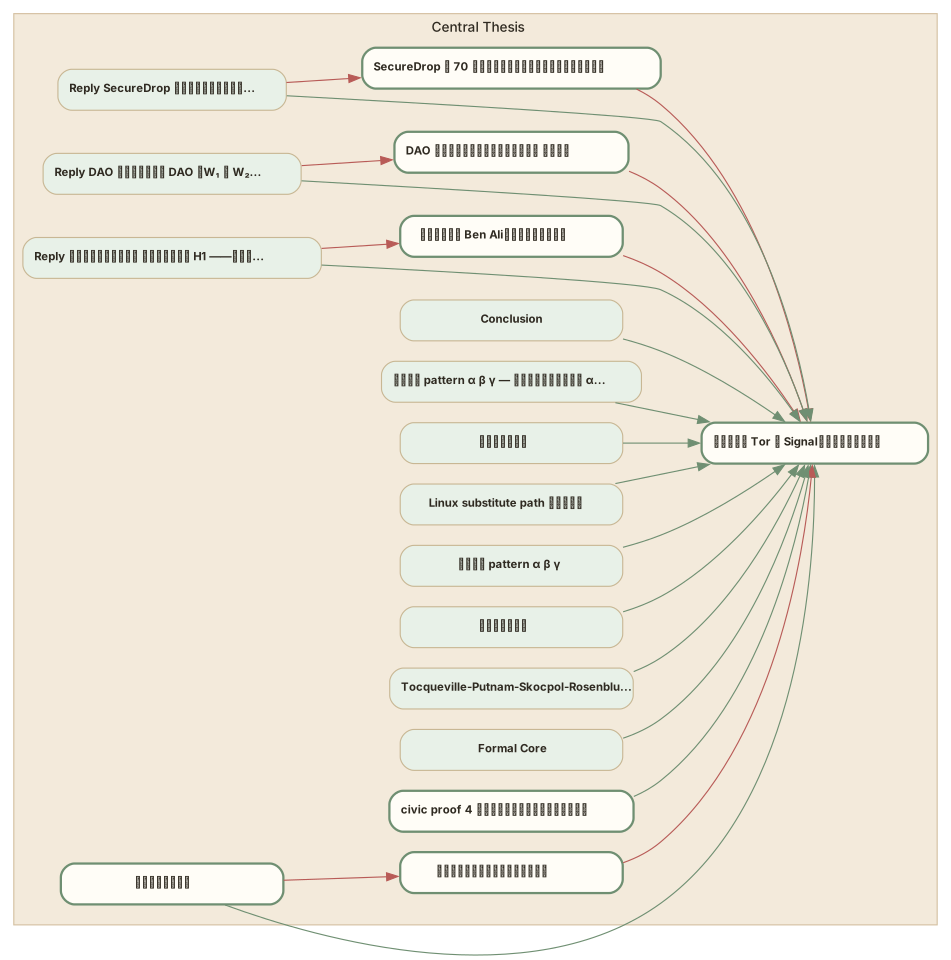
The failure of digital association should not be reduced to a single downstream consequence of "insufficient identity privacy" (H0); it is a structural problem in which three walls remain simultaneously unsolved (H1'). The three walls are verifiable group boundaries, intra-group accountability, and cross-case scalability — the absence of any one entails failure. Tools such as Tor, Signal, and Briar only address the upstream identity-privacy bottleneck; the three downstream walls remain standing.
H0 (single-factor identity privacy) revised to H1' (conjunctive three walls); civic proof's 4 conditions map onto the three walls.
H1' ⇔ ¬F ⇔ W₁ ∧ W₂ ∧ W₃

∀ case ∈ {Tunisia, HongKong, Catalonia, Iran, Belarus}:
  ¬F(case) ⇒ ∃i ∈ {1,2,3}: ¬Wᵢ(case)

civic_proof.4_conditions ↪ {W₁, W₂, W₃}
Digital association success F obtains if and only if all three walls are simultaneously resolved. An N=5 case sample is insufficient to establish this as a theorem; it is treated as an empirical regularity.
F- Successful digital association (formation of sustained association)
W₁- Verifiable group boundary (who is in / out, cryptographically attestable)
W₂- Intra-group accountability (without external state coercion)
W₃- Cross-case scalability (scaling beyond a single mobilisation event)
H0- Original hypothesis — "insufficient identity privacy → failure" (tested and found insufficient as a single cause)
H1'- Revised conjunctive hypothesis — "three walls simultaneously unsolved ⇔ failure"
⇔- If and only if (necessary and sufficient)
∧- Conjunction (all conditions simultaneously satisfied)
The first step of hypothesis testing is to write the original proposition in its "strongest reading" H0 (single-factor sufficiency); only by falsifying the strongest reading can the necessity of the revised H1' (conjunctive necessity) be demonstrated.
Insufficient identity privacy is the sole sufficient cause of failure
"Only by raising identity privacy to sufficient strength will digital association emerge." This reading reduces all associational failure to the downstream expression of an upstream privacy bottleneck, and aligns with the cypherpunk tool-optimism lineage since the 1990s. However, process tracing across N=5 cases shows that even after years of Tor / Signal / Briar deployment, the three downstream walls remained unmoved and association continued to fail.
H0: ¬privacy(t) ⇒ ¬F(t) ❌ converse does not hold Three walls simultaneously unsolved
Digital association succeeds if and only if all three walls are simultaneously resolved. Identity privacy is a *necessary bottleneck* for W₁ (verifiable group boundary) — resolving it still leaves failure possible at W₂ and W₃ — but it is not a sufficient condition. The three walls form a conjunctive bundle of normative necessary conditions; the absence of any one entails failure.
H1': ¬F ⇔ W₁ ∧ W₂ ∧ W₃ H1' is not an a priori theorem — it requires five independent supports: the historical universality of strong mobilisation versus weak association, the conceptual derivation of the three walls, process tracing across N=5 cases, the cypherpunk tool-optimism counterexample, and the mapping onto civic proof's 4 conditions.
§2 — Historical Universality of Strong Mobilisation / Weak Association
The Tocqueville–Putnam–Skocpol–Rosenblum Lineage
whyProvides the normative reference point — in a democratic society, association is a political practice that bears normative obligations, not a romanticised claim that "association is naturally good."
From Tocqueville's 1840 documentation of association as a school of freedom in Democracy in America, through Putnam's social capital, Skocpol's political associations, and Rosenblum's democratic side — a four-century lineage defines association as a political practice bearing normative obligations. "Strong mobilisation" (one-off collective action) and "weak association" (continuous membership) are distinct political forms; conflating them obscures the three-wall problem.
association(g) ⇒ normative_obligations(g) ∧ persistent(g) ∧ scaled(g) §3 — Conceptual Derivation of the Three Walls
Formalising the Conjunctive Structure
whyProvides the formal skeleton — without the conjunctive necessary structure of "failure of any one entails overall failure," this study would remain mere case accumulation; formalisation transforms the structure into a testable proposition.
W₁ — verifiable group boundary (who is a member, who may vote, who may allocate resources); W₂ — intra-group accountability (how the group handles violations, resource allocation, and power abuse without state coercion); W₃ — cross-case scalability (extending from a one-off mobilisation to a sustained organisation spanning regions and issues). The three walls are independent but conjunctive — failure of any one causes overall failure.
F ⇔ W₁ ∧ W₂ ∧ W₃ §4 — N=5 Process Tracing
Three Failure Patterns α/β/γ
whyProvides empirical testing — if H1' is observed to yield consistent failure patterns across 5 geographically diverse cases, this is sufficient to establish an empirical regularity (without claiming theorem status).
Tunisia Jasmine (α: W₁ resolved + W₂ failed); Hong Kong Anti-ELAB (α: strong mobilisation but W₂ and W₃ failed); Catalan independence referendum (β: W₁ + W₃ partially resolved but W₂ failed); Iran Green Movement (γ: all three walls failed); Belarus protests (α: W₁ partially resolved but W₂ and W₃ failed). The N=5 sample is insufficient to establish a theorem; treated as an empirical regularity.
∀ case observed : ∃ i : ¬Wᵢ(case) §6 — Cypherpunk Tool Optimism
Boundary Inference from the Linux Substitute Path
whyAddresses the counterexample — the Linux community is a case of an engineering community sustaining organisation without centralised accountability, potentially challenging H1'. However, Linux is a substitute path (strong W₂, weak W₁) rather than a full simultaneous resolution of all three walls.
Linux achieves W₂ (internal accountability) through code contributions and the maintainer system, but W₁ (group boundary) is relatively loose — anyone may contribute, and "membership" is emergent rather than declared. Linux shows that W₂ can operate without a fully defined W₁, but this substitute path cannot be directly replicated in political association contexts.
Linux ⊨ W₂ ∧ partial(W₁) ⇒ ¬general_substitute(political_association) §7 — Civic Proof 4-Condition Correspondence Map
Bundle of Normative Necessary Conditions
whyConnects articles 04 / 05 / 06 / 07 — civic proof's 4 conditions correspond precisely to the normative necessary conditions required by H1's three walls, providing a possible engineering resolution.
Civic proof's 4 conditions comprise: (i) accountability without identification (corresponding to W₂ intra-group accountability); (ii) group boundary verifiability (corresponding to W₁ group boundary); (iii) revocable membership (corresponding to W₃ scalability); (iv) conditional unmasking (corresponding to article 04's T three-part conjunction + article 01's V₁..V₆). However, this is only a normative proposal, not a verified engineering implementation.
civic_proof.{c₁, c₂, c₃, c₄} ↪ {W₁, W₂, W₃} ∧ T_conj The causal structure of the three walls is conjunctive and does not unfold in a linear sequence — failure of any single wall causes overall failure. The three failure patterns α/β/γ correspond to failures of different walls.
Three Failure Patterns α/β/γ — Conjunctive Failure Modes of the Three Walls
⇒ Structural necessity ◊⇒ Probabilistic (contingent on political context) Counter-arguments focus on "but some cases appear to have achieved association" (early Tunisia, Hong Kong Telegram groups, the Linux community) — these counterexamples in fact demonstrate that one or two of the three walls were resolved, yet all three were never simultaneously in place, lending inverse support to H1'.
Counter-argument 1
The Tunisian Jasmine Revolution succeeded
pivotThe counter-argument claims that "the Jasmine Revolution overthrew Ben Ali, therefore digital association succeeded." But "overthrowing" is strong mobilisation (W₁ partially resolved + mass turnout), not "sustained association" (W₂ + W₃). Tunisia's decade of repeated setbacks in post-revolutionary political transition demonstrates that the collapse of association following mobilisation is precisely what H1' predicts.
The Jasmine Revolution inversely supports H1' — strong mobilisation ≠ strong association; resolving W₁ still leaves failure possible at W₂ and W₃.
Counter-argument 2
DAO governance is digital association
pivotThe counter-argument claims that "DAOs have already realised sustained membership + on-chain accountability on the blockchain." However, the causes of DAO governance failure are not insufficient identity privacy; plutocracy + VC capture + core-team exit are multiple manifestations of W₂ intra-group accountability failure. DAOs resolved W₁ (on-chain credentials) but suffered severe W₂ failure.
DAOs are the clearest example of "W₁ resolved + W₂ catastrophically failed"; the failure lies not in the tooling but in governance quality.
Counter-argument 3
SecureDrop is an operational digital association
pivotThe counter-argument claims that "SecureDrop has operated across 70+ news organisations for years and is a success story for digital association." However, SecureDrop is a one-way whistleblower-to-journalist communication channel, not an "association" (member-to-member interaction + persistent membership + internal accountability); it belongs to the scenario of article 04's T three-part conjunction, and falls outside the scope of H1'.
SecureDrop is a category error — it is a secure communication tool, not an association formation tool; it inversely clarifies the scope of H1'.
Working back from H1' to "conditions for success" — civic proof's 4 conditions (accountability without identification + 4 engineering sub-conditions) correspond precisely to the normative necessary conditions required by the three walls.
Civic Proof's 4 Conditions Correspond to the Normative Necessary Conditions Required by the Three Walls
civic_proof ⇔ c₁ ∧ c₂ ∧ c₃ ∧ c₄ ↪ W₁ ∧ W₂ ∧ W₃Accountability is achievable without real-name disclosure (corresponding to the P[U] formula in article 01). This is the engineering foundation for W₂ intra-group accountability.
c₁: A ⇐ P[U] (same formula as article 01) Group membership can be cryptographically verified (who is in, who is not) without revealing specific individual identities. Corresponds to W₁.
c₂: ∃ proof : member(x, G) ∧ ¬reveal(x) Members may join, exit, or be removed; governance rules are explicit and enforceable. Corresponds to W₃ scalability (sustained membership management).
c₃: ∃ governance : add(x, G) ∨ remove(x, G) ∨ leave(x, G) Unmasking in exceptional circumstances must pass through the V₁..V₆ firewall (integrated with article 01 + article 04's T three-part conjunction). Corresponds to the remedy pathway for W₂.
c₄: U valid ⇔ V₁ ∧ ... ∧ V₆ (article 01) ∧ T_Trigger ∧ T_Authority ∧ T_Remedy (article 04) The hypothesis holds under an N=5 sample but is not claimed as a theorem; civic proof is a normative proposal, not a verified engineering implementation; no case to date has simultaneously resolved all three walls.
The failure of digital association has its root cause in the three walls remaining simultaneously unsolved; whether the tooling is adequate is merely a surface symptom. Identity privacy is only the first wall upstream — a necessary bottleneck. Resolving it still leaves failure possible at the second wall (verifiable group boundary) and the third (intra-group accountability).
The bundle of normative conditions in civic proof corresponds precisely to the normative necessary conditions required by the three walls, offering a normative proposal for a systematic resolution. However, civic proof is a normative proposal, not a verified engineering implementation; no case to date has simultaneously resolved all three walls.
H1' holds under an N=5 sample but is not claimed as a theorem. Strong mobilisation ≠ strong association; the tool optimism of the cypherpunk tradition will continue to fall short within the three-wall framework. The next article asks: what joint legal and engineering configuration can actually resolve all three walls simultaneously?
H1' ⇔ ¬F ⇔ W₁ ∧ W₂ ∧ W₃
civic_proof.{c₁, c₂, c₃, c₄}  ↪  {W₁, W₂, W₃}
∀ observed case : ∃ i : ¬Wᵢ(case)   ⊨   empirical regularity (N=5)
Source
===
title: 為什麼有了 Tor 與 Signal,數位結社仍然失敗
subTitle: Digital Association Empirical Test — 身分隱私假說的實證檢驗
slug: 2026-05-03-digital-association-empirical-test
author: research-article-pipeline argdown export
model:
  removeTagsFromText: true
===

# Central Thesis

[Core Thesis]
  + <Formal Core>
  + [Accepted]
  + <P1>
  + <P2>
  + <P3>
  + <P4>
  + <P5>
  + <Causal Chain>
  + [Deployment Conditions]
  + <Conclusion>
  - [Rejected]
    - [Accepted]
  + [Accepted]
  - [Objection 1]
    - <Reply 1>
  + <Reply 1>
  - [Objection 2]
    - <Reply 2>
  + <Reply 2>
  - [Objection 3]
    - <Reply 3>
  + <Reply 3>

[Core Thesis]: 數位結社失敗不應化約為「身分隱私不足」的單因下游後果(H0) 它是三道牆同時未被解的結構性問題(H1 )。三道牆指可驗證群體界線、群體內部問責、跨案例規模化,缺一即失敗 Tor Signal Briar 等工具只解了上游的身分隱私瓶頸,但下游三牆仍在。 #thesis

<Formal Core>: Formula H1 F W₁ W₂ W₃ case 突尼西亞, 香港, 加泰隆尼亞, 伊朗, 白俄 F(case) i 1,2,3 Wᵢ(case) civic proof.4 conditions W₁, W₂, W₃ Caption 數位結社 未失敗 F 的成立,當且僅當三道牆同時被解。N 5 案例樣本不足以證實為定理 視為 empirical regularity。 #formal

[Accepted]: 三道牆同時未被解. 數位結社未失敗,當且僅當三道牆同時被解。身分隱私是 W₁ 可驗證群體界線的 必要瓶頸 (解了它仍會在 W₂、W₃ 失敗),但不是充分條件。三道牆是規範必要條件束,缺一即敗。 #accepted

[Rejected]: 身分隱私不足是失敗的單因充分條件. 「只要把身分隱私推到足夠強度,數位結社就會出現。」這個讀法把所有結社失敗化約為上游隱私瓶頸的下游表現,與 cypherpunks 自 1990s 起的工具樂觀主義系譜對齊。但 N 5 案例的 process tracing 顯示,即使 Tor Signal Briar 部署多年,下游三牆未動,結社仍失敗。 #rejected

<P1>: Title Tocqueville-Putnam-Skocpol-Rosenblum 系譜 Section 2 — 強集會 弱結社的歷史普遍性 Role 提供規範性參照——民主社會的結社是承擔規範義務的政治實踐,不是「結社天然 good」的浪漫化命題。 從 Tocqueville 1840 美國民主一書記錄結社作為自由的學校,到 Putnam social capital、Skocpol 政治結社、Rosenblum 民主之側——四百年系譜把結社界定為承擔了規範義務的政治實踐。「強集會」(一次性動員)與「弱結社」(持續成員身分)是不同的政治形態,混為一談會掩蓋三牆問題。 Finding 結社的規範義務正是三牆要承擔的內容 W₁ 對應成員身分、W₂ 對應內部問責、W₃ 對應規模化規範義務。 Formal association(g) normative obligations(g) persistent(g) scaled(g) #pillar

<P2>: Title 形式化合取結構 Section 3 — 三道牆的概念演繹 Role 提供形式化骨架——若沒有「缺一即敗」的合取必要結構,本研究只能停在案例堆砌 形式化把這個結構變成可被檢驗的命題。 W₁ 可驗證群體界線(誰是成員、誰可以投票、誰可以分配資源) W₂ 群體內部問責(沒有國家強制力下,內部如何處理違規、利益分配、權力濫用) W₃ 跨案例規模化(從一次性動員擴展到跨地域、跨議題的持續組織)。三牆獨立但合取——任一牆失效即整體失敗。 Finding H1 與 article 04 T 三件式 05 IT 06 CB-Justice 07 SRP 同樣是合取結構,但用於不同層級——H1 是工程結構(缺一即敗),IT 是工程張力(無法同時拉滿),CB-Justice 是規範前提,SRP 是主權前提。 Formal F W₁ W₂ W₃ #pillar

<P3>: Title 三種失敗 pattern α β γ Section 4 — N 5 process tracing Role 提供經驗檢驗——若 H1 在 5 個跨地域案例中觀察到一致的失敗模式,就足以建立 empirical regularity(不主張定理)。 突尼西亞茉莉花(α W₁ 解 W₂ 失敗)、香港反送中(α 強集會但 W₂、W₃ 失敗)、加泰隆尼亞獨立公投(β W₁ W₃ 部分解但 W₂ 失敗)、伊朗綠色運動(γ 三牆全失敗)、白俄羅斯抗議(α W₁ 部分解但 W₂、W₃ 失敗)。N 5 樣本不足以證實為定理 視為 empirical regularity。 Finding 沒有任何案例同時解了三道牆——H1 無正面驗證案例,只有否證式檢驗(all observed cases fail at least one wall)。 Formal case observed i Wᵢ(case) #pillar

<P4>: Title Linux substitute path 的邊界推論 Section 6 — Cypherpunks 工具樂觀主義 Role 處理反例——Linux 社群是工程社群在無中央問責下持續組織的案例,可能挑戰 H1 。但 Linux 是 substitute path(強 W₂ 弱 W₁)而非完整三牆並解。 Linux 透過代碼貢獻 maintainer 制度承擔 W₂(內部問責),但 W₁(群體界線)相對寬鬆——任何人可貢獻,「成員」是 emergent 而非 declared。Linux 顯示 W₂ 可在沒有完整 W₁ 的情況下運作,但這條 substitute path 在政治結社場景無法直接複製。 Finding Linux 是 W₂ 強解但 W₁ 弱定義的 substitute path 案例 推論非已驗證 政治結社不能直接複製這個結構。 Formal Linux W₂ partial(W₁) general substitute(political association) #pillar

<P5>: Title 規範必要條件束 Section 7 — Civic proof 4 條件對應映射 Role 接合 article 04 05 06 07——civic proof 4 條件正好對應 H1 三道牆所需的規範必要條件,提供工程解的可能性。 civic proof 4 條件包含(i)accountability without identification(對應 W₂ 內部問責) (ii)group boundary verifiability(對應 W₁ 群體界線) (iii)revocable membership(對應 W₃ 規模化) (iv)conditional unmasking(對應 article 04 T 三件式 article 01 V₁..V₆)。但這只是規範性提案,不是已驗證的工程實作。 Finding civic proof 是 H1 的規範性回應,不保證工程能實際解三牆 目前尚無案例同時解了三道牆。 Formal civic proof. c₁, c₂, c₃, c₄ W₁, W₂, W₃ T₃件式 #pillar

<Causal Chain>: Title 三種失敗 pattern α β γ — 三道牆的合取失效模式 α (deterministic) W₁ 部分解(Telegram 群 加密通訊有效) W₂ 失敗(內部問責缺位) 強集會但無持續結社(突尼西亞、香港、白俄羅斯) β (deterministic) W₁ W₃ 部分解(社群 規模)但 W₂ 失敗(外部國家壓制取代了內部問責的位置) 一次性動員後解散(加泰隆尼亞) γ (probabilistic) 三牆全失敗 即使有強身分隱私工具也無結社(伊朗綠色運動) (probabilistic) 沒有觀察到三牆同時被解的案例 H1 無正面驗證,只有否證式檢驗 #chain

[Deployment Conditions]: civic proof 4 條件對應三道牆所需的規範必要條件. civic proof c₁ c₂ c₃ c₄ W₁ W₂ W₃ #conditions

<C1>: Title Accountability without identification 不需要實名也能問責(對應 article 01 P U 公式)。這是 W₂ 內部問責的工程基礎。 Formal c₁ A P U (article 01 同公式) #condition

<C2>: Title Group boundary verifiability 群體成員身分可被密碼學驗證(誰是、誰不是),同時不揭露具體 individual identity。對應 W₁。 Formal c₂ proof member(x, G) reveal(x) #condition

<C3>: Title Revocable membership 成員可加入、退出、被移除 治理規則明示且可被執行。對應 W₃ 規模化(持續成員管理)。 Formal c₃ governance add(x, G) remove(x, G) leave(x, G) #condition

<C4>: Title Conditional unmasking with multi-party keys 例外情境的啟封必須通過 V₁..V₆ 防火牆(與 article 01 article 04 T 三件式整合)。對應 W₂ 救濟路徑。 Formal c₄ U valid V₁ ... V₆ (article 01) T Trigger T Authority T Remedy (article 04) #condition

<Conclusion>: 數位結社的失敗, 根本問題在於三道牆同時未被解 工具是否足夠只是表象。 身分隱私只是上游的第一道牆,它是必要的瓶頸 解了它,仍會在第二道(群體界線可驗證)與第三道(內部問責)失敗。 Civic proof 的規範條件束恰好對應這三道牆所需的規範必要條件,提供一個系統性解法的 規範性提案 。然而 civic proof 是規範性提案,並非已驗證的工程實作 目前尚無案例同時解了三道牆。 H1 在 N 5 樣本下成立,但不主張為定理。 強集會 強結社 cypherpunks 的工具樂觀主義在三牆框架下會持續落空。下一篇要問的是 什麼樣的法律 工程聯合配置,能真的把三牆同時解開? Formal Coda H1 F W₁ W₂ W₃ civic proof. c₁, c₂, c₃, c₄ W₁, W₂, W₃ observed case i Wᵢ(case) empirical regularity (N 5) #conclusion

# Deployment Conditions

[Deployment Conditions]
  + <C1>
  + <C2>
  + <C3>
  + <C4>

# Objections And Replies

[Objection 1]: 突尼西亞茉莉花成功了. 反論訴求是「茉莉花推翻了 Ben Ali,所以數位結社成功」。但「推翻」是強集會(W₁ 部分解 大量動員),不是「持續結社」(W₂ W₃)。突尼西亞後續政治轉型十年的反覆證明,動員後的結社崩潰正是 H1 預測的失敗。 #objection

<Reply 1>: Title 突尼西亞茉莉花成功了 茉莉花反向支持 H1 ——強集會 強結社 W₁ 解了仍然會在 W₂、W₃ 失敗。 #reply

[Objection 2]: DAO 治理是數位結社. 反論訴求是「DAO 已經在區塊鏈上實現持續成員身分 鏈上問責」。但 DAO 治理失敗的原因不是身分隱私不足 plutocracy VC capture core-team exit 是 W₂ 內部問責的多重表現之一。DAO 解了 W₁(鏈上憑證)但 W₂ 嚴重失敗。 #objection

<Reply 2>: Title DAO 治理是數位結社 DAO 是「W₁ 解 W₂ 大失敗」的最清楚案例 它的失敗不在工具,在治理品質。 #reply

[Objection 3]: SecureDrop 已是運作中的數位結社. 反論訴求是「SecureDrop 在 70 新聞機構運作多年,是數位結社的成功案例」。但 SecureDrop 是吹哨者 記者單向通訊,不是「結社」(成員間互動 持續身分 內部問責) 屬於 article 04 T 三件式的場景,不在 H1 範疇內。 #objection

<Reply 3>: Title SecureDrop 已是運作中的數位結社 SecureDrop 範疇錯誤——它是 secure communication tool,不是 association formation tool 反向釐清 H1 適用範圍。 #reply