Argument Map
Why Democratic Societies Have Long Accepted Pseudonymous Participation
從吹哨者保護到 sealed indictment 的法理重建
Democratic constitutional systems have already recognised "ordinary pseudonymity plus post-hoc conditional unmasking" as a legitimate and stable institutional paradigm across five independent legal domains. This paradigm can be formalised as a three-part conjunctive structure T = T_Trigger ∧ T_Authority ∧ T_Remedy; it can be analogically transplanted to four civic proof scenarios and distilled into a preliminary five-clause legal contract specification.
T three-part conjunction = Trigger ∧ Authority ∧ Remedy; the absence of any one clause causes the institutional template to collapse.
T = T_Trigger ∧ T_Authority ∧ T_Remedy

∀ institution 𝓘 ∈ {WPA, John Doe, sealed indictment, campaign finance, WITSEC}:
  valid(𝓘) ⇔ T_Trigger(𝓘) ∧ T_Authority(𝓘) ∧ T_Remedy(𝓘)

civic_proof scenarios {α, β, γ, δ} ⊨ T  (with adjustments)
The legitimacy argument template for "pseudonymity plus post-hoc conditional unmasking" holds if and only if all three parts of the conjunction are simultaneously satisfied. The template is transplantable but the analogy strength is "medium-strong" — structural isomorphism is not claimed.
T- Template — the three-part institutional template
T_Trigger- Unmasking condition (objectively determinable / specified in advance / related to the protected interest)
T_Authority- Distribution of unmasking authority (independent of the party involved / subject to oversight / procedurally auditable)
T_Remedy- Remedy pathway (concrete appeal mechanism / substantive relief / appeal body distinguishable from the unmasking authority)
∧- Conjunction (all three parts simultaneously satisfied)
𝓘- Legal institution (5 historical precedents + 4 civic proof transplant scenarios)
The formula provides the formal skeleton, but to persuade the reader that "pseudonymity plus post-hoc accountability" is a constitutional norm rather than an exception, the first step is to distinguish two conflated pathways. Real-name binding versus pseudonymity with conditional unmasking are not two ends of the same spectrum — they are different categories of accountability configuration.
Pseudonymity = absolute anonymity / real-name disclosure is the only basis for accountability
"Pseudonymity plus post-hoc accountability" is commonly misread as "absolute anonymity" — a conceptual confusion that equates pseudonymity with anonymity. The actual structure of the five historical institutions is "pseudonymity maintained toward a specific counterparty + post-hoc identifiability retained toward at least one authorised party," which has never approached absolute anonymity.
anonymity_absolute(g) ⊋ pseudonymity_with_unmask(g) T = Trigger ∧ Authority ∧ Remedy
The three-part institutional template: Trigger specified objectively and in advance, Authority independent of the party and subject to oversight, Remedy distinguishing the appeal body from the unmasking authority. All five historical institutions follow this structure; the absence of any one clause causes the institutional template to collapse.
T = T_Trigger ∧ T_Authority ∧ T_Remedy The distinction itself is merely a declaration. To demonstrate that the three-part conjunction is not wishful thinking, five independent supports are needed: induction from five existing legal domains, deduction of the three-part conjunction, analogical transplantation to four civic proof scenarios, a comparison of political and temporal costs, and cross-jurisdictional cases with failure boundaries.
§2 — Survey of Five Institutions
Historical Sedimentation across Five Independent Legal Domains
whyProvides historical precedent — treating the three-part conjunction as a generalisation of existing democratic constitutional institutions (i.e., the common skeleton across five independent domains) substantially lowers the burden of justification compared with defining it from scratch.
Whistleblower Protection Act (5 U.S.C. § 2302 / SOX §806 / Dodd-Frank §922 / EU 2019/1937); John Doe litigation (Cahill five-factor test / Dendrite four-factor test); Sealed Indictment (Federal Rule 6(e)); anonymous campaign contribution limits (Buckley / BCRA / Citizens United / Doe v. Reed); Witness Protection Program (WITSEC, 18 U.S.C. § 3521–3528). The five institutions span criminal / civil / administrative / electoral / administrative management domains.
∀ 𝓘 ∈ {WPA, JohnDoe, SealedIndictment, CampaignFinance, WITSEC}: valid(𝓘) ⇔ T(𝓘) §3 — Formalisation of the Three-Part Conjunction
Structure of Conjunctive Necessary Conditions
whyProvides the formal skeleton — if the commonality across the five institutions were merely "all permit pseudonymity," that would be description alone; only by formalising it as conjunctive necessary conditions does "failure of any one entails collapse" become a testable proposition.
T_Trigger — three sub-clauses (objectively determinable / specified in advance / related to the protected interest); T_Authority — three sub-clauses (independent of the party / subject to oversight / procedurally auditable); T_Remedy — three sub-clauses (concrete appeal pathway / substantive relief / appeal body distinguishable from the unmasking authority). The conjunctive structure of the three-part conjunction is isomorphic with article 03's H1' three walls, but operates at the legal institution level rather than the engineering level.
T = T_Trigger ∧ T_Authority ∧ T_Remedy (necessary, not sufficient) §5 — Analogical Transplantation to Four Scenarios
Transplantability of Pseudonymous Civic Proof
whyProvides an analogy-strength assessment — transplanting the three-part conjunction from the legal institution level to the engineering level is analogical reasoning (not structural isomorphism), requiring explicit statement of transplantation costs and limitations.
Four scenarios: α online petition / β forum verification badge / γ intra-association political accountability / δ sensitive consultation and whistleblowing. For each scenario, T_Trigger / T_Authority / T_Remedy each have "directly applicable" and "requires modification" components. Three scenarios are strongly transplantable (γ political association / δ whistleblowing / α petition partially), β forum badge is medium transplantable.
T_legal ≅_analogy T_civic_proof (medium-strong analogy, not isomorphism) §6 — Five-Clause Legal Contract Specification
Preliminary Contract Draft for Technology–Law Interfacing
whyProvides engineering interface material — for the three-part conjunction to land from the legal institution level to the civic proof engineering level, it requires a negotiable contract template; otherwise it remains normative rhetoric.
§7.1 Template declaration (each civic proof service explicitly declares in its ToS which existing institution it adopts as its three-part template); §7.2 Unmasking trigger specification (threshold key holders k-of-n + audit log); §7.3 Unmasking authority distribution specification (cross-organisation / cross-jurisdiction / cross-tech-stack holders + fiduciary duty agreement); §7.4 Remedy pathway specification (three-tier ladder + monetary compensation + chilling effect presumed damages); §7.5 Cross-jurisdictional forum selection clause.
∃ 5_clauses : T_civic_proof ⊨ {§7.1, §7.2, §7.3, §7.4, §7.5} §7 — Five Boundary Conditions
Assessment of Transplantation Strength
whyProvides failure boundaries — without boundary conditions, applying the three-part conjunction risks being misread as a "universal solution"; only explicit boundaries allow the argument's strength to stand.
B1 minimum threshold for judicial independence (China as control case); B2 minimum threshold for remedy justiciability (WITSEC sovereign immunity cases); B3 minimum threshold for technical metadata control (Reality Winner / media intermediary failure); B4 minimum threshold for cross-jurisdictional cooperation (Twitter Doe cross-state divergence); B5 minimum threshold for political context (in authoritarian states, "pseudonymity plus post-hoc accountability" degrades into "de facto prior real-name disclosure").
T_civic_proof valid ⇔ T ∧ ⋀ⱼ Bⱼ (j ∈ 1..5) Counter-arguments centre on three boundaries: "cross-jurisdiction," "commercial wallet vs. government wallet," and "stateless persons." Examining the boundary conditions of each counter-argument reveals that the three-part conjunction does not collapse; rather, it exposes five companion design obligations.
Counter-argument 1
Pseudonymity = absolute anonymity (red line)
pivotThe actual structure of the five historical institutions is "pseudonymity maintained toward a specific counterparty + post-hoc identifiability retained toward at least one authorised party" — absolute anonymity was never the design goal. Rendering whistleblower protection legislation as a synonym for "anonymous reporting" would directly contradict the explicit design of whistleblower identity management under 5 U.S.C. § 2302 and EU Directive 2019/1937.
The counter-argument misreads the concept — once the concept is clarified, the five historical institutions become the clearest examples that "pseudonymity ≠ absolute anonymity."
Counter-argument 2
Institutional design = verified deployment (red line)
pivotRecognition on paper does not equal institutional effectiveness. OSC win rate < 5%, Taiwan's Dalinkuih four-year remedy delay, EU infringement proceedings for incomplete transposition in nine member states — these gaps demonstrate that the three-part conjunction is only a necessary condition; deployment effectiveness requires case-specific clause reinforcement.
The counter-argument strengthens the three-part conjunction's positioning as "necessary but not sufficient" — it is a reinforcement, not a refutation.
Counter-argument 3
Unmasking authority = purely a technical problem
pivotUnmasking authority is a political-economic problem, not purely technical. FEC partisan deadlock, sealed indictment courts substantially deferring to prosecutors, WITSEC with USMS and DOJ both belonging to the executive branch — "formal third parties" can be paralysed. Who holds the key, the k-of-n threshold, and inter-agency checks and balances are all political-economic design questions.
The counter-argument exposes the distinction between "formal third party" and "substantively independent supervisor," demonstrating precisely the necessity of T_Authority's three sub-clauses.
Once the counter-arguments are absorbed, what remains is a preliminary legal contract specification — five sub-clauses translating the three-part conjunction into concrete contractual obligations negotiable between engineering and legislative parties.
Five-Clause Legal Contract Specification (§7.1–§7.5)
T_civic_proof ⊨ {§7.1 Template Declaration, §7.2 trigger, §7.3 authority distribution, §7.4 remedy, §7.5 forum selection}Each civic proof service explicitly declares in its ToS which existing institution it adopts as its three-part template, and explicitly states that "structural isomorphism is not claimed — only the portability of the legitimacy argument template is claimed."
§7.1: ∃ legal_template ∈ {WPA, JohnDoe, ...}: declared_in(ToS, legal_template) Threshold key holders adopt a k-of-n design (k ≥ ⌈n/2⌉ + 1; recommended n ≥ 5, k ≥ 3); each unmask request audit log includes request time, requesting party, trigger clause number, and share submission sequence with timestamps; append-only Merkle tree publicly verifiable.
§7.2: holders(k-of-n, k ≥ ⌈n/2⌉+1) ∧ audit_log ∈ Merkle_tree Threshold key holders distributed across organisations, jurisdictions, and technology stacks; each holder signs a fiduciary duty agreement; individual and institutional joint liability for violations; key rotation at minimum every 24 months.
§7.3: holders ⊆ orgs × jurisdictions × tech_stacks ∧ ∀ h: fiduciary(h) Unmasked parties have full audit capability; three-tier appeal ladder (platform dispute board 30 days → industry self-regulation 90 days → court or arbitral tribunal); remedy types include monetary compensation + chilling effect presumed damages + audit log deletion + public apology.
§7.4: ∀ unmask u : audit(u) ∧ appeal(u, 3-tier) ∧ remedy(u) ⊨ {monetary, chilling_damages, log_deletion, apology} ToS pre-specifies (a) primary applicable law (e.g., EU 2019/1937 + New York SHIELD Act), (b) arbitral institution (e.g., PCA or ICC), (c) emergency relief court; users may opt in to enhanced protection but may not opt out of primary legal protection.
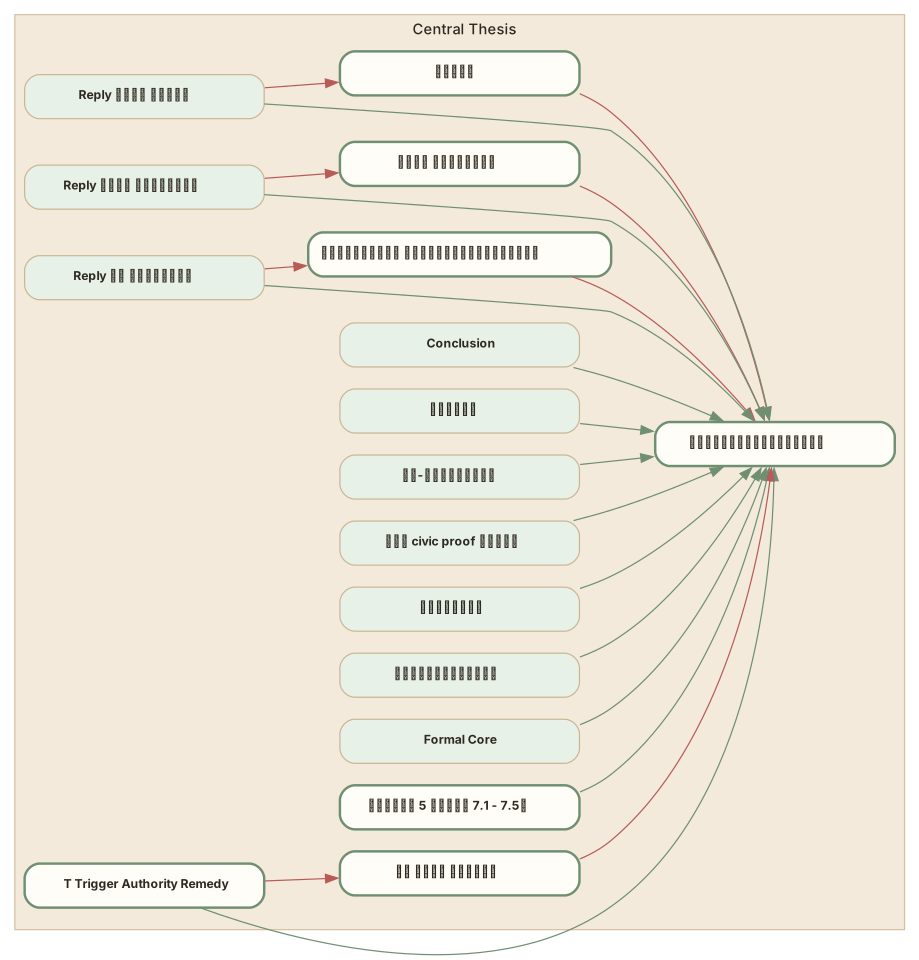
§7.5: ∃ forum : ToS ⊨ {primary_law, arbitration, emergency_court} ∧ no_opt_out(primary) Five historical institutions + three-part conjunction + four-scenario transplantation + five-clause specification + five boundary conditions converge on: the legal tools are not lacking; what is lacking is a contract specification for technology–law interfacing.
Democratic constitutional acceptance of pseudonymous participation has a long history. From whistleblower protection to sealed indictments, five institutional domains jointly constitute the historical sedimentation of the "pseudonymity plus post-hoc accountability" paradigm, which can be formalised as a three-part conjunctive structure and analogically transplanted to four civic proof scenarios.
The legal tools already provide the institutional template; what is lacking is a preliminary contract specification for technology–law interfacing. The five sub-clauses in §7 of this article represent an initial attempt at this intervention point. However, deployment remains subject to five boundary conditions (judicial independence / remedy justiciability / metadata control / cross-jurisdictional cooperation / political context); the absence of any one leads to the failure modes seen in Reality Winner / WITSEC / Twitter Doe.
The three-part conjunction shares a conjunctive structure with article 03's H1' three walls, article 05's IT' impossibility triangle, article 06's CB-Justice, and article 07's SRP — but operates at different levels: T is a conjunctive necessary condition at the legal institution level.
Final form:
  T = T_Trigger ∧ T_Authority ∧ T_Remedy   (necessary, not sufficient)
  T_civic_proof valid ⇔ T ∧ ⋀ⱼ Bⱼ   (j ∈ 1..5)
  ∀ scenario ∈ {α, β, γ, δ}:  T ⊨ scenario  (with case-specific clauses)
Source
===
title: 為什麼民主社會早就接受過假名式參與
subTitle: 從吹哨者保護到 sealed indictment 的法理重建
slug: 2026-05-04-pseudonymous-participation-legal
author: research-article-pipeline argdown export
model:
  removeTagsFromText: true
===

# Central Thesis

[Core Thesis]
  + <Formal Core>
  + [Accepted]
  + <P1>
  + <P2>
  + <P3>
  + <P4>
  + <P5>
  + [Deployment Conditions]
  + <Conclusion>
  - [Rejected]
    - [Accepted]
  + [Accepted]
  - [Objection 1]
    - <Reply 1>
  + <Reply 1>
  - [Objection 2]
    - <Reply 2>
  + <Reply 2>
  - [Objection 3]
    - <Reply 3>
  + <Reply 3>

[Core Thesis]: 民主憲政體系早已在五個獨立法律場域承認「常態假名加事後條件性啟封」作為合法穩定的制度範式。這個範式可被形式化為三件式合取結構 T T Trigger T Authority T Remedy 可類比移植到四個 civic proof 場景並提煉為 5 段法律契約規格初稿。 #thesis

<Formal Core>: Formula T T Trigger T Authority T Remedy institution 𝓘 WPA, John Doe, sealed indictment, campaign finance, WITSEC valid(𝓘) T Trigger(𝓘) T Authority(𝓘) T Remedy(𝓘) civic proof scenarios α, β, γ, δ T (with adjustments) Caption 「假名加事後條件性啟封」的合法性論證模板成立,當且僅當三件式同時滿足。模板可移植但類比強度為「中強」,不主張結構同構。 #formal

[Accepted]: T Trigger Authority Remedy. 制度模板三件式 Trigger 客觀預先明定、Authority 與當事方獨立可監督、Remedy 申訴與救濟可區分。五個歷史制度都遵循這個結構,缺一即制度模板崩潰。 #accepted

[Rejected]: 假名 絕對匿名 實名才能問責. 「假名加事後問責」常被誤讀為「絕對匿名」,這是把假名等同於 anonymity 的概念混淆。五個歷史制度的實際結構是「對特定相對方保留假名 對至少一個有權主體保留事後可識別性」,從未走向絕對匿名。 #rejected

<P1>: Title 五個獨立法律場域的歷史沉澱 Section 2 — 五制度盤點 Role 提供歷史先例——把三件式視為民主憲政既有制度的一般化(亦即五個獨立場域的共同骨架),辯護負擔比從零定義大幅降低。 吹哨者保護法(5 U.S.C. 2302 SOX 806 Dodd-Frank 922 EU 2019 1937) John Doe 訴訟(Cahill 五要件 Dendrite 四要件) Sealed Indictment(Federal Rule 6(e)) 匿名捐款上限(Buckley BCRA Citizens United Doe v. Reed) 證人保護程序(WITSEC, 18 U.S.C. 3521-3528)。五制度跨刑事 民事 行政 選舉 行政管理五個場域。 Finding 五制度共享「假名為制度常態 啟封需明確 trigger 第三方主持 啟封決定可申訴 錯誤啟封有救濟」五點骨架。 Formal 𝓘 WPA, JohnDoe, SealedIndictment, CampaignFinance, WITSEC valid(𝓘) T(𝓘) #pillar

<P2>: Title 合取必要條件結構 Section 3 — 三件式形式化 Role 提供形式化骨架——若五制度的共同點只是「都允許假名」,那是描述 只有形式化為合取必要條件,才能讓「缺一即敗」成為可被檢驗的命題。 T Trigger 三條子條款(客觀可判定 預先明定 與保護利益相關) T Authority 三條子條款(與當事方獨立 可被監督 程序可稽核) T Remedy 三條子條款(具體申訴路徑 實質救濟 申訴對象與啟封權力者可區分)。三件式合取結構與 article 03 H1 三道牆同構,但用於法律制度層而非工程層。 Finding 三件式是必要而非充分條件——個案仍需 case-specific 條款(時效 舉證標準 第三方介入機制)。 Formal T T Trigger T Authority T Remedy (necessary, not sufficient) #pillar

<P3>: Title 假名式 civic proof 的可移植性 Section 5 — 四場景類比移植 Role 提供類比強度評估——三件式從法律制度層移植到工程層屬類比推理(不是結構同構),需要明示移植成本與限制。 4 場景填充 α 線上連署 β 論壇藍勾勾 γ 政治結社內部問責 δ 敏感諮詢與吹哨。每場景的 T Trigger T Authority T Remedy 各有「直接套用」與「需要修改」處。三場景強可移植(γ 政治結社 δ 吹哨 α 連署部分),β 論壇藍勾勾中可移植。 Finding 類比強度依賴 (i) 同樣對抗性目標 (ii) 同樣規範約束組合 (iii) 同樣失敗模式。結構不同構但模板可借——是後續寫作必須繼承的措辭紅線。 Formal T legal analogy T civic proof (medium-strong analogy, not isomorphism) #pillar

<P4>: Title 工程-法律對接的契約初稿 Section 6 — 法律契約規格 5 段子規格 Role 提供工程接合素材——三件式從法律制度層落地到 civic proof 工程層,需要可被協商的契約樣板。否則仍是規範口號。 7.1 模板宣告(每個 civic proof 服務在 ToS 中明示採用何種既有制度作為三件式模板) 7.2 啟封 trigger 規格(threshold key holders k-of-n audit log) 7.3 啟封權力分配規格(跨組織 跨法域 跨技術棧 holders fiduciary duty agreement) 7.4 救濟路徑規格(三層階梯 金錢賠償 chilling effect 推定損害) 7.5 跨法域 forum selection 條款。 Finding 5 段規格是三件式的工程具體化,但需要 wallet provider 立法方 監管方多方協商——是 article 06 商業 wallet vs 政府 wallet 規範類別差異的前置條件。 Formal 5 clauses T civic proof 7.1, 7.2, 7.3, 7.4, 7.5 #pillar

<P5>: Title 移植強度評估 Section 7 — 5 條邊界條件 Role 提供失敗邊界——若三件式套用沒有邊界條件,會被誤推為「萬能解」 只有明確邊界才能讓論證強度站得住。 B1 司法獨立性最低門檻(中國對照組) B2 救濟可訴性最低門檻(WITSEC 主權豁免案例) B3 技術 metadata 控制最低門檻(Reality Winner 媒體中介失靈) B4 跨法域協作最低門檻(Twitter Doe 跨州歧異) B5 政治脈絡最低門檻(威權國家「假名加事後問責」會退化為「事前實名」)。 Finding 5 條邊界缺一就會落入 Reality Winner WITSEC Twitter Doe 中國模式的失敗模式。 Formal T civic proof valid T ⱼ Bⱼ (j 1..5) #pillar

[Deployment Conditions]: 法律契約規格 5 段子規格( 7.1 - 7.5). T civic proof 7.1 模板宣告, 7.2 trigger, 7.3 權力分配, 7.4 救濟, 7.5 forum selection #conditions

<C1>: Title 7.1 模板宣告(Template Declaration) 每個 civic proof 服務在 ToS 中明示採用何種既有制度作為三件式模板,且明示「不主張結構同構,僅主張合法性論證模板的可移植」。 Formal 7.1 legal template WPA, JohnDoe, ... declared in(ToS, legal template) #condition

<C2>: Title 7.2 啟封 trigger 規格 threshold key holders 採 k-of-n 設計(k n 2 1,建議 n 5、k 3) 每次 unmask 請求 audit log 含請求時間 請求方 trigger 條款編號 shares 提交順序與時間戳 append-only Merkle tree 公開可驗。 Formal 7.2 holders(k-of-n, k n 2 1) audit log Merkle tree #condition

<C3>: Title 7.3 啟封權力分配規格 threshold key holders 跨組織、跨法域、跨技術棧分散 每位 holder 簽 fiduciary duty agreement 違反者個人 機構連帶責任 key rotation 至少每 24 個月。 Formal 7.3 holders orgs jurisdictions tech stacks h fiduciary(h) #condition

<C4>: Title 7.4 救濟路徑規格 被啟封者具完整 audit 能力 申訴三層階梯(平台 dispute board 30 天 行業自律 90 天 法院或仲裁庭) 救濟類型包含金錢賠償 chilling effect 推定損害 audit log 銷毀 公開道歉。 Formal 7.4 unmask u audit(u) appeal(u, 3-tier) remedy(u) monetary, chilling damages, log deletion, apology #condition

<C5>: Title 7.5 跨法域 forum selection 條款 ToS 事先約定 (a) 主要適用法(如 EU 2019 1937 紐約州 SHIELD Act)、(b) 仲裁庭(如 PCA 或 ICC)、(c) 緊急救濟法院 使用者可 opt-in 補強保護但不得 opt-out 主要法律保護。 Formal 7.5 forum ToS primary law, arbitration, emergency court no opt out(primary) #condition

<Conclusion>: 民主憲政對假名式參與的接受由來已久。從吹哨者保護到 sealed indictment,五條制度共同構成「假名加事後問責」範式的歷史沉澱,可被形式化為三件式合取結構並類比移植到四個 civic proof 場景。 法律工具已經提供制度模板,欠缺的是技術-法律對接的契約規格初稿 本文 7 的 5 段子規格是這個介入點的初步嘗試。 但部署仍受 5 條邊界條件約束(司法獨立 救濟可訴 metadata 控制 跨法域協作 政治脈絡),缺一就會落入 Reality Winner WITSEC Twitter Doe 的失敗模式。 三件式與 article 03 H1 三道牆 article 05 IT 不可能三角 article 06 CB-Justice article 07 SRP 同樣是合取結構,但用於不同層級——T 是法律制度層的合取必要條件。 Formal Coda Final form T T Trigger T Authority T Remedy (necessary, not sufficient) T civic proof valid T ⱼ Bⱼ (j 1..5) scenario α, β, γ, δ T scenario (with case-specific clauses) #conclusion

# Deployment Conditions

[Deployment Conditions]
  + <C1>
  + <C2>
  + <C3>
  + <C4>
  + <C5>

# Objections And Replies

[Objection 1]: 假名 絕對匿名(紅線). 五個歷史制度的實際結構是「對特定相對方保留假名 對至少一個有權主體保留事後可識別性」——絕對匿名從未是設計目標。把吹哨者保護法寫成「匿名舉報」的同義詞,會直接違反 5 U.S.C. 2302 與 EU Directive 2019 1937 對舉報人身分管理的明文設計。 #objection

<Reply 1>: Title 假名 絕對匿名(紅線) 反論誤讀概念——一旦概念釐清,五個歷史制度恰好成為「假名 絕對匿名」的最清楚範例。 #reply

[Objection 2]: 制度設計 實證部署(紅線). 紙面承認不等於制度有效。OSC 勝訴率 5%、台灣大林蒲 4 年救濟拖延、EU 9 國 transposition 未完成 infringement 程序——這些落差證明三件式只是必要條件,部署有效性需 case-specific 條款補強。 #objection

<Reply 2>: Title 制度設計 實證部署(紅線) 反論加強三件式作為「必要但不充分」的定位,屬於補強。 #reply

[Objection 3]: 啟封權力 純技術問題. 啟封權力是政治經濟問題而非純技術問題。FEC 黨派僵局、sealed indictment 法院實質倚賴檢察官、WITSEC USMS-DOJ 同屬行政部門——「形式第三方」可被癱瘓。誰持鑰、k-of-n threshold、跨機關制衡都是政治經濟設計。 #objection

<Reply 3>: Title 啟封權力 純技術問題 反論揭露「形式第三方」與「實質獨立主持人」的區分,正好示範 T Authority 三條子條款的必要性。 #reply