Argument Map
The Impossibility of the Passport Root
Sovereignty-Root Paradox — Argument Map (v2)
Treating the passport as the ultimate root of civic identity is equivalent to placing the trust root inside a sovereign container that can at any moment become an adversary. When the Issuer simultaneously belongs to the Adversary set of that container, the Trust property of the root cannot be satisfied — SRP is a conjunctive structural failure at the sovereignty level, not a cryptographic error. The solution lies in Multi-Rooted Civic Proof: demoting the single sovereign root to one of four fallback options (abolishing the passport root is not an option).
When the issuer of a sovereign root is also in its adversary set, the root cannot satisfy its trust property.
SRP:  ∀R ∈ ℛ_sov  [ I_R ∈ Adv(T_R) ]  ⇒  ¬(R ⊨ T_R)

MR-CivicProof:  ⊨ T  ⇔  ∃ Rᵢ ∈ {R₁, R₂, R₃, R₄}  ∧  Rᵢ ⊨ T  ∧  ¬compromised(Rᵢ, D₁ ∧ D₂ ∧ D₃)
SRP is the built-in paradox of the class "sovereign root": when the Issuer belongs to the Adversary set, the Trust property T_R cannot be satisfied by that root R. MR-CivicProof distributes trust from a single R into four independent sources R₁..R₄, with D₁/D₂/D₃ as three demotion criteria for switching.
R- Root — trust root (e.g., ICAO PKI passport root, community root, institutional root, self-hosted root)
T_R- Trust property — the trust property claimed by the root (e.g., "will not revoke for political purposes")
I_R- Issuer — the entity that issues / revokes the root (in most cases a sovereign state or its authorised body)
Adv(T_R)- Adversary set — the set of actors that attack or threaten T_R
⊨- Satisfies (model satisfies formula)
ℛ_sov- Set of roots within a sovereign container (ICAO eMRTD PKI is the representative example)
D₁/D₂/D₃- Three demotion criteria (single-root failure detection / cross-root consistency / remedy document fallback)
∧- Conjunction (simultaneously holds)
The formula states the position, but the first step is to distinguish two ways of viewing the passport root. Most engineering communities treat ICAO PKI as a "reliable root for civic identity"; this map opposes that classification — it should be treated as a "high-utility tool within a sovereign container," not as a root.
Passport root as the ultimate root of civic identity
Treating the ICAO eMRTD PKI (CSCA → DSC → DG → SOD) as the "ultimately trustworthy root" of civic identity. This structure assumes the Issuer (sovereign state) permanently stands on the side of the Trust property; but in practice the Issuer can at any moment revoke, demote, or even weaponise the passport root, causing it to become an Adversary.
I_R ∈ Adv(T_R) is the norm within a sovereign container, not the exception Multi-Rooted Civic Proof (four-way fallback)
Demoting the single sovereign root to one of four independent sources: R₁ passport root (high utility, low resilience), R₂ community root (medium utility, medium resilience), R₃ institutional root (medical / educational / UNHCR, medium utility, medium resilience), R₄ self-hosted root (low utility, high resilience). If any one root fails, the other three can take over; D₁/D₂/D₃ provide the switching criteria.
⊨ T ⇔ ∃ Rᵢ ∈ {R₁..R₄} ∧ Rᵢ ⊨ T ∧ ¬compromised(Rᵢ, D₁ ∧ D₂ ∧ D₃) The distinction itself is merely a declaration. To demonstrate the pathway by which "sovereign roots fail," four independent sources are needed: an engineering analysis of the ICAO PKI three-tier architecture, historical evidence of weaponisation cases, formalisation of the conjunctive necessary structure, and the feasibility of the alternative design (Multi-Rooted). Without all four, the argument reverts to anti-ICAO rhetoric.
§2 — Engineering Analysis of ICAO PKI
Three-Tier Architecture + Six Governance Threats
whyProvides the engineering basis — if ICAO PKI were truly unassailable at the cryptographic layer, the "sovereign container paradox" would be mere sociological imagination. But each layer of the three-tier architecture (CSCA → DSC → DG → SOD) has corresponding governance threats D1–D4b, which are not hypothetical but documented events.
ICAO eMRTD PKI three-tier architecture: CSCA (national signing) → DSC (document signing certificate) → DG (data groups) → SOD (security object document). The security claims of three generations of ePassport cover only the second generation onward (zkPassport is also valid only within this range). Six governance threats: D1 (CSCA revocation), D2a (DSC political revocation), D2b (DSC engineering error), D3 (DG content tampering), D4a (SOD re-signing), D4b (offline verification cache expiry). The EU LoTL and the ICAO system operate in parallel, but both systems assume the Issuer is not an Adversary.
∀ Dᵢ ∈ {D1, D2a, D2b, D3, D4a, D4b} : realizes(Dᵢ) ⇒ ¬(R ⊨ T_R) §3 — Historical Evidence of Weaponisation
8 Cases + 4 Primary Forms + 2 Boundary Forms
whyProvides counter-evidence — if it cannot be demonstrated that "passport roots are weaponised by sovereigns," SRP remains only a theoretical possibility. Eight historical cases repeating the same 4 primary forms + 2 boundary forms across different sovereign systems elevate theoretical possibility to mechanistic necessity.
8 cases: USSR exit visa, Apartheid South Africa, Myanmar Rohingya, Iranian female journalists, Turkish Gülenists, Hong Kong BN(O), Chinese Xinjiang, Russian mobilisation-age males. 4 primary forms: W1 passport revocation, W2 passport denial, W3 demotion of remedy documents, W4 cross-border tracking. 2 boundary forms: W5 third-country cooperation (e.g., Interpol Red Notice abuse), W6 counterfeit passport circulation (North Korea, Iran). Remedy documents (refugee travel document, laissez-passer) are routinely automatically downgraded during digitalisation — this is the empirical basis for the SA-4 design criterion.
∀ regime r ∈ {USSR, SA, MM, IR, TR, HK, CN, RU} : ∃ Wⱼ : weaponized(r, Wⱼ) §4 — Formalisation of SRP
Conjunctive Necessary Structure of the Sovereign Container
whyProvides the argument skeleton — without formalisation, SRP can still be dismissed as "a failure of specific regimes" rather than "a paradox inherent in the category of sovereign containers." Formalisation elevates the argument from individual cases to a category.
SRP revised statement: ∀R ∈ ℛ_sov [I_R ∈ Adv(T_R)] ⇒ ¬(R ⊨ T_R). Three-stage reconstruction of the sovereign container: (1) Issuer = Adversary is a built-in possibility of sovereign containers, not a deviant case; (2) Trust property is a conjunctive necessary condition T_R = T_R₁ ∧ T_R₂ ∧ T_R₃ — failure of any one pillar causes overall failure; (3) Cross-container isomorphism — the same conjunctive structure recurs in article 01 (V₁..V₆), article 04 (T_Trigger ∧ T_Authority ∧ T_Remedy), and article 05 (IT' impossibility triangle).
T_R ≡ T_R₁ ∧ T_R₂ ∧ T_R₃ ∧ ∃ i : compromised(T_Rᵢ) ⇒ ¬T_R §5 — Multi-Rooted Civic Proof
R₁..R₄ Four-Tier Trust Roots + Three Demotion Criteria
whyProvides feasibility of the alternative design — without a concrete implementable alternative, SRP is only critique without construction. R₁..R₄ four tiers + D₁/D₂/D₃ switching criteria lower Multi-Rooted from rhetoric to engineering specification.
R₁ passport root (ICAO PKI, high utility, low resilience, default root); R₂ community root (DAO / web of trust / guild attestation, medium utility, medium resilience); R₃ institutional root (medical records / educational credentials / UNHCR documents, medium utility, medium resilience); R₄ self-hosted root (PGP / DID / self-declaration + witnesses, low utility, high resilience). Three demotion criteria: D₁ single-root failure detection (signals: revocation frequency > threshold ∨ political association > threshold); D₂ cross-root consistency check (k-of-n multi-root verification); D₃ remedy document fallback (when R₁..R₃ all fail, R₄ + witness chain). Interfaces with article 05 SA-5 multi-rooted scheme and with prompt 11 wallet-as-essential-facility.
MR-CivicProof: ⊨ T ⇔ ∃ Rᵢ : Rᵢ ⊨ T ∧ ¬compromised(Rᵢ, D₁ ∧ D₂ ∧ D₃) §6 — Boundary Conditions and UNHCR Iris in Jordan
B1–B5 Five Boundaries + Real-World Scenario Testing
whyProvides intellectual honesty — without boundaries, Multi-Rooted risks being misread as a "universal solution." B1–B5 + the UNHCR Iris in Jordan case precisely delineate the scope of applicability of MR-CivicProof.
B1 coverage vs. vulnerability trade-off (the broader the root's coverage, the more susceptible to weaponisation); B2 stateless persons ≠ general cross-border problem (categorical distinction); B3 political economy of NGO roots and community roots (funding source determines independence); B4 UNHCR / IOM dual mandate risk (humanitarian protection and return are both within the same mandate); B5 the four barriers of self-hosted roots for vulnerable populations (device / connectivity / literacy / key custody). UNHCR Iris in Jordan is the best case of R₃ institutional root: iris biometrics of 6.7 million Syrian refugees + blockchain vouchers, but it also faces the B4 dual mandate transparency problem.
applicable(MR-CivicProof, ctx) ⇔ ctx ∈ {stateless, refugee, persecuted} ∧ ¬over_general(ctx) The four pillars provide the positive argument. But the claim "sovereign root → trust collapse" requires a concrete causal chain to underpin it. The ICAO three-tier architecture (CSCA → DSC → DG) with its six governance threats (D1/D2a/D2b/D3/D4a/D4b), together with eight weaponisation cases, provides a mechanistically traceable sequence; four of these are primary forms (structural necessity) and two are boundary forms (probabilistic events).
Seven-Step Causal Chain of Sovereign Root Failure: Issuer → Adversary → Trust Collapse
⇒ Mechanistic necessity (structural necessity within sovereign container, independent of external triggers) ◊⇒ Probabilistic (contingent on regime choice + third-country cooperation + international intervention) Once the position and causal chain are established, counter-arguments become genuinely threatening. "ICAO PKI is widely regarded as robust in mainstream literature," "zkPassport has solved the privacy problem," and "cross-national governance systems cannot be replaced" are three arguments commonly cited as reasons; but careful examination of the empirical basis and temporal scope of each reveals that they not only fail to support "the passport root as the sole root" but actually flip to support multi-root design — that is, the scope limitations of the counter-arguments themselves constitute the second layer of support for MR-CivicProof.
Counter-argument 1
ICAO PKI is regarded as robust in mainstream literature
pivotThe counter-argument claims that "ICAO PKI is an engineered and verified root." But this "robustness" is relative to cryptographic attacks, not relative to the political reorientation of the Issuer itself. When a sovereign state revokes the CSCA or politically weaponises DSC revocation, the cryptographic robustness is precisely what makes weaponisation more precise — that is, the "robustness" as a tool property itself violates the core concern of SRP (I_R ∈ Adv(T_R)).
The cryptographic robustness of ICAO PKI not only fails to support "the passport root as the sole root" — it provides the strongest argument for "the weaponisation of sovereign roots will be more precise," and therefore the need for non-sovereign alternatives R₂/R₃/R₄.
Counter-argument 2
zkPassport has solved the privacy problem
pivotThe counter-argument claims that "zkPassport / age proof and other ZK applications have resolved the privacy leakage of the passport root." But zkPassport resolves "verification privacy," not "revocation weaponisation" — privacy protection cannot prevent the Issuer from revoking your root. In other words, zkPassport and SRP are orthogonal problems; zkPassport resolves some problems within R₁, but R₁ as a whole remains subject to SRP.
zkPassport resolves an important but scope-limited problem, and cannot absorb SRP. This result inversely supports the view that "zkPassport should be treated as the V_privacy sub-specification within R₁, not as a guarantee of R₁ as a whole."
Counter-argument 3
Cross-national governance systems cannot be replaced
pivotA partial exception to the counter-argument — but the claim is overextended. "ICAO cannot be replaced" holds only in the narrow domain of "global civic identity verification"; it does not necessarily hold for "a trustworthy root for specific groups (stateless persons / refugees / politically persecuted)." The role of R₂/R₃/R₄ is to provide a fallback when R₁ fails — it does not require replacing ICAO.
Even if ICAO cannot be replaced, universalising "ICAO is the sole root" cannot be defended. The scope of MR-CivicProof is "groups for whom sovereign roots have failed," which is entirely consistent with "ICAO remaining effective for general citizens" — this is precisely how B1–B5 boundary conditions constrain over-generalisation.
Once the counter-arguments are absorbed, what remains are the design implications: under what conditions can the passport root be "demoted to one of four options" without loss of functionality? The five boundary conditions B1–B5 translate the abstract "Multi-Rooted" into testable engineering obligations, tested against the real-world scenario of UNHCR Iris in Jordan.
Legitimate Deployment of MR-CivicProof Requires Passing Five Boundary Conditions
deploy(MR-CivicProof) valid ⇔ B₁ ∧ B₂ ∧ B₃ ∧ B₄ ∧ B₅The broader the root's coverage, the more susceptible it is to weaponisation (R₁ passport root covers global citizens but is vulnerable to sovereignty; R₄ self-hosted root has narrow coverage but high resilience). Each root's coverage-vulnerability point must be explicitly identified when designing a deployment.
B₁: ∀ Rᵢ : coverage(Rᵢ) × resilience(Rᵢ) ≤ k (Pareto frontier) The statelessness problem is the extreme scenario of SRP (I_R does not exist), and is in a different category from the general cross-border identity verification problem. MR-CivicProof is a necessary remedy in the former and a redundant design in the latter. Cross-categorical generalisation is not warranted.
B₂: scope(MR-CivicProof) ⊆ {stateless, refugee, persecuted} ∪ {high-risk-cross-border} The independence of R₂ community roots and R₃ NGO roots is constrained by funding sources — if an NGO's primary funding comes from a specific sovereign state, that root's trustworthiness for citizens of that state is necessarily diminished. Funding structure must be disclosed at design time.
B₃: ∀ R₂ ∨ R₃ : independence(R) ∝ funding_diversity(R) International humanitarian organisations simultaneously bear protection (refugee status) and return (repatriation) mandates, meaning R₃ institutional roots are both tools and threats for those under protection. Transparent disclosure of the dual mandate is a precondition for R₃ deployment.
B₄: ∀ R₃ ∈ {UNHCR, IOM} : transparent(dual_mandate(R₃)) prerequired R₄ self-hosted roots are not free for vulnerable groups "without devices / without connectivity / with low literacy / without key custody capability" — treating it as the "last resort" when R₁ fails shifts responsibility onto those least able to bear it. R₄ must be accompanied by humanitarian organisations' "assisted self-custody" design.
B₅: deploy(R₄) ⇒ ∃ assisted(device, network, literacy, key_custody) Bringing together the five layers of engineering, cases, formalisation, design, and boundaries, the map ultimately argues that "sovereign container" as a category is misapplied at the civic identity level (the engineering failures of ICAO PKI are only symptoms), and that a fallback principle cuts across all levels.
SRP is the built-in paradox of the category "sovereign container as the root of civic identity"; engineering-level repairs (such as ICAO PKI design improvements) cannot resolve it. Resolving SRP requires demoting the single sovereign root to a "four-way fallback" in order to maintain the Trust property.
The debate should shift from "passport root vs. self-sovereign identity" to "under what conditions is which root appropriate." The value of MR-CivicProof lies in ensuring citizens retain a usable root when R₁ fails, corresponding to T_Remedy in article 04 and the D₂* fairness condition in article 06; R₁ retains its original high-utility position within the multi-rooted design.
One fallback principle runs through the entire text: coverage and resilience cannot be simultaneously maximised — degradable multiple roots are necessary. The more sovereignty-friendly the root, the broader its coverage and the more vulnerable it is; the more self-hosted the root, the more resilient and the narrower the access threshold — this gradient is itself the necessary extension of the MR-CivicProof formula.
Final form:
  SRP:  ∀R ∈ ℛ_sov  [ I_R ∈ Adv(T_R) ]  ⇒  ¬(R ⊨ T_R)
  MR-CivicProof:  ⊨ T  ⇔  ∃ Rᵢ ∈ {R₁, R₂, R₃, R₄}  ∧  Rᵢ ⊨ T  ∧  ¬compromised(Rᵢ, D₁ ∧ D₂ ∧ D₃)
  deploy valid  ⇔  ⋀ⱼ Bⱼ  (j ∈ 1..5)
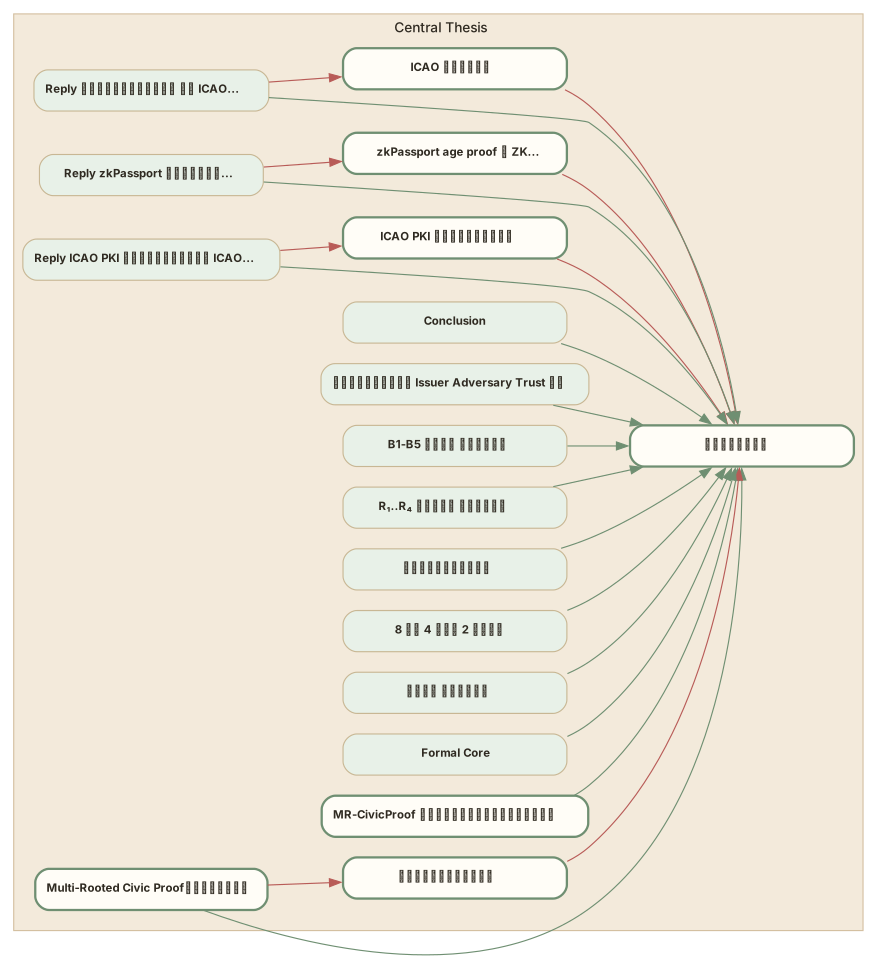
Source
===
title: 護照根的不可能性
subTitle: Sovereignty-Root Paradox — Argument Map (v2)
slug: 2026-05-05-passport-rooted-paradox
author: research-article-pipeline argdown export
model:
  removeTagsFromText: true
===

# Central Thesis

[Core Thesis]
  + <Formal Core>
  + [Accepted]
  + <P1>
  + <P2>
  + <P3>
  + <P4>
  + <P5>
  + <Causal Chain>
  + [Deployment Conditions]
  + <Conclusion>
  - [Rejected]
    - [Accepted]
  + [Accepted]
  - [Objection 1]
    - <Reply 1>
  + <Reply 1>
  - [Objection 2]
    - <Reply 2>
  + <Reply 2>
  - [Objection 3]
    - <Reply 3>
  + <Reply 3>

[Core Thesis]: 把護照當作公民身分的最終根,等於把信任根放在隨時可成為敵手的主權容器內。當 Issuer 同時屬於該容器的 Adversary 集合,根的 Trust 屬性無法被滿足——SRP 是主權層級的合取結構失敗,並非密碼學失誤。解方落在 Multi-Rooted Civic Proof 把單一主權根降級為「四選一可退路」(廢除護照根並非選項)。 #thesis

<Formal Core>: Formula SRP R ℛ sov I R Adv(T R) (R T R) MR-CivicProof T Rᵢ R₁, R₂, R₃, R₄ Rᵢ T compromised(Rᵢ, D₁ D₂ D₃) Caption SRP 是「主權根」這一類別的內建悖論 當 Issuer 屬於 Adversary 集合,Trust 屬性 T R 不可能被該根 R 滿足。MR-CivicProof 把信任從單一 R 拆成四個獨立來源 R₁..R₄,並用 D₁ D₂ D₃ 三條降級準則切換。 #formal

[Accepted]: Multi-Rooted Civic Proof(四選一可退路). 把單一主權根降級為四個獨立來源中的其中之一 R₁ 護照根(高效用、低韌性)、R₂ 社群根(中效用、中韌性)、R₃ 機構根(醫療 教育 UNHCR,中效用、中韌性)、R₄ 自托管根(低效用、高韌性)。任一根失效,其他三根可接續 D₁ D₂ D₃ 提供切換準則。 #accepted

[Rejected]: 護照根作為公民身分最終根. 把 ICAO eMRTD PKI(CSCA DSC DG SOD)當作公民身分的「最終可信任根」。這個結構假設 Issuer(主權國家)永遠站在 Trust property 那一邊 但實際上 Issuer 隨時可以撤銷、降級、甚至武器化護照根,使其成為 Adversary。 #rejected

<P1>: Title 三層架構 六項治理威脅 Section 2 — ICAO PKI 工程剖析 Role 提供工程根據——若 ICAO PKI 在密碼學層真的無懈可擊,「主權容器悖論」就只是社會學想像。但三層架構(CSCA DSC DG SOD)的每一層都有對應的治理威脅 D1-D4b,這些威脅不是假設,是已記錄的事件。 ICAO eMRTD PKI 三層架構 CSCA(國家簽發) DSC(文件簽證者) DG(資料群組) SOD(安全物件文件)。三代 ePassport 的安全宣稱只覆蓋第二代以後(zkPassport 也僅在此範圍內成立)。六項治理威脅 D1(CSCA 撤銷)、D2a(DSC 政治化撤銷)、D2b(DSC 工程錯誤)、D3(DG 內容篡改)、D4a(SOD 重簽)、D4b(離線驗證 cache 過期)。EU LoTL 與 ICAO 體系並行運作,但兩體系都假設 Issuer 不是 Adversary。 Finding 工程層 D1-D4b 構成 SRP 的具體攻擊向量 任何一個威脅實現都使 R T R 不成立。 Formal Dᵢ D1, D2a, D2b, D3, D4a, D4b realizes(Dᵢ) (R T R) #pillar

<P2>: Title 8 案例 4 主形式 2 邊界形式 Section 3 — 武器化歷史證據 Role 提供反向證據——若無法證明「護照根會被主權武器化」,SRP 還只是理論可能性。8 個歷史案例在不同主權體制下重複出現同樣的 4 主形式 2 邊界形式,把理論可能性推上機制必然。 8 案例 USSR exit visa、Apartheid SA、緬甸 Rohingya、伊朗女記者、土耳其 Gülenist、香港 BN(O)、中國新疆、俄羅斯動員年齡男性。4 主形式 W1 撤銷護照、W2 拒發護照、W3 降級救濟文件、W4 跨境追蹤。2 邊界形式 W5 第三國協作(pp. Interpol Red Notice 濫用)、W6 假護照流通(朝鮮、伊朗)。救濟文件(refugee travel document、laissez-passer)在數位化過程中常被自動降級——這是 SA-4 設計準則的經驗根據。 Finding 武器化不是少數異常,是「主權容器內 Issuer Adversary」的可預期實現。但 W5 W6 是邊界形式,不能誤推為主形式。 Formal regime r USSR, SA, MM, IR, TR, HK, CN, RU Wⱼ weaponized(r, Wⱼ) #pillar

<P3>: Title 主權容器的合取必要結構 Section 4 — SRP 形式化 Role 提供論證骨架——若沒有形式化,SRP 仍可被當作「特定政權的失敗」而非「主權容器類別本身的悖論」。形式化把論證從個案推到類別。 SRP 修訂版陳述 R ℛ sov I R Adv(T R) (R T R)。主權容器的三段重構 (1) Issuer 即 Adversary 屬於主權容器的內建可能性,並非偏差個案 (2) Trust 屬性是合取必要條件 T R T R₁ T R₂ T R₃,任一支柱失效全體失效 (3) 跨容器同構性——同樣的合取結構在 article 01 (V₁..V₆)、article 04 (T Trigger T Authority T Remedy)、article 05 (IT 不可能三角) 反覆出現。 Finding SRP 屬於「以單一主權容器作為公民根」的類別失敗,工程層級(如 ICAO PKI 設計)的修補無法解除這個結構性問題 要走出 SRP 必須換出主權根。 Formal T R T R₁ T R₂ T R₃ i compromised(T Rᵢ) T R #pillar

<P4>: Title R₁..R₄ 四層信任根 三條降級準則 Section 5 — Multi-Rooted Civic Proof Role 提供替代設計可行性——若沒有具體可實作的替代,SRP 只是批判而非建構。R₁..R₄ 四層 D₁ D₂ D₃ 切換準則把 Multi-Rooted 從口號降到工程規範。 R₁ 護照根(ICAO PKI,高效用、低韌性,預設根) R₂ 社群根(DAO web of trust 公會證明,中效用、中韌性) R₃ 機構根(醫療紀錄 教育認證 UNHCR 文件,中效用、中韌性) R₄ 自托管根(PGP DID 自我宣告 證人,低效用、高韌性)。三條降級準則 D₁ 單根失效偵測(信號 撤銷頻率 閾值 政治關聯 閾值) D₂ 跨根一致性檢查(k-of-n 多根驗證) D₃ 救濟文件回退(當 R₁..R₃ 全失效時,R₄ 證人鏈)。與 article 05 SA-5 multi-rooted 方案接合,與 prompt 11 wallet-as-essential-facility 接合。 Finding 四根 三準則提供「逐步降級」而非「全有全無」的退路 但每往下一根,效用遞減、韌性遞增,不存在免費的多根。 Formal MR-CivicProof T Rᵢ Rᵢ T compromised(Rᵢ, D₁ D₂ D₃) #pillar

<P5>: Title B1-B5 五條邊界 真實場景測試 Section 6 — 邊界條件與 UNHCR Iris in Jordan Role 提供誠實性——若不畫邊界,Multi-Rooted 會被誤推為「萬能解」。B1-B5 UNHCR Iris in Jordan 案例把 MR-CivicProof 的適用範圍精確標出。 B1 覆蓋率 vs 脆弱性 trade-off(覆蓋越廣的根越易被武器化) B2 無國籍者 一般跨境問題(範疇差異) B3 NGO 根與社群根的政治經濟(資金來源即影響獨立性) B4 UNHCR IOM 雙重 mandate 風險(人道與遣返同源) B5 自托管根對弱勢者的 4 重門檻(裝置 連網 識讀 私鑰托管)。UNHCR Iris in Jordan 是 R₃ 機構根的最佳案例 670 萬敘利亞難民虹膜 區塊鏈 voucher,但同樣面臨 B4 雙重 mandate 透明化問題。 Finding MR-CivicProof 在無國籍者、跨境難民、政治壓迫場景內成立 但對「具裝置能力 主權友好」的一般公民,R₁ 護照根仍是預設且效用最高選項。不能跨情境通用化。 Formal applicable(MR-CivicProof, ctx) ctx stateless, refugee, persecuted over general(ctx) #pillar

<Causal Chain>: Title 主權根失效七步因果鏈 Issuer Adversary Trust 崩壞 T0 (deterministic) 主權國家設計 R₁(ICAO PKI),假設 I R₁ 永久站在 T R₁ 那一邊(結構性樂觀) T1 (deterministic) 政治情勢轉變(政變 制裁 異議者出走 種族清洗),I R₁ 進入 Adv(T R₁) 集合 T2 (deterministic) 工程能力被武器化(D1 CSCA 撤銷 D2a DSC 政治化 D3 DG 篡改) T3 (probabilistic) 武器化採取 W1-W4 主形式 撤銷護照 拒發護照 降級救濟文件 跨境追蹤 T4 (probabilistic) 第三國採取 W5(Interpol Red Notice 協作)或 W6(假護照流通)邊界形式 T5 (probabilistic) 公民失去 R₁,若無 R₂ R₃ R₄ 退路 流落、無國籍、政治受迫 T6 (probabilistic) 國際人道體系(UNHCR IOM)介入提供 R₃ 機構根,但受 B4 雙重 mandate 限制 #chain

[Deployment Conditions]: MR-CivicProof 的合法部署,必須先通過五條邊界條件. deploy(MR-CivicProof) valid B₁ B₂ B₃ B₄ B₅ #conditions

<C1>: Title B₁ 覆蓋率 vs 脆弱性 trade-off 覆蓋越廣的根越易被武器化(R₁ 護照根覆蓋全球公民但脆弱於主權,R₄ 自托管根覆蓋小但韌性高)。設計部署時必須明確標出每根的覆蓋-脆弱性點。 Formal B₁ Rᵢ coverage(Rᵢ) resilience(Rᵢ) k (Pareto frontier) #condition

<C2>: Title B₂ 無國籍者 一般跨境問題(範疇差異) 無國籍者問題是 SRP 的極端情境(I R 不存在),跟一般跨境身分驗證問題不在同一個範疇。MR-CivicProof 在前者是必要救濟,在後者是冗餘設計。不能跨範疇通用化。 Formal B₂ scope(MR-CivicProof) stateless, refugee, persecuted high-risk-cross-border #condition

<C3>: Title B₃ NGO 根與社群根的政治經濟 R₂ 社群根與 R₃ NGO 根的獨立性受資金來源限制——若 NGO 主要資金來自特定主權國家,該根對該國公民的可信度必然降低。設計時必須揭露資金結構。 Formal B₃ R₂ R₃ independence(R) funding diversity(R) #condition

<C4>: Title B₄ UNHCR IOM 雙重 mandate 風險 國際人道組織同時承擔保護(refugee status)與遣返(return)兩種 mandate,這意味 R₃ 機構根對受保護者來說同時是工具與威脅。透明化雙重 mandate 是 R₃ 部署的前置條件。 Formal B₄ R₃ UNHCR, IOM transparent(dual mandate(R₃)) prerequired #condition

<C5>: Title B₅ 自托管根對弱勢者的 4 重門檻 R₄ 自托管根對「無裝置 無連網 低識讀 無私鑰托管能力」的弱勢群體並不免費——把它當作 R₁ 失效後的「最後退路」會把責任甩給最沒能力承擔的人。R₄ 必須配合人道組織的「assisted self-custody」設計。 Formal B₅ deploy(R₄) assisted(device, network, literacy, key custody) #condition

<Conclusion>: SRP 是「主權容器作為公民身分根」這一類別的內建悖論,工程層級(如 ICAO PKI 設計)的修補無法解除它。 解套要求把單一主權根降級為「四選一可退路」才能維持 Trust 屬性。 辯論應從「護照根 vs 自我主權」轉向 「在什麼條件下哪一根適用」 。MR-CivicProof 的價值落在 R₁ 失效時讓公民仍有根可用,對應到 article 04 的 T Remedy 與 article 06 的 D₂ 公平條件 R₁ 在 multi-rooted 設計中仍保留其原本的高效用位置。 一條退路原則貫穿全文 覆蓋率與韌性不可同時最大化,必須有可降級的多根。 越主權友好的根覆蓋越廣、越脆弱 越自托管的根越韌性、越窄門檻——這個梯度本身就是 MR-CivicProof 公式的必然延伸。 Formal Coda Final form SRP R ℛ sov I R Adv(T R) (R T R) MR-CivicProof T Rᵢ R₁, R₂, R₃, R₄ Rᵢ T compromised(Rᵢ, D₁ D₂ D₃) deploy valid ⱼ Bⱼ (j 1..5) #conclusion

# Deployment Conditions

[Deployment Conditions]
  + <C1>
  + <C2>
  + <C3>
  + <C4>
  + <C5>

# Objections And Replies

[Objection 1]: ICAO PKI 已在主流文獻被視為穩固. 反論訴求是「ICAO PKI 是工程上經過驗證的根」。但這個「穩固」是相對於密碼學攻擊,而不是相對於 Issuer 自身的政治轉向。當主權國家撤銷 CSCA 或政治化 DSC 撤銷,密碼學層的穩固性正是讓武器化更精確的工具——亦即「穩固」這個工具屬性自身就違反 SRP 的核心關切(I R Adv(T R))。 #objection

<Reply 1>: Title ICAO PKI 已在主流文獻被視為穩固 ICAO PKI 的密碼學穩固性不僅不支持「護照根作為唯一根」,反而給「主權根的武器化將更精確」提供了最強論證——因此需要 R₂ R₃ R₄ 的非主權替代。 #reply

[Objection 2]: zkPassport 已解決隱私問題. 反論訴求是「zkPassport age proof 等 ZK 應用已解決護照根的隱私洩漏」。但 zkPassport 解決的是「驗證隱私」,不是「撤銷武器化」——隱私保護無法防止 Issuer 撤銷你的根。換言之,zkPassport 與 SRP 是正交問題 zkPassport 在 R₁ 內解決部分問題,但 R₁ 整體仍受 SRP 約束。 #objection

<Reply 2>: Title zkPassport 已解決隱私問題 zkPassport 解決一個重要但範圍有限的問題,卻無法吸收 SRP。這個結果反向支持「應將 zkPassport 視為 R₁ 內的 V privacy 子規格,而非 R₁ 整體的擔保」。 #reply

[Objection 3]: 跨國治理體系不可能被取代. 反論的部分例外——但訴求過度延伸。「ICAO 不可能被取代」只在「全球公民身分驗證」這個窄場域成立,對「特定群體(無國籍 難民 政治受迫)的可信任根」並不必然成立。R₂ R₃ R₄ 的角色是在 R₁ 失效時提供退路,並未要求取代 ICAO。 #objection

<Reply 3>: Title 跨國治理體系不可能被取代 即使 ICAO 不可能被取代,普世化「ICAO 是唯一根」也無法被辯護。MR-CivicProof 的適用範圍是「主權根失效的群體」,與「ICAO 對一般公民有效」並無矛盾——這恰好示範 B1-B5 邊界條件如何約束過度通用化。 #reply