Argument Map
The Price of Nordic Commercial Identity Infrastructure
Nordic CII Tyranny — Argument Map (v2)
The five Nordic countries' BankID/MitID/Mobiilivarmenne/Auðkenni constitute commercial identity infrastructure (CII) coexisting across four governance forms, with 92–99.9% coverage rates that do not eliminate exclusion but instead recode bank KYC conclusions as necessary conditions for civic capability. When α's infrastructural rights, β's last-mile capture, and γ's remedy failure are simultaneously realized, infrastructural tyranny is established — this is a structural problem of "single monopolist + no remedy procedure," not a problem with commerciality per se. The Nordic governance framework may serve as a partial export model, but only if the three necessary conditions N₁ bank penetration ≥ 0.90, N₂ central bank agency, and N₃ welfare state floor are met, supported by E₁/E₂/E₃ enabling conditions.
When CII becomes the de facto gate of civic infrastructure under α ∧ β ∧ γ, infrastructural tyranny is structurally implied; transferability is conditional on N₁ ∧ N₂ ∧ N₃ ∧ ⋀ⱼ Eⱼ.
NCT (Nordic CII Tyranny):
  ∀ i ∈ {SE, NO, DK, FI, IS},  CII_i ⊨ (α_i ∧ β_i ∧ γ_i)  ⇒  infrastructural_tyranny_i

  α: infrastructural_rights(citizen, government_services)
  β: last_mile_capture(I, C·BankID/MitID),  where  I = C·BankID/MitID
  γ: ¬(voice ∨ exit)  ⇒  loyalty_only

Conditional transferability:
  applicable(NCT-remedy, region)  ⇔  N₁ ∧ N₂ ∧ N₃  ∧  ⋀ⱼ Eⱼ   (j ∈ 1..3)
  N₁: bank_penetration(region) ≥ 0.90
  N₂: central_bank_agency(region)
  N₃: welfare_state_floor(region)
  E₁: social_trust(region) ≥ θ_trust    (WVS Wave 7 baseline)
  E₂: labor_protection(region) ≥ θ_labor
  E₃: scale_homogeneity(region)

Remedy design:
  T_Remedy_CII  ⊨  R₁ ∧ R₂ ∧ R₃ ∧ R₄
  R₁: central_bank_warning_authority
  R₂: government_eID_as_baseline_right
  R₃: non_bank_fallback(legal, permanent)
  R₄: statutory_appeal_procedure(time_bound, burden_on_C)
NCT is a conjunctive necessary-condition structure: if any of α, β, or γ is structurally weakened, infrastructural tyranny degrades accordingly; conditional transferability is likewise conjunctive — the absence of any one of N₁/N₂/N₃ is sufficient reason not to export the CII model.
CII- Commercial Identity Infrastructure — commercial identity infrastructure (replacing the single label "BankID model")
I- Identity verification system — in the Nordic five-country context, I = C·BankID/MitID
C- Commercial entity — the commercial or public-private entity that exclusively owns I
α- Infrastructural rights — functionally equivalent civic rights under the convergence of Marshall–Sen–Anderson three lines
β- Last-mile capture — most government services in practice require passage through I, and I is exclusively owned by C
γ- Hirschman failure — simultaneously lacking voice and exit, leaving loyalty as the only option
N₁/N₂/N₃- Necessary conditions — bank penetration, central bank agency, welfare state floor
E₁/E₂/E₃- Enabling conditions — social trust, labor protection, scale homogeneity
R₁..R₄- Remedy design four components — central bank warning authority, government e-ID as baseline right, non-bank fallback, statutory remedy procedure
⊨- "satisfies" (the model satisfies the formula)
∧- conjunction (simultaneously holds; failure of any one component is sufficient for failure)
The formula provides the formal skeleton, but a classificatory error must first be addressed. Most English-language policy circles refer collectively to Sweden, Norway, Denmark, Finland, and Iceland as the "Nordic BankID model," treating it as a single template that can be packaged for export. This map steps back from that external label, arguing that the five countries fall into four distinct governance forms (pure private law / public-private partnership / telecom-led / substantive state control), and that the deeper shared structure common to all five is CII's last-mile capture (a shared layer obscured by the "BankID template" label). Only by correcting the classification can the subsequent argument find proper footing.
The "BankID Model" as a Single Template
Collectively labeling Sweden, Norway, Denmark, Finland, and Iceland as the "Nordic BankID model" for packaged export is a convenient shorthand in English-language policy circles. This label conceals at least four dimensions of governance structure: legal status (pure private law / public-private partnership / substantive government control), coerciveness (legal mandate / substantive compulsion / formal plurality), regulatory pathway (antitrust / direct ownership / interoperability and rate caps / indirect equity control), and appeal channels (commercial contract / administrative remedy / regulatory channel / financial supervisory authority). Downstream arguments that take the "BankID model" as a single unit will misestimate the impact of these differences on the scale of exclusion, central bank warning intensity, and transferability.
label("BankID model") ≠ token(structural_unit) ; five_states ⊭ single_template CII with Four Coexisting Governance Forms + NCT Structural Critique
The five countries' governance forms fall into four categories: (a) pure private-law products (Swedish BankID, Norwegian BankID); (b) public-private joint ventures (Danish MitID); (c) telecom operator-led (Finnish Mobiilivarmenne + Bank IDs, with mandatory interoperability and rate caps under Traficom Luottamusverkosto); (d) substantive state control (Icelandic Auðkenni, with indirect government control through bank-side equity). All four share the structural feature of CII's last-mile capture (a shared layer obscured by the "BankID template" label); when α ∧ β ∧ γ simultaneously hold, infrastructural tyranny follows — this is the proposition the map defends.
five_states ⊨ {private, PPP, telecom, state_controlled} ∧ ∀ i : CII_i ⊨ (α_i ∧ β_i ∧ γ_i) ⇒ infrastructural_tyranny_i The classificatory correction is merely a declaration. To demonstrate that NCT is not simply a terminological substitution, five independent supporting arguments are required: (1) a typology of the five countries' market structures (inductive); (2) a causal chain for the excluded population and five concrete cases (causal mechanism); (3) the Riksbank "viktigt komplement" framework's four-stage evolution (central bank warning abduction); (4) the three-condition abductive argument α ∧ β ∧ γ (deductive skeleton); (5) conditional transferability (counterexamples and failed exports). Without any one of these five, the argument degrades into rhetoric about "commercial monopoly critique," unable to sustain the more precise proposition of infrastructural tyranny.
§2 — Market Structure Typology of the Five Nordic CII Countries
Four Governance Forms (I Inductive)
whyProvides the inductive foundation — if the five countries truly share a single template, classifying them into four governance forms would be redundant. But the Riksbank 2024 Payments Report, Norges Bank 2024 Financial Infrastructure, Digst 2024 statistics, Traficom Määräys 72 B/2022, and Auðkenni equity disclosures show that the four governance structure differences actually exist; the classification itself is part of the burden of defense, not rhetorical decoration.
Swedish BankID is issued by Finansiell ID-Teknik BID AB, 100% owned by seven banks, with 99.9% coverage, no legal mandate but substantive compulsion; Konkurrensverket launched an anti-abuse of dominant position investigation on 2024-09-18 following a complaint against Vipps MobilePay. Norwegian BankID substantively dominates over 90% of ID-porten despite its formally plural structure. Danish MitID, since 2022-09-22, is held as a single entity by Digst + Finans Danmark, with Nets DanID as contractor under a DKK 939 million 10-year contract, decoupling "identity verification" from "bank account." Finland mandates broker interoperability and rate caps under Traficom Määräys 72 B/2022; the market structure is more open but remains oligopolistic. Iceland's Auðkenni is formally a commercial entity, but is substantively under indirect government control through bank-side equity in Landsbankinn (100% state-owned), Íslandsbanki (65% state-owned), and Arion (13% state-owned).
∀ i ∈ {SE, NO, DK, FI, IS} : governance_form(CII_i) ∈ {private, PPP, telecom, state_controlled} §3 — Causal Chain of the Excluded Population and Case Studies
Four-Link Causal Chain + Five Concrete Cases (C Causal)
whyProvides the causal mechanism — without the ability to connect "92–99.9% coverage rate" with "600,000–950,000 actually excluded persons" (two seemingly contradictory figures), the map would face the objection: why is exclusion a functional consequence of CII structure rather than a byproduct? The four-link causal chain translates exclusion from a static stock into a dynamic flow, giving the three-condition abductive argument in §5 concrete mechanical grounding.
The first link is "bank KYC conclusions equated with civic identity conclusions." The Swedish BankID issuance threshold is "bank customer relationship"; Danish MitID, though decoupled, still relies upstream on the NemKonto bank account; CII directly recodes bank PEP/AML/credit score conclusions as civic identity capability conditions. The second link is "single mandatory lock-in for government services." Sahlfeld (2022) finds that over 86% of Swedish central government online identity verification portals accept only BankID; JO 2023 beslut 6235-2022 found that Skatteverket's refusal to accept alternative verification violated §9 and §21 of the Förvaltningslagen. The third link is "fallback erosion" — Swedish Skatteverket local offices have been progressively reduced; Danish Borgerservice has 3–5 week queues; Norwegian NAV paper forms take 9–14 weeks; Stockholms Stadsmission (2024) reports that social workers assisting clients without BankID spend on average 11 times longer. The fourth link is "remedy breakdown." Seeking redress itself requires BankID login to the judicial electronic system, creating a self-enclosed loop. Five cases — Anwar/Fatima/Per/Yelena/Else — correspond to five typical mechanisms: KYC rejection, asylum seeker without personnummer, credit dispute leading to account closure, sanctions list trigger, and elderly UX barrier.
exclusion = f(coverage, enforcement, fallback_efficacy) ; KYC_conclusion ⊑ civic_capability_condition §4 — Four-Stage Evolution of the Riksbank "viktigt komplement" Framework
Central Bank Warning as a Signal of Policy Feasibility (Ab Abductive)
whyProvides abductive strength assessment — if the central bank warning were merely a "neutral technical assessment," the three-condition abductive argument would be vulnerable to the charge of politically motivated interpretation. But the Riksbank itself has self-interested motives (e-krona) and statutory authority expansion motives; the credibility of the warning requires political-economy scrutiny. Disaggregating the four-stage evolution from 2020 technical note → 2022 supplementary framework → 2023 crisis framework → 2024 preparedness function, and comparing warning intensity across Norges Bank, Suomen Pankki, Danmarks Nationalbank, and Seðlabanki Íslands, avoids conflating "the central bank said so" with "therefore it is a fact" (appeal to authority).
Riksbank moved from classifying BankID as a third-party identification provider without risk assessment in 2020–2021, to introducing the "viktigt komplement" framework in the 2022 Payments Report (government e-legitimation as an important supplement to existing private-sector solutions), to incorporating payments and identity infrastructure into Swedish totalförsvar planning in 2023 with Deputy Governor Anna Breman publicly stating "BankID-utfall är ett hot mot finansiell stabilitet," to introducing "statlig betalningsinfrastruktur som beredskapsfunktion" in 2024 and supporting the SOU 2023:61 proposal — this four-stage evolution shows a genuine upward trajectory of warning intensity. The five Nordic central banks' warning intensity distributions are not uniform: Riksbank 5, Norges Bank 4, Suomen Pankki 4, Danmarks Nationalbank 4 (strong warning but causal chain most strongly manifested in the MitID 2022 reform), Seðlabanki Íslands 2 — this is not a "synchronized Nordic consensus."
warn_strength(CB_i) ↑ ⊨ ∃ structural_risk(CII_i) ; ¬(warn_strength = pure_technical_assessment) §5 — Three-Condition Abductive Argument α ∧ β ∧ γ
NCT Formal Skeleton (D Deductive)
whyProvides the argumentative skeleton. Without formalization, the proposition that "commercial BankID monopoly threatens democratic civic identity" would be treated as a political stance rather than a structurally testable proposition. The three-condition abductive argument lifts the argumentative skeleton from individual cases to structure, and makes "can condition modification dismantle NCT" an answerable question. Formalization is also a prerequisite for engaging with the Hayek counterexample — by narrowing the object of critique from "commerciality" to the more precise structure of "single gateway + no remedy," state monopoly cases can be subjected to the same analysis.
Let S = { welfare, taxation, electoral registration, appeals, litigation, visas, healthcare }, I = identity verification system, C = operating entity. Condition α (infrastructural rights): in contemporary welfare democracies, citizens' right of access to services in S constitutes "functionally equivalent civic rights" under the three axes of Marshall–Sen–Anderson (normative status rests on three adjacent arguments; legal status remains unnamed in most jurisdictions). Condition β (last-mile capture): when most services in S in practice require passage through I and I = C·BankID/MitID, I constitutes a last-mile gatekeeper. Condition γ (remedy failure): when citizens have neither voice (no meaningful political process through which to contest BankID policy) nor exit (no practically available alternative pathway) against C's policy decisions, Hirschman's three options reduce to loyalty alone. When α ∧ β ∧ γ are jointly satisfied, infrastructural tyranny is established, manifesting as compression of democratic agency in a form that is not government surveillance. The Hirschman application requires two intermediate premises: (a) structural dependency and (b) constitutional spillover (spillover into the exercise of constitutional rights); both intermediate premises hold conditionally, not analytically.
NCT ⊨ α ∧ β ∧ γ ⇒ infrastructural_tyranny ; ∃ k : weakened(condition_k) ⇒ degraded(tyranny) §6 — Conditional Transferability + Three Failed Export Cases
Counterexample Set and Export Difficulty Gradient (Counterexample)
whyProvides counterexamples and boundaries — without failed export cases, the map's "conditional transferability" would be treated as cautious rhetoric rather than a testable proposition. South Africa NABID (2014–2019), Brazil Itaú-Serasa (2018–2022), and Central and Eastern European eIDAS 1.0 follow-on failures (2014–2020) provide counterexamples that precisely mark the boundaries of transferability, and prevent Estonia e-ID and Aadhaar from being mistakenly promoted as "Southern BankID equivalents."
Three-tier export difficulty gradient: technical < governance << social structure. The technical layer (PKI, SAML/OIDC, QR signing) is commodity, packaged for export by Gemalto/Thales/Signicat; the governance layer (central bank oversight protocols, dispute resolution mechanisms, SLAs) is partially transferable; the social structure layer (high bank penetration, high trust, strong labor protection, welfare state floor, scale homogeneity, central bank independence tradition) is almost entirely non-transferable. The three cases share four structural features: bank penetration below 90%, social trust below 25% (WVS Wave 7), strong state-led alternatives within the political-economy structure, and financial regulators with sufficient agency to steer model selection toward government-led paths. Estonia e-ID's key design is government-led + mandatory + statutory identity — structurally different from BankID's bank-led + voluntary + commercial contract; Aadhaar and BankID are structurally opposed across six dimensions (principal agent, authentication basis, coerciveness, privacy architecture, excluded populations, failure consequences). Conflating the critiques of these two systems would misread the political-economic structure and misplace the design goals of remedy.
applicable(NCT-remedy, region) ⇔ N₁ ∧ N₂ ∧ N₃ ∧ ⋀ⱼ Eⱼ ; Estonia, Aadhaar ⊭ BankID-output_evidence The pillars are positive structural descriptions. But the core conversion — "bank KYC conclusions → civic identity conclusions" — requires a causally traceable chain to hold it up. From high coverage → enforcement hardening → fallback erosion → KYC conclusions equated with civic identity conclusions → remedy breakdown → infrastructural tyranny, the first four steps are mechanically necessary (not dependent on external triggers), while the fifth and sixth are probabilistic (dependent on regime actions or sanction triggers). The chain translates static structure into dynamic flow, giving the objections in the next section concrete targets to attack.
CII Six-Step Causal Chain: Coverage → Enforcement Hardening → Fallback Erosion → KYC Equated with Civic Identity → Remedy Breakdown → Infrastructural Tyranny
⇒ Mechanically necessary (built into CII structure, not dependent on external trigger) ◊⇒ Probabilistic (dependent on regime action / sanction trigger / individual bank decisions) Once the causal chain is established, the objections become genuinely threatening. Three objections recur repeatedly in policy circles: "BankID is not a monopoly, it is a technically neutral standard"; "the commercial vs. state binary critique is outdated"; "Nordic preconditions are non-transferable, therefore the model cannot be learned from." Examining the empirical and logical limits of each objection reveals that not only do they fail to refute NCT, they actually flip to support it — that is, the limiting scope of each objection itself becomes a second layer of support for the map's position. The technical neutrality argument highlights the political character of last-mile capture; the "binary critique is outdated" argument returns precisely to the "structural critique" position the map advocates; and the non-transferability argument precisely marks the boundary between what is learnable (the governance framework) and what is not (CII itself).
Objection 1
"BankID is not a monopoly, it is a technically neutral standard"
pivotThe objection claims that BankID uses open standards such as PKI, SAML/OIDC, and ICAO eMRTD — technically any implementer can participate; multiple Konkurrensverket reports prior to 2023 also did not directly identify BankID as holding a dominant market position. The commercial consortium self-regulatory model describes itself as "neutral infrastructure + multi-bank access," framing last-mile capture as a political critique rather than a market structure fact.
Konkurrensverket's 2024-09-18 investigation launched against Vipps MobilePay's complaint explicitly noted that "under conditions where the private sector has no obligation to accept BankID alternatives, new entrants find it difficult to establish operations"; Finland's Traficom Määräys 72 B/2022 design mandating broker interoperability and rate caps was precisely a response to "technically open standards but last-mile still monopolized by the consortium." The technical neutrality argument precisely highlights the political-economic character of last-mile capture — under coverage conditions of 92–99.9%, a structural gap appears between "technically open" and "alternatives effective," and the objection inversely supports the map's core concern about the "gateway problem" (β).
Objection 2
"The commercial vs. state binary critique is outdated"
pivotThe objection claims that post-structuralist deconstruction of "public-private distinction" has become mainstream; framing the BankID critique as "commercial monopoly versus state services" would be seen as theoretical regression. Three contemporary frameworks — Anderson (2017) Private Government, Cohen (2019) Between Truth and Power, and Zuboff (2019) Surveillance Capitalism — all argue that commercial entities wielding powers of a public character is the norm; if the map remains at the binary opposition level it would miss this broader discursive field.
The map's core proposition agrees that "the binary critique is outdated" and shifts the critical focus to the composite structure of "single gateway + no remedy." The functional role of the Hayek 1960 counterexample is precisely to delimit the object of critique — substituting state monopoly for commercial monopoly in the model, as long as α ∧ β ∧ γ still hold, infrastructural tyranny is established equally; commerciality per se is not within the scope of critique. The Anderson/Cohen/Zuboff three frameworks differ from NCT in normative consequences: private government's scenario is domination within labor relations; informational capitalism's scenario is the legal basis for information capital accumulation; NCT's particularity is that the commercial entity holds the key to "entry into the democratic political community itself." The "demand for critical precision" revealed by the objection becomes precisely the ground for NCT's re-slicing of the commercial vs. state binary.
Objection 3
"Nordic preconditions non-transferable = model unlearnable"
pivotThe objection claims that if the three necessary conditions N₁ bank penetration ≥ 0.90, N₂ central bank agency, and N₃ welfare state floor do not hold in most regions, the map is effectively declaring NCT-remedy ineffective for the vast majority of global regions — if unlearnable, the entire argument has no practical significance for non-Nordic readers. Industry lobbyists further counter with "we sell only technology, not society," treating non-transferability as political mystification.
The objection confuses "model" with "governance framework." The learnable object is limited to the R₁..R₄ governance framework (central bank warning authority, government e-ID as baseline right, non-bank fallback, statutory remedy procedure); the BankID commercial entity and its bank consortium structure are not within the learnable scope. The three-tier export difficulty gradient (technical < governance << social structure) precisely separates the learnable from the non-learnable — technical components can be purchased but do not constitute the core of the transfer; governance frameworks can be partially transferred in regions where N₁ ∧ N₂ ∧ N₃ hold; social structure is a long historical process that cannot be constructed within a policy cycle. The non-transferability list provided by the objection inversely supports the operational use of the NCT-remedy criteria (checking N₁..N₃ before deciding whether to export CII); three alternative pathways — South Africa NIS, Brazil PIX/CPF, Central and Eastern European EUDI Wallet — also demonstrate that "cannot learn BankID" does not mean "no path forward."
After the objections are absorbed, what remains is design implications. The Hayek counterexample has already shown that infrastructural tyranny falls within the composite structure of "single monopolist + no remedy procedure" (commerciality per se is not within the scope of critique); to translate NCT from critique into verifiable engineering and legal obligations requires two sets of conditions: one is the four-component remedy procedure design (R₁..R₄) — central bank warning authority, government e-ID as baseline right, non-bank fallback, statutory remedy procedure; the other is the conditional transferability criteria (N₁..N₃ + E₁..E₃), specifying which regions may adopt NCT-remedy and which should pursue a government-led path. Together these two sets of conditions reduce the abstract position to a negotiable list of obligations; Denmark's MitID 2022 reform is the strongest case because it partially implemented R₂ and R₃ on the ground, but R₁ and R₄ remain unresolved.
NCT-remedy Two Sets of Conditions — Four-Component Remedy Procedure Design + Conditional Transferability Criteria
deploy(NCT-remedy, region) valid ⇔ T_Remedy_CII ⊨ R₁ ∧ R₂ ∧ R₃ ∧ R₄ ∧ applicable(region) ⇔ N₁ ∧ N₂ ∧ N₃ ∧ ⋀ⱼ EⱼCorresponds to the core political implication of the Riksbank "viktigt komplement → beredskapsfunktion" framework — the statutory authority of the central bank as the ultimate responsible institution for financial infrastructure; the e-krona policy is merely one application of this authority. Any region introducing CII requires corresponding central bank warning capacity, premised on central bank independence (N₂).
R₁: ∃ central_bank : warn_authority(central_bank, CII) ∧ statutory_responsibility(payment_infrastructure) The SOU 2023:61 Statens digitala identitet proposal, the Swedish Sverige-id project (launch 2026-12-01), and the Danish MitID 2022 reform (though not resolving all problems) all embody this component. The core characteristics of baseline rights are legal mandate + non-dependence on commercial relationships, and they correspond to the design objectives of article 15 inclusion rights.
R₂: ∃ gov_eID : baseline_right(gov_eID) ∧ ¬depends_on(gov_eID, commercial_relation) Civil registry ID, health insurance card, migrant worker certificate, and paper code cards (e.g., Denmark's papkort should be permanently retained rather than being phased out during a transition period) are all candidates. Det Centrale Handicapråd (2022) and Ældre Sagen (2022) counterfactual estimates indicate that permanent retention of paper alternatives could recapture 60–75% of those excluded due to disability or old age. Legal status is critical — if the fallback is merely an administrative convenience rather than a statutory right, it will be progressively eroded under budget pressure (T2 fallback erosion).
R₃: ∃ non_bank_fallback : statutory(fallback) ∧ permanent(fallback) ∧ ∀ S_j : accessible(fallback, S_j) JO 2023 beslut 6235-2022, the Parliamentary Ombudsman's individual case decision against Skatteverket, established the position that "§9 and §21 of the Förvaltningslagen apply to refusals of digital identity verification" — its effect remains limited to individual cases but has guiding significance for other administrative authorities. The design of statutory remedy procedures must include time limits (e.g., adjudication within 30 days), allocation of the burden of proof (the burden of proving why access was refused rests on the commercial entity), and provisional alternative pathways (paper-based channels during dispute). Corresponds to the engineering-legal interface point of the article 04 T_Remedy sub-specification.
R₄: ∀ unmask_or_revoke u : appeal(u) ∧ time_bound(u, ≤ 30 days) ∧ burden_on(C, u) ∧ provisional_path(u) If more than 10% of the adult population in a region lacks a bank account, CII directly excludes this segment, violating the political premise of "universality of democratic infrastructure" and inevitably triggering political backlash. Findex 2021 shows the Nordic five at 99–100%; comparison groups include South Africa 85% (Black adults 76%), Brazil 84% (low-income Northeast 67%), India 78%, Indonesia 52%, Mexico 49%, Nigeria 45%, Poland 96%, Czech Republic 81%, Hungary 88%, Romania 69%, Bulgaria 84%. N₁ is a necessary condition — a multi-ledger coalition (telecom + public sector + microfinance) can reduce the specificity to "bank" and rewrite N₁ as "financial account ≥ 0.90."
N₁: bank_penetration(region) ≥ 0.90 ∨ generalized_account_penetration(region) ≥ 0.90 If the central bank cannot issue binding warnings to the commercial bank consortium, cannot require the establishment of non-bank fallbacks, and cannot intervene when financial sanctions trigger failure, commercial monopoly will be amplified into a democratic crisis. The Cukierman index leading positions globally are a common characteristic of the Nordic five countries; comparison groups include South Africa's SARB under 2017–2018 political pressure, Brazil's BCB with legal independence since 2021 but a short history, India's RBI during the 2018 Patel resignation incident, and Bank Indonesia still in the process of establishing independence. R₁'s effectiveness is premised on N₂.
N₂: independence_index(CB) ≥ θ_indep ∧ agency(CB, CII) If an individual whose identity has been severed has no state-provided basic living channel, the consequences of commercial monopoly will escalate to a human rights crisis. Among the three welfare state types in Esping-Andersen (1990), the Nordic type is social democratic (universalism + de-commodification); when the market (such as commercial bank's BankID) fails, citizens can still maintain basic living through tax-supported services. N₃ is necessary — the other two types (liberal, conservative-corporatist) would escalate exclusion to a human rights crisis under CII failure.
N₃: welfare_state_floor(region) ⊨ universalism ∧ de_commodification E₁ (high social trust, WVS Wave 7 Nordic 63.8–73.9%, world median approximately 20%) makes the coordination costs of commercial consortium self-regulation affordable, but even lower trust can be compensated by strong regulation — this is enabling rather than necessary. E₂ (strong labor protection, OECD Better Life Index Nordic 49–91%, OECD average 16%) overlaps significantly with N₃ and has low independent necessity. E₃ (small-scale homogeneous population) makes consortium coordination feasible, but technical means can partially overcome scale limitations. Rothstein & Uslaner (2005) argue that social trust is a byproduct of "equality + universal welfare state + low corruption" and cannot be rapidly constructed through policy.
E₁ ∧ E₂ ∧ E₃ : enabling(NCT-remedy) ; ¬E_j ⇒ higher_coordination_cost ; E_j ⊭ necessary After five layers of closure — classification, five pillars, causal chain, three objections, two sets of conditions — the map's final message is a cross-level principle: infrastructural tyranny is the result of design choices, not the inevitable fate of CII. When the four components R₁..R₄ are legally enshrined, β and γ can be structurally weakened; when the three necessary conditions N₁..N₃ are not met, what is exported is the "shell" of CII rather than its "substance," potentially amplifying existing inequalities. Nordic CII is a conditional equilibrium; what can be learned is the governance framework — BankID itself is not within the learnable scope.
Nordic CII is a conditional equilibrium under six historical preconditions, not a success story of "commercial vs. government" binary opposition. A 92–99.9% coverage rate coexists with 600,000–950,000 persons actually excluded (median estimate, uncertainty interval ±25%); the five Nordic central banks have issued warnings since 2022, and the Danish MitID 2022 reform partially implemented R₂ and R₃ on the ground while leaving R₁ and R₄ unresolved; exporting to non-Nordic contexts would amplify rather than reduce existing inequalities (Brazil regional / India economic and gender / Central and Eastern European political polarization). NCT narrows infrastructural tyranny from "commercial monopoly rhetoric" to the structural proposition of "single gateway + no remedy" — commerciality per se is not within the scope of critique, and a state monopoly under the Hayek counterexample that equally satisfies α ∧ β ∧ γ yields the same conclusion.
A cross-level principle runs throughout: infrastructural tyranny is the result of design choices, not the inevitable fate of CII. When the four components R₁..R₄ are legally enshrined, β (last-mile capture) and γ (remedy failure) can be structurally weakened; when the three necessary conditions N₁..N₃ are not met, what is exported is the "shell" of CII rather than its "substance," potentially amplifying existing inequalities. The learnable object is limited to the governance framework of "central bank warning + government e-ID as baseline right + non-bank fallback + remedy procedure design"; the BankID commercial entity and its bank consortium structure are not within the learnable scope. The effectiveness of the governance framework is also constrained by central bank independence, government capacity, and fiscal capacity — it is not a free global template.
NCT is isomorphic with other articles in the series in conjunctive structure, but operates at a different level. CII corresponds to article 02 𝒩 framework M₂ (qualification) + M₄ (privacy assessment); R₄ corresponds to the article 04 T_Remedy sub-specification; CII exclusion patterns correspond to article 06 CB-Justice D₂* democratic citizenship (fallback obligations for the vulnerable); CII single-root fragility corresponds to article 07 SRP framework R₃ institutional root (the Icelandic Auðkenni substantive state control case can serve as an R₃ variant); the conditionality of Nordic six preconditions corresponds to article 08 HM historical precondition misplacement (Nordic 6 preconditions are another P_Nordic ∩ P_Other = ∅ case); the governance framework claim corresponds to article 11 essential facility doctrine; government e-ID as baseline right corresponds to article 15 civic-proof-inclusion-rights inclusion design. The conjunctive structure operates as a shared skeleton across different articles, placing NCT in a position within the convention series (a reading in isolation misses the isomorphic context).
Final form:
  NCT:  ∀ i ∈ {SE, NO, DK, FI, IS},  CII_i ⊨ (α_i ∧ β_i ∧ γ_i)  ⇒  infrastructural_tyranny_i

  α: infrastructural_rights(citizen, government_services)
  β: last_mile_capture(I, C·BankID/MitID)
  γ: ¬(voice ∨ exit)  ⇒  loyalty_only

  Conditional transferability:
    applicable(NCT-remedy, region)  ⇔  N₁ ∧ N₂ ∧ N₃  ∧  ⋀ⱼ Eⱼ   (j ∈ 1..3)
    N₁: bank_penetration(region) ≥ 0.90
    N₂: central_bank_agency(region)
    N₃: welfare_state_floor(region)
    E₁: social_trust(region) ≥ θ_trust
    E₂: labor_protection(region) ≥ θ_labor
    E₃: scale_homogeneity(region)

  Remedy design:
    T_Remedy_CII  ⊨  R₁ ∧ R₂ ∧ R₃ ∧ R₄
    R₁: central_bank_warning_authority
    R₂: government_eID_as_baseline_right
    R₃: non_bank_fallback(legal, permanent)
    R₄: statutory_appeal_procedure(time_bound, burden_on_C)

  Cross-article coupling (isomorphic conjunctive structure across levels):
    article 02 𝒩.{M₂, M₄}  ;  article 04 T_Remedy  ;  article 06 CB-Justice.D₂*
    article 07 SRP.R₃ (Auðkenni as institutional root variant)
    article 08 HM (P_Nordic ∩ P_Other = ∅)
    article 11 essential_facility_doctrine  ;  article 15 inclusion_rights
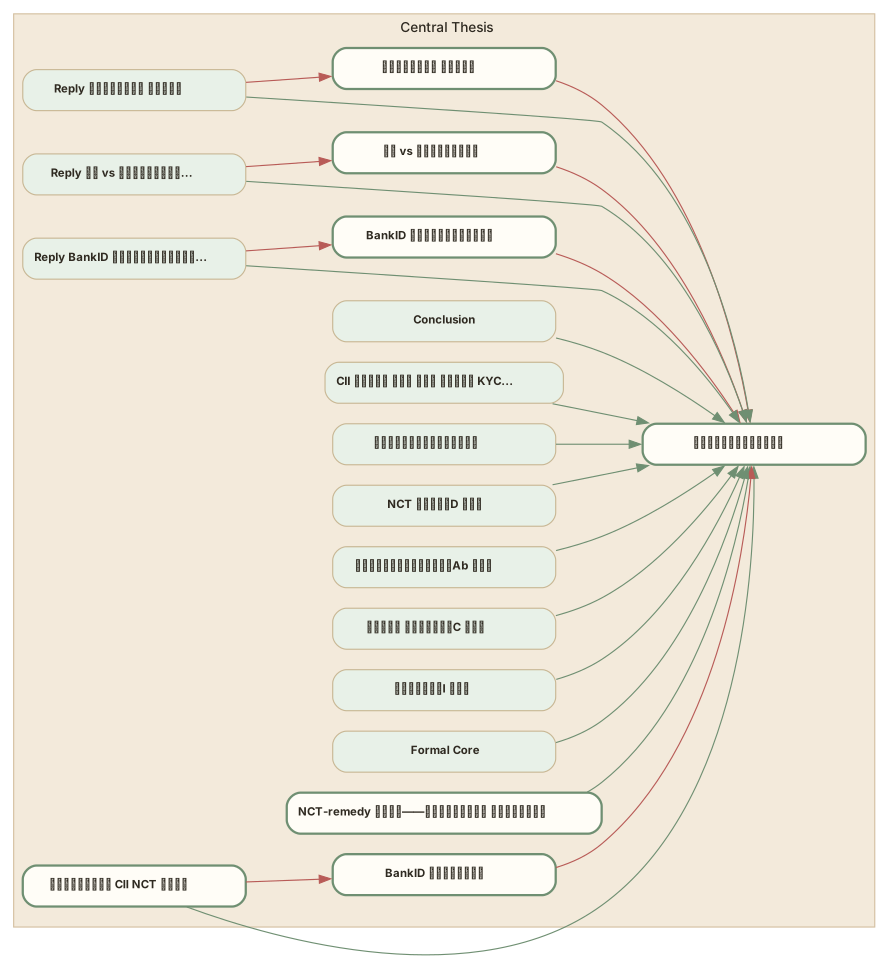
Source
===
title: 北歐商業身分基礎設施的代價
subTitle: Nordic CII Tyranny — Argument Map (v2)
slug: 2026-05-07-bankid-nordic-monopoly-democracy
author: research-article-pipeline argdown export
model:
  removeTagsFromText: true
===

# Central Thesis

[Core Thesis]
  + <Formal Core>
  + [Accepted]
  + <P1>
  + <P2>
  + <P3>
  + <P4>
  + <P5>
  + <Causal Chain>
  + [Deployment Conditions]
  + <Conclusion>
  - [Rejected]
    - [Accepted]
  + [Accepted]
  - [Objection 1]
    - <Reply 1>
  + <Reply 1>
  - [Objection 2]
    - <Reply 2>
  + <Reply 2>
  - [Objection 3]
    - <Reply 3>
  + <Reply 3>

[Core Thesis]: 北歐五國 BankID MitID Mobiilivarmenne Auðkenni 屬於四種治理形態並存的商業身分基礎設施(CII),覆蓋率 92 99.9% 並未消除排除,反而把銀行 KYC 結論轉碼為公民身分能力的必要條件。當 α 的 infrastructural rights、β 的 last-mile capture、γ 的救濟失能三者同時實現,infrastructural tyranny 成立——這是「單一壟斷者 無救濟程序」的結構問題,而非商業性本身的問題。北歐治理框架可作為部分輸出對象,但須通過 N₁ 銀行普及率 0.90、N₂ 央行能動性、N₃ 福利國家底層三項必要條件,並由 E₁ E₂ E₃ enabling 條件支撐。 #thesis

<Formal Core>: Formula NCT (Nordic CII Tyranny) i SE, NO, DK, FI, IS , CII i (α i β i γ i) infrastructural tyranny i α infrastructural rights(citizen, government services) β last mile capture(I, C BankID MitID), where I C BankID MitID γ (voice exit) loyalty only Conditional transferability applicable(NCT-remedy, region) N₁ N₂ N₃ ⱼ Eⱼ (j 1..3) N₁ bank penetration(region) 0.90 N₂ central bank agency(region) N₃ welfare state floor(region) E₁ social trust(region) θ trust (WVS Wave 7 baseline) E₂ labor protection(region) θ labor E₃ scale homogeneity(region) Remedy design T Remedy CII R₁ R₂ R₃ R₄ R₁ central bank warning authority R₂ government eID as baseline right R₃ non bank fallback(legal, permanent) R₄ statutory appeal procedure(time bound, burden on C) Caption NCT 為合取必要條件結構 α、β、γ 任一條件被結構性弱化,infrastructural tyranny 隨之退化 條件性可移植同樣是合取結構,N₁ N₂ N₃ 缺一即建議不輸出 CII 模式。 #formal

[Accepted]: 四種治理形態並存的 CII NCT 結構批判. 五國治理形態分為四類 (a) 純私法產品(瑞典 BankID、挪威 BankID) (b) 公私合營合資(丹麥 MitID) (c) 電信營運商主導(芬蘭 Mobiilivarmenne Bank IDs,由 Traficom Luottamusverkosto 強制互通與費率上限) (d) 國家實質控制(冰島 Auðkenni,以銀行端股權間接掌握)。四類共享的結構落在 CII 的 last-mile capture(「BankID 範本」標籤掩蓋了這個共享層) 當 α β γ 同時成立,infrastructural tyranny 隨之而來,這是地圖辯護的命題。 #accepted

[Rejected]: 「BankID 模式」作為單一範本. 把瑞挪丹芬冰五者統稱「北歐 BankID 模式」並打包輸出,是英語政策圈的便利稱呼。這個標籤至少掩蓋四項治理結構差異 法律地位(純私法 公私合營 政府實質控制)、強制性(法律強制 實質強制 形式多元)、監管路徑(反壟斷 直接擁有 互通與費率上限 股權間接掌握)、申訴管道(商業契約 行政救濟 監管途徑 金管局)。下游論證若以「BankID 模式」為單一單位,會錯估這些差異對排除規模、央行警示強度、可移植性的影響。 #rejected

<P1>: Title 四種治理形態(I 歸納) Section 2 — 五國 CII 的市場結構分類 Role 提供歸納基礎——若五國真的共用一個範本,把它們分類成四種治理形態就是多餘工。但 Riksbank 2024 Payments Report 、Norges Bank 2024 Financial Infrastructure 、Digst 2024 統計、Traficom Määräys 72 B 2022、Auðkenni 股權揭露顯示四項治理結構差異實際存在 分類本身就是辯護負擔的一部分,不是修辭裝飾。 瑞典 BankID 由 Finansiell ID-Teknik BID AB 發行、七家銀行 100% 持有,覆蓋率 99.9%,無法律強制但實質強制 Konkurrensverket 2024-09-18 對 Vipps MobilePay 投訴啟動反濫用市場支配地位調查。挪威 BankID 在 ID-porten 形式多元下實質主導 90% 以上。丹麥 MitID 自 2022-09-22 起為 Digst Finans Danmark 合組單一持有,Nets DanID 為 9.39 億克朗 10 年合約承包商,把「身分驗證」與「銀行帳戶」解耦。芬蘭以 Traficom Määräys 72 B 2022 強制 broker 互通與費率上限,市場結構較開放但仍寡頭。冰島 Auðkenni 形式上為商業實體,實質以 Landsbankinn(100% 國有)、Íslandsbanki(65% 國有)、Arion(13% 國有)的銀行端股權間接政府控制。 Finding 五國共享 last-mile capture 結構,但治理形態與監管路徑分屬四類 分類差異對 4 央行警示強度與 6 條件性可移植的判定有直接影響。 Formal i SE, NO, DK, FI, IS governance form(CII i) private, PPP, telecom, state controlled #pillar

<P2>: Title 因果鏈四環 五個具體案例(C 因果) Section 3 — 排除人口的因果鏈與案例 Role 提供因果機制——若無法把「覆蓋率 92 99.9%」與「60 95 萬人實際被排除」這兩個看似矛盾的數字接起來,本地圖會被反問為何「排除是 CII 的功能性結果而非副產品」。四環因果鏈把排除從靜態存量翻譯為動態流量,使 5 的三條件溯因論證有具體機制承載。 第一環是「銀行 KYC 結論等同公民身分結論」。瑞典 BankID 發行門檻為「銀行客戶關係」 丹麥 MitID 雖解耦但上游仍仰賴 NemKonto 銀行帳戶 CII 把銀行 PEP AML 信用評分結論直接轉碼為公民身分能力。第二環是「政府服務的單一強制鎖定」。Sahlfeld 2022 統計瑞典中央政府網站 86% 以上線上身分驗證入口僅接受 BankID JO 2023 beslut 6235-2022 認定 Skatteverket 拒絕替代驗證違反 Förvaltningslagen 第 9 條與第 21 條。第三環是「替代管道擠出」——瑞典 Skatteverket 地方辦事處逐年減少 丹麥 Borgerservice 排隊 3 5 週 挪威 NAV 紙本 9 14 週 Stockholms Stadsmission 2024 指無 BankID 個案社工協助平均耗時 11 倍。第四環是「救濟管道斷裂」。爭取救濟反過來需要 BankID 登入司法電子系統,形成自我封閉循環。五個案例 Anwar Fatima Per Yelena Else 對應 KYC 拒絕、庇護申請者無 personnummer、信用爭議解約、制裁名單觸發、高齡 UX 障礙五種典型機制。 Finding 排除是 CII 結構的功能性結果,並非其副產品 四環因果鏈構成 5 條件 β(last-mile capture)與條件 γ(救濟失能)的具體實現基礎。 Formal exclusion f(coverage, enforcement, fallback efficacy) KYC conclusion civic capability condition #pillar

<P3>: Title 央行警示作為政策可行性訊號(Ab 溯因) Section 4 — Riksbank「viktigt komplement」框架四階段演進 Role 提供溯因強度評估——若央行警示只是「中立技術評估」,三條件溯因論證會被質疑為政治化解讀。但 Riksbank 自身有 e-krona 自利動機與法定權威擴張動機,警示的可信度需要經過政治經濟學審視。把 2020 技術備註 2022 補充框架 2023 危機框架 2024 備災功能四階段演進拆開,配以 Norges Bank、Suomen Pankki、Danmarks Nationalbank、Seðlabanki Íslands 的警示分布差異,避免「央行說了 事實」的訴諸權威滑混。 Riksbank 從 2020 2021 把 BankID 列為 third-party identification provider 不作風險評估,到 2022 Payments Report 引入「viktigt komplement」框架(政府 e-legitimation 作為現有私人解決方案的重要補充),到 2023 把支付與身分基礎設施納入瑞典 totalförsvar 規劃並由副行長 Anna Breman 公開指 「BankID-utfall är ett hot mot finansiell stabilitet」,到 2024 引入「statlig betalningsinfrastruktur som beredskapsfunktion」並支持 SOU 2023 61 提案——四階段演進顯示警示強度的真實上升軌跡。五國央行警示強度分布並不同調 Riksbank 5、Norges Bank 4、Suomen Pankki 4、Danmarks Nationalbank 4(強警示但因果鏈最強體現於 MitID 2022 改革)、Seðlabanki Íslands 2,並非「同步同調的北歐共識」。 Finding 央行警示為 NCT 提供政策可行性訊號,但警示有自利動機,下游論述須以獨立證據(學術研究、技術審計、實際事件)佐證 警示強度的不同調本身就是「警示反映本地脈絡」的證據。 Formal warn strength(CB i) structural risk(CII i) (warn strength pure technical assessment) #pillar

<P4>: Title NCT 形式骨架(D 演繹) Section 5 — 三條件溯因論證 α β γ Role 提供論證骨架。若沒有形式化,「商業 BankID 壟斷對民主公民身分構成威脅」的命題會被當作政治立場而非可被檢驗的結構命題。三條件溯因論證把論證骨架從個案推到結構,並使「條件改造能否瓦解 NCT」成為可被回答的問題。形式化也是與 Hayek 反例對話的前提——把批判對象從「商業性」收束到「單一閘門 無救濟」這個更精確的結構,國家壟斷案例才能被同樣套入。 設 S 社福、稅務、選舉登記、申訴、訴訟、簽證、健康照護 、I 為身分驗證系統、C 為運營實體。條件 α(infrastructural rights) 當代福利民主國家中,公民對 S 的服務進入權,是 Marshall Sen Anderson 三條軸線下的「功能等價公民權」(規範地位仰賴三條鄰接論證,法律地位在多數司法管轄區仍未被命名)。條件 β(last-mile capture) 當 S 中多數服務在實踐上要求通過 I 且 I C BankID MitID,I 構成 last-mile gatekeeper。條件 γ(救濟失能) 當公民對 C 的政策決定既無 voice(無有意義的政治程序可對 BankID 政策異議)又無 exit(無實質可用的替代路徑),Hirschman 三選項只剩 loyalty。α β γ 共同滿足時,infrastructural tyranny 成立,呈現為非政府監控形式的民主能動性壓縮。Hirschman 套用須兩個中介前提 (a) 結構性依賴(structural dependency),(b) 憲政外溢(外溢到憲政權利的行使) 兩個中介前提皆條件性成立,並非分析性成立。 Finding NCT 屬合取必要條件結構——三個條件任一被結構性弱化,infrastructural tyranny 隨之退化 R₁..R₄ 四元件設計就是針對 β(弱化 last-mile capture)與 γ(強化 voice exit)的工程 法律對接點。 Formal NCT α β γ infrastructural tyranny k weakened(condition k) degraded(tyranny) #pillar

<P5>: Title 反例集合與輸出難度梯度(反例) Section 6 — 條件性可移植 三失敗輸出案例 Role 提供反例與邊界——若沒有失敗輸出案例,本地圖的「條件性可移植」會被當作謹慎修辭而非可被檢驗的命題。南非 NABID(2014 2019)、巴西 Itaú-Serasa(2018 2022)、中東歐 eIDAS 1.0 跟進失敗(2014 2020)三個案例提供反例,把可移植性的邊界精確標出,並避免把 Estonia e-ID 與 Aadhaar 誤推為「BankID 南方版本」。 三層輸出難度梯度 技術 治理 社會結構。技術層(PKI、SAML OIDC、QR 簽章)是 commodity,由 Gemalto Thales Signicat 打包輸出 治理層(央行監督協議、爭議解決機制、SLA)部分可移植 社會結構層(高銀行普及、高信任、強勞工保護、福利國家底層、規模均質、央行獨立性傳統)幾乎不可移植。三案例共享四項結構特徵 銀行普及率低於 90%、社會信任低於 25%(WVS Wave 7)、國家主導替代方案在政治經濟結構中強勢、金融監理機關有足夠能動性把模式選擇導向政府主導。Estonia e-ID 的關鍵設計是政府主導 強制使用 法定身分,與 BankID 的銀行主導 自願使用 商業契約結構性不同 Aadhaar 與 BankID 在六個維度(主導者、認證基礎、強制性、隱私架構、排除人群、失能後果)上呈現結構性反向。把兩個系統的批判合流會誤判政治經濟結構,並錯置救濟方案的設計目標。 Finding 條件性可移植是合取結構 N₁ N₂ N₃ ⱼ Eⱼ 三案例的失敗點精確對應三項必要條件之缺失 可學的對象限於 R₁..R₄ 治理框架,BankID 商業實體本身不在可學範圍內。 Formal applicable(NCT-remedy, region) N₁ N₂ N₃ ⱼ Eⱼ Estonia, Aadhaar BankID-output evidence #pillar

<Causal Chain>: Title CII 六步因果鏈 覆蓋率 強制性 替代品擠出 KYC 同等於公民身分 救濟斷裂 infrastructural tyranny T0 (deterministic) 覆蓋率擴張階段 銀行聯盟以 PKI 行動 app SDK SAML OIDC 整合在 2003 2020 期間達到 92 99.9% 覆蓋 政府服務逐步把 BankID 設為唯一或預設登入路徑(瑞典中央政府網站 86% 以上、丹麥 borger.dk、挪威 altinn.no、芬蘭 suomi.fi、冰島 island.is)。 T1 (deterministic) 強制性硬化 丹麥 2022-09-22 起法律強制 MitID 瑞典實質強制無法律明文 挪威形式多元但 BankID 主導 90% 以上 芬蘭較開放仍寡頭 冰島接近獨佔。「形式可選」與「實質強制」的差距由替代路徑成本決定。 T2 (deterministic) 替代品擠出(fallback erosion) 紙本 臨櫃 政府 e-ID 名義上保留,實質維護成本被持續削減——Skatteverket 地方辦事處逐年減少、Borgerservice 排隊 3 5 週、NAV 紙本 9 14 週、Kela 報告 10% 以上申辦者因紙本耗時放棄申請應得福利、Freja eID Loa 3 等級發行仍需 BankID 或實體臨櫃。 T3 (deterministic) KYC 結論等同公民身分結論 銀行 PEP AML 信用評分 制裁名單比對結果直接決定 BankID 發行與失效 金融排斥被結構性轉碼為公民排斥(「銀行能否承認你」決定「政府能否認你」)。 T4 (probabilistic) 救濟管道斷裂 被 CII 排除者要爭取救濟,反過來需要 BankID 登入司法電子系統(Domstolsverket、minretssag.dk) DO 2022 年報坦承收到的 BankID 相關投訴中有相當比例「無法以原本管道遞交」,形成自我封閉循環。 T5 (probabilistic) infrastructural tyranny 實現 α β γ 三條件同時滿足 個人層級(單介面失效全部斷線)、家庭照護層級(隱私委任濫用)、機構層級(系統性 operational risk)、民主制度層級(投票、聯署、工會選舉同步斷線)四層警示同步出現 中位估計 60 95 萬人受影響(不確定區間 25%)。 #chain

[Deployment Conditions]: NCT-remedy 兩組條件——救濟程序設計四元件 條件性可移植判準. deploy(NCT-remedy, region) valid T Remedy CII R₁ R₂ R₃ R₄ applicable(region) N₁ N₂ N₃ ⱼ Eⱼ #conditions

<C1>: Title R₁ 央行對商業身分基礎設施的警示與監督權 對應 Riksbank「viktigt komplement beredskapsfunktion」框架的核心政治意涵——央行作為金融基礎設施最終責任機構的法定權威 e-krona 政策只是這個權威的一個應用案例。任何引入 CII 的地區都需要對應的央行警示能力,前提是央行獨立性(N₂)成立。 Formal R₁ central bank warn authority(central bank, CII) statutory responsibility(payment infrastructure) #condition

<C2>: Title R₂ 政府 e-ID 作為基準權利,不可被商業實體取代 SOU 2023 61 Statens digitala identitet 提案、瑞典 Sverige-id 計畫(2026-12-01 上線)、丹麥 MitID 2022 改革(雖未解決全部問題)均體現此元件。基準權利的核心特徵為法律強制 不依賴商業關係,並對應 article 15 inclusion rights 的設計目標。 Formal R₂ gov eID baseline right(gov eID) depends on(gov eID, commercial relation) #condition

<C3>: Title R₃ 非銀行 fallback 必須法定為平行通道 戶政 ID、健保卡、移工證、紙本碼卡(如丹麥 papkort 應永久保留而非過渡期廢止)均是候選。Det Centrale Handicapråd 2022 與 Ældre Sagen 2022 的反事實估算指出,若紙本永久保留,可挽回 60 75% 的失能與高齡被排除者。法定地位是關鍵——若 fallback 僅為行政便利而非法定權利,會在預算壓力下被持續削減(T2 替代品擠出)。 Formal R₃ non bank fallback statutory(fallback) permanent(fallback) S j accessible(fallback, S j) #condition

<C4>: Title R₄ 個人身分被斷時的爭議解決機制必須法定且時效短 JO 2023 beslut 6235-2022 對 Skatteverket 的監察使個案決定確立「行政程序法第 9 條與第 21 條適用於數位身分驗證拒絕」此立場,效力範圍仍限於個案,但對其他行政機關具引導性意義。法定救濟程序的設計需要包含時效(例如 30 日內裁決)、舉證責任分配(由商業實體舉證為何拒絕)、暫時性替代路徑(爭議期間使用紙本)。對應 article 04 T Remedy 子規格的工程 法律對接點。 Formal R₄ unmask or revoke u appeal(u) time bound(u, 30 days) burden on(C, u) provisional path(u) #condition

<C5>: Title N₁ 銀行帳戶普及率 0.90 若該地區成年人口有 10% 以上沒有銀行帳戶,CII 直接排除這部分人口,違反「民主基礎設施普及性」的政治前提,必然引發政治反彈。Findex 2021 顯示北歐五國 99 100% 對照組南非 85%(黑人成人 76%)、巴西 84%(東北部低收入 67%)、印度 78%、印尼 52%、墨西哥 49%、奈及利亞 45%、波蘭 96%、捷克 81%、匈牙利 88%、羅馬尼亞 69%、保加利亞 84%。N₁ 為必要條件——多元帳本聯盟(電信 公部門 微金融)可弱化對「銀行」的特化,使 N₁ 改寫為「金融帳戶 0.90」。 Formal N₁ bank penetration(region) 0.90 generalized account penetration(region) 0.90 #condition

<C6>: Title N₂ 央行 監理機關獨立性與能動性 若央行無法對商業銀行聯盟發出有約束力的警示、無法要求設立非銀行 fallback、無法在金融制裁觸發失能時介入,商業壟斷會放大為民主危機。Cukierman index 全球前段是北歐五國的共同特徵 對照組南非 SARB 受 2017 2018 政治壓力、巴西 BCB 2021 起法定獨立但歷史短、印度 RBI 2018 Patel 辭職事件、印尼 BI 獨立性逐步建立中。R₁ 的有效性以 N₂ 為前提。 Formal N₂ independence index(CB) θ indep agency(CB, CII) #condition

<C7>: Title N₃ 強普及福利國家底層作為 fallback 若身分被斷的個人沒有任何國家供給的基本生活通道,商業壟斷的後果會升級為人權危機。Esping-Andersen 1990 三類福利國家中,北歐屬社會民主主義(普及主義 de-commodification) 當市場(如商業銀行的 BankID)失能時,公民仍可透過稅收支撐的服務維持基本生活。N₃ 為必要——其餘兩類(自由主義、保守—合作主義)在 CII 失能下會把排除升級為人權危機。 Formal N₃ welfare state floor(region) universalism de commodification #condition

<C8>: Title E₁ E₂ E₃ Enabling 條件(社會信任、勞工保護、規模均質性) E₁(高社會信任,WVS Wave 7 北歐 63.8 73.9%、世界中位數約 20%)使商業聯盟自我規範的協調成本可承受,但即使信任較低也可以靠強監理替代,屬 enabling 而非必要。E₂(強勞工保護,OECD Better Life Index 北歐 49 91%、OECD 平均 16%)與 N₃ 重疊性高,獨立必要性低。E₃(小規模均質人口)使聯盟協調可行,但若以技術手段替代,可以部分突破規模限制。Rothstein Uslaner 2005 論證社會信任是「平等 普及福利國家 低貪腐」的副產物,無法以政策快速建構。 Formal E₁ E₂ E₃ enabling(NCT-remedy) E j higher coordination cost E j necessary #condition

<Conclusion>: 北歐 CII 是六項歷史前提下的條件性均衡,並非「商業 vs 政府」二元對立的成功案例。 覆蓋率 92 99.9% 與 60 95 萬人實際被排除(中位估計,不確定區間 25%)並列存在 五國央行已從 2022 年起警示,丹麥 MitID 2022 改革在 R₂ 與 R₃ 上部分落地但仍未解決 R₁ 與 R₄ 輸出到非北歐脈絡會放大原本的不平等(巴西區域 印度經濟與性別 中東歐政治極化),而不是縮減。NCT 把 infrastructural tyranny 從「商業壟斷修辭」收束到「單一閘門 無救濟」這個結構命題——商業性本身不在批判範圍內,Hayek 反例下的國家壟斷如果同樣滿足 α β γ,結論不變。 跨層級原則貫穿全文 infrastructural tyranny 是設計選擇的結果,不是 CII 的必然命運。 當 R₁..R₄ 四元件被法定保留,β(last-mile capture)與 γ(救濟失能)可被結構性弱化 當 N₁..N₃ 三項必要條件不成立,輸出的會是 CII 的「外殼」而非「內涵」,可能放大原本的不平等。可學的對象限於「央行警示 政府 e-ID 為基準權利 非銀行 fallback 救濟程序設計」這個治理框架 BankID 商業實體與其銀行聯盟結構不在可學範圍內。治理框架的有效性也受央行獨立性、政府能力、財政能力限制,並非免費的全球範本。 NCT 與系列其他文章在合取結構上同構,但用於不同層級。 CII 對應 article 02 𝒩 框架的 M₂(資格性) M₄(隱私衡量) R₄ 對應 article 04 T Remedy 子規格 CII 排除模式對應 article 06 CB-Justice D₂ 民主公民身分(弱勢者 fallback 義務) CII 單一根脆弱性對應 article 07 SRP 框架的 R₃ 機構根(冰島 Auðkenni 國家實質控制案例可作 R₃ 變形) 北歐六項前提的條件性對應 article 08 HM 歷史前提錯置(北歐 6 項前提是另一個 P Nordic P Other 案例) 治理框架主張對應 article 11 essential facility doctrine 政府 e-ID 為基準權利對應 article 15 civic-proof-inclusion-rights 的 inclusion 設計。合取結構在不同文章中作為共用骨架,使 NCT 落在公約系列的一個位置(孤立批判的讀法則錯過了同構脈絡)。 Formal Coda Final form NCT i SE, NO, DK, FI, IS , CII i (α i β i γ i) infrastructural tyranny i α infrastructural rights(citizen, government services) β last mile capture(I, C BankID MitID) γ (voice exit) loyalty only Conditional transferability applicable(NCT-remedy, region) N₁ N₂ N₃ ⱼ Eⱼ (j 1..3) N₁ bank penetration(region) 0.90 N₂ central bank agency(region) N₃ welfare state floor(region) E₁ social trust(region) θ trust E₂ labor protection(region) θ labor E₃ scale homogeneity(region) Remedy design T Remedy CII R₁ R₂ R₃ R₄ R₁ central bank warning authority R₂ government eID as baseline right R₃ non bank fallback(legal, permanent) R₄ statutory appeal procedure(time bound, burden on C) Cross-article coupling (合取結構在不同層級的同構) article 02 𝒩. M₂, M₄ article 04 T Remedy article 06 CB-Justice.D₂ article 07 SRP.R₃ (Auðkenni 為機構根變形) article 08 HM (P Nordic P Other ) article 11 essential facility doctrine article 15 inclusion rights #conclusion

# Deployment Conditions

[Deployment Conditions]
  + <C1>
  + <C2>
  + <C3>
  + <C4>
  + <C5>
  + <C6>
  + <C7>
  + <C8>

# Objections And Replies

[Objection 1]: 「BankID 不是壟斷,是技術中立標準」. 反論訴求是 BankID 採用 PKI、SAML OIDC、ICAO eMRTD 等開放標準,技術上任何實作者都可以參與 瑞典 Konkurrensverket 在 2023 年前的多份報告也未把 BankID 直接認定為市場支配地位。商業聯盟自我規範模式以「中立基礎設施 多銀行入口」為自我描述,把 last-mile capture 視為政治批判而非市場結構事實。 #objection

<Reply 1>: Title 「BankID 不是壟斷,是技術中立標準」 Konkurrensverket 2024-09-18 對 Vipps MobilePay 投訴啟動反濫用市場支配地位調查,並明確指出「在私部門無義務接受 BankID 替代品的條件下,新進業者難以建立業務」 芬蘭 Traficom Määräys 72 B 2022 強制 broker 互通與費率上限的設計,正是對「技術標準開放但 last-mile 仍被聯盟壟斷」的回應。技術中立論恰好凸顯 last-mile capture 的政治經濟性質——在覆蓋率 92 99.9% 的條件下,「技術可開放」與「替代品有效」之間出現結構落差,反論反向支持本地圖對「閘門問題」(β)的核心關切。 #reply

[Objection 2]: 「商業 vs 國家二元批判已過時」. 反論訴求是後結構主義對「公私分野」的解構已主流化,把 BankID 批判化約為「商業壟斷對抗國家服務」會被視為理論退步。Anderson 2017 Private Government 、Cohen 2019 Between Truth and Power 、Zuboff 2019 Surveillance Capitalism 三條當代框架都指出商業實體握有公權力性質的權力是常態,本地圖若停留在二元對立會錯失這個更廣的論述場。 #objection

<Reply 2>: Title 「商業 vs 國家二元批判已過時」 本地圖的核心命題正好同意「二元批判過時」,並把批判重心移到「單一閘門 無救濟」這個複合結構。Hayek 1960 反例的功能正是限定批判對象——把模式從商業壟斷替換為國家壟斷,只要 α β γ 仍成立,infrastructural tyranny 同樣成立 商業性本身不在批判範圍內。Anderson Cohen Zuboff 三框架與 NCT 規範後果不同 private government 的場景是勞動關係內支配 informational capitalism 的場景是資訊資本累積的法律基礎 NCT 的特殊性在於商業實體握有「進入民主政治社群本身」的鑰匙。反論揭露的「批判精確化」要求,恰好成為 NCT 把商業 vs 國家二元立場重新切片的根據。 #reply

[Objection 3]: 「北歐前提不可移植 模式不可學」. 反論訴求是若 N₁ 銀行普及率 0.90、N₂ 央行能動性、N₃ 福利國家底層三項必要條件在多數區域不成立,本地圖等於宣告 NCT-remedy 對全球大多數區域無效——既然不可學,整套論證對非北歐讀者毫無實踐意義。產業 lobbyists 進一步以「我們只賣技術,不賣社會」反駁,把不可移植論視為政治神秘化。 #objection

<Reply 3>: Title 「北歐前提不可移植 模式不可學」 反論誤把「模式」與「治理框架」當成同一物。可學的對象限於 R₁..R₄ 治理框架(央行警示權、政府 e-ID 為基準權利、非銀行 fallback、法定救濟程序),BankID 商業實體與其銀行聯盟結構不在可學範圍內。三層輸出難度梯度(技術 治理 社會結構)正好把可學與不可學分開——技術元件可購買但不構成移植的核心 治理框架可在 N₁ N₂ N₃ 成立的區域部分移植 社會結構是長期歷史過程,無法在政策周期內建構。反論給出的不可移植清單,反向支持 NCT-remedy 的判準操作(檢查 N₁..N₃ 後再決定是否輸出 CII) 南非 NIS、巴西 PIX CPF、中東歐 EUDI Wallet 三條替代路徑也顯示「不可學 BankID」並不等於「無路可走」。 #reply