Argument Map
The Political-Philosophical Foundations of the Public Realm: Arendt / Habermas / Pettit / Mouffe Four-Strand Conjunction as the Normative Floor of the Civic-Proof Series
Public Realm Floor (PRF) — Argument Map (v2)
Arendt plurality (three ontological layers: natality + mortality + uniqueness), Habermas Öffentlichkeit (ideal speech situation + three Geltungsansprüche: Wahrheit / Richtigkeit / Wahrhaftigkeit + Sluice model), Pettit contestation (four conditions: Equally Accepted Terms + Equally Accessible Influence + Active Stance bearer position + editorial democracy), and Mouffe agonism (three conditions for legitimate adversary: mutual recognition ∧ shared rules ∧ agonistic frame) jointly constitute, within the civic-proof series scenario, a composite normative floor PRF ≜ ⟨plurality, validity, contestation, agonism⟩. Each of the four strands is individually necessary, irreducible, and cannot be substituted by the other three (borne by four formal theorems T_PRF1–T_PRF4); violation of any single component entails LegitimacyDegrade(d) ≥ θ_dem ≈ 0.5 (borne by theorem T_PRF0). The series' eight core bearer articles (A1 / A3 / A8 / A14 / A15 / F1 / F2 / F3) × four components constitute a 32-cell bearer matrix (● core: 18 cells / ○ partial: 9 cells / — no correspondence: 5 cells); F1 is the only article that core-bears all four components; the Z₃-intrinsic boundary of F1's RT-ℬ ✗ / AA-ℬ ✗ cells is borne by theorem T_PRF5, "the engineering unreachability lemma of the PRF floor," which engineering cannot cross and cannot replace. Five classes of objection (CF1 Coeckelbergh relational personhood / CF2 Floridi infosphere monism / CF3 posthumanism Braidotti + Hayles / CF4 digital democracy optimism Benkler / CF5 meta-objection "why these four theorists") "weaken but do not overturn" the conjunctive floor of PRF under a likelihood × impact matrix. PRF is a composite floor, not the absolute unique floor, and remains open to Rawls / Sen / Nussbaum / Honneth as ceiling or boundary conditions.
Arendt plurality + Habermas Öffentlichkeit + Pettit contestation + Mouffe agonism conjunction constitutes the civic-proof series' composite normative floor PRF; violation of any component triggers LegitimacyDegrade ≥ θ_dem ≈ 0.5; the 8×4 = 32 cell bearer matrix maps the eight core series articles onto the four PRF components, with F1 as the only article that bears all four core, and T_PRF5 forbids engineering bypass of the floor.
PRF ≜ ⟨plurality, validity, contestation, agonism⟩                    (Definition 3.1)

PRF_violated(d) ⇔ ∃ i ∈ {plurality, validity, contestation, agonism}
                  : violation(d, PRF_i)                                (conjunctive floor)

PRF_satisfied(d) ⇔ ⋀_{i ∈ {plurality, validity, contestation, agonism}} satisfies(d, PRF_i)

LegitimacyDegrade(d) ≜ σ( β₁·violation_intensity(d, plurality)
                        + β₂·violation_intensity(d, validity)
                        + β₃·violation_intensity(d, contestation)
                        + β₄·violation_intensity(d, agonism) )
where σ ≜ logistic sigmoid (same form as F1 §3.2 P_degrade), β₁=β₂=β₃=β₄≈1.0 (prior equal weights, pending empirical calibration)

T_PRF0 : PRF_violated(d) ⇒ LegitimacyDegrade(d) ≥ θ_dem ≈ 0.5

T_PRF1 : ¬∃ d : (d satisfies validity ∧ contestation ∧ agonism)
                ∧ (d violates plurality) → legitimate(d)               (plurality necessary)
T_PRF2 : ¬∃ d : (d satisfies plurality ∧ contestation ∧ agonism)
                ∧ (d violates validity)  → legitimate(d)               (validity necessary)
T_PRF3 : ¬∃ d : (d satisfies plurality ∧ validity ∧ agonism)
                ∧ (d violates contestation) → legitimate(d)            (contestation necessary)
T_PRF4 : ¬∃ d : (d satisfies plurality ∧ validity ∧ contestation)
                ∧ (d violates agonism)   → legitimate(d)               (agonism necessary)

T_PRF5 (Engineering Unreachability Lemma of the PRF Floor) :
  ∀ engineering design d : ¬ (PRF_violated(d) ∧ LegitimacyDegrade(d) < θ_dem)
  F1 RT-ℬ ✗ ⇒ violation(plurality) ∧ violation(validity)
  F1 AA-ℬ ✗ ⇒ violation(contestation) ∧ violation(agonism)

PRF ⊆ NormativeFloors                                                 (composite floor, not absolutely unique)
NormativeFloors ⊇ {PRF, Rawls justice, Sen capability, Nussbaum dignity, Honneth recognition, ...}

8 articles × 4 components bearer matrix (32 cells):
              | plurality | validity | contestation | agonism
  A1 accountable    |     ●     |    ○     |      ○       |    ●
  A3 conceptual     |     ●     |    ●     |      ○       |    —
  A8 FTLA           |     ○     |    ●     |      ●       |    ●
  A14 remedy gap    |     —     |    ○     |      ●       |    ●
  A15 inclusion     |     ●     |    ●     |      ●       |    ○
  F1 delegation limits |  ●     |    ●     |      ●       |    ●   (core bearer = 4)
  F2 receipts       |     ○     |    ●     |      ●       |    ○   (F2 §9 CF1-CF5 agonistic engineering upgrade)
  F3 UX cognition   |     ○     |    ●     |      ○       |    ●

  ● core: 18 cells / ○ partial: 9 cells / — no correspondence: 5 cells
  ●_plurality = 4 / ●_validity = 5 / ●_contestation = 4 / ●_agonism = 5

Stress Test (likelihood × impact, with mitigation):
  CF1 Coeckelbergh   ⇒ plurality      ; medium-high → low-medium (F1 §4.1 one-notch not two-notch reduction)
  CF2 Floridi        ⇒ plurality      ; medium      → low        (category distinction: descriptive vs normative)
  CF3 posthumanism   ⇒ plurality + contestation ; medium-low → low (subjecthood condition, not human exceptionalism)
  CF4 Benkler        ⇒ validity + agonism      ; low        → low (new affordance ≠ new legitimacy)
  CF5 meta-objection ⇒ overall methodology      ; low-medium → low (open-floor position)
PRF is constituted by the conjunction of four components forming a composite floor; LegitimacyDegrade is a sigmoid of the linear combination of the four components' violation_intensity, with threshold θ_dem ≈ 0.5 as an analytically suggested figure. T_PRF1–T_PRF4 are borne by a reductio structure of "individually necessary, cannot be substituted by the other three"; T_PRF5 extends the Z₃-intrinsic boundary of F1's RT-ℬ ✗ / AA-ℬ ✗ cells to all engineering design layers, asserting that no engineering bearer can bypass the PRF floor. The 32-cell bearer matrix marks the correspondence intensity of 8 articles × 4 components using three categories ●/○/—; F1 is the only article that core-bears all four components; F2's agonistic engineering upgrade of the §9 CF1-CF5 stress test upgrades F2-agonism from — to ○. The five classes of objection "weaken but do not overturn" PRF under the mitigated versions; the strongest impact, CF1 Coeckelbergh's weakening of plurality, is addressed by the ontological vs. functionalist distinction of F1 §4.1.
PRF- Public Realm Floor (PRF) — the composite normative floor of the civic-proof series constituted by the conjunction of four strands ⟨plurality, validity, contestation, agonism⟩
plurality- Arendt 1958 §1 + §24 + §44: ontological co-presence of multiple *who* (three ontological conditions: natality + mortality + uniqueness)
validity- Habermas 1962 / 1981 / 1992 Öffentlichkeit structure ∧ three Geltungsansprüche: Wahrheit / Richtigkeit / Wahrhaftigkeit ∧ Sluice model
contestation- Pettit 1997 / 2012: active-stance bearer position ∧ Equally Accepted Terms ∧ Equally Accessible Influence ∧ editorial democracy — four conditions
agonism- Mouffe 2000 / 2013: three conditions for legitimate adversary (mutual recognition ∧ shared rules ∧ agonistic frame), strictly distinguished from antagonism
T_PRF1 / T_PRF2 / T_PRF3 / T_PRF4- Four formal theorems establishing that each strand is individually necessary and cannot be substituted by the other three
T_PRF5- Engineering Unreachability Lemma of the PRF Floor: no engineering design can bypass PRF; corresponds to the Z₃-intrinsic boundary of F1's RT-ℬ ✗ (plurality + validity dual violation) and AA-ℬ ✗ (contestation + agonism dual violation) cells
LegitimacyDegrade- Logistic sigmoid of the linear combination of the four components' violation_intensity (value in [0,1]): 'probability of legitimacy degradation,' not 'empirically measured degradation'
θ_dem- Legitimacy degradation threshold ≈ 0.5 (analytically suggested figure, pending reverse-calibration against V-Dem 2024 / Bertelsmann Transformation Index / Freedom House)
32-cell matrix- 8 core bearer articles of the series × 4 components = 32 cells; ● core bearer: 18 / ○ partial bearer: 9 / — no correspondence: 5
● / ○ / —- Core bearer (the article's main normative claim directly falls on the component) / partial bearer (indirect support) / no correspondence (no significant relation)
≜- is defined as
⇔- if and only if
∧- conjunction
The formal statement establishes the position; the next step is to pull apart common misreadings. The first 18 articles of the civic-proof series implicitly employ the four political philosophers as normative anchors at different levels, but a common misreading in academic and engineering communities takes a synthetic (synthesis / syncretism) approach, fusing the four strands into a new "composite democratic theory" and dissolving the conceptual tensions in the original works. So long as this classification holds, PRF is read as "another candidate version of democratic theory," listed alongside Rawls / Sen / Nussbaum / Honneth as an upper bound directly optimizable by engineering implementations, and engineering bearers are taken to independently sustain legitimacy. The map's first move is to pull this synthetic approach apart from "conjunctive floor + individually necessary + cannot be substituted by the other three" — PRF adopts a conjunction methodology in which all four strands retain their original positions and tensions under conjunction; PRF is a floor (failure of any one entails failure of the whole), not an upper bound (attaining the highest level of legitimacy).
The four strands can be fused into a new "composite democratic theory," PRF is an upper bound among democratic theory candidates, and engineering bearers can independently sustain legitimacy
Treating Arendt / Habermas / Pettit / Mouffe as elements fusible into a new "composite democratic theory" via a syncretic-fusion approach dissolves the conceptual tensions in the four original works (e.g., the fundamental divergence between Habermas's consensus and Mouffe's agonism, and the hierarchical difference between Arendt's ontological plurality and Pettit's republican contestability). So long as this classification holds, PRF is read as "another candidate version of democratic theory," listed alongside Rawls justice, Sen capability, Nussbaum dignity, and Honneth recognition as an upper bound directly optimizable by engineering implementations; engineering bearers (wallet schema, UX design, platform governance) can then independently sustain democratic legitimacy. Conflating floor and upper bound carries three argumentative costs — first, syncretic-fusion tends to forcibly merge concepts from different levels (e.g., Arendt's ontological plurality and Mouffe's political-theoretical agonism), losing the conceptual precision of the original works; second, the four strands are most deeply implicitly employed across the civic-proof series' first 18 articles (F1 §4's three-approach conjunction has already established the bearing of Arendt + Habermas + Pettit, with Mouffe serving as an auxiliary in F1 §4.2 (iii)), so treating the four as a reduction substitutable by any one strand invalidates the 32-cell bearer matrix; third, if engineering bearers can independently sustain legitimacy, the Z₃-intrinsic boundaries of F1's RT-ℬ ✗ and AA-ℬ ✗ (accountability bearing requires first-personal mens rea; contestation bearer requires Pettit's active-stance) are cancelled, and the PRF floor is bypassed at the engineering implementation layer.
syncretic_PRF(d) ≜ fusion(plurality, validity, contestation, agonism) ∧ PRF_as_ceiling(d) ⇒ engineering_floor(d) The four strands retain their original positions and tensions under conjunction; PRF is a composite normative floor (failure of any one entails failure of the whole); engineering bearers are concrete implementations of the floor (not replacements)
The four original works (Arendt 1958 *The Human Condition*; Habermas 1962 *Strukturwandel der Öffentlichkeit* + 1981 *TKH* + 1992 *Faktizität und Geltung*; Pettit 1997 *Republicanism* + 2012 *On the People's Terms*; Mouffe 2000 *The Democratic Paradox* + 2013 *Agonistics*) each serve as floor anchors for different articles in the civic-proof series' first 18 articles, but none of the series' articles has yet directly borne the positive claim that the four-strand conjunction constitutes the series' normative floor. This article elevates the four-strand conjunction to a positive argument for the series' normative floor, adopting a conjunction methodology: the four strands retain their original positions and tensions within PRF (e.g., the tension between Habermas's consensus position and Mouffe's agonism position is retained; the two strands conjoin at the point that "the public realm's bearers are human personality subjects"), without claiming fusion into a new theory. Two entailments of the conjunctive floor — first, violation of any single component entails violation of PRF as a whole, without permitting trade-off compensation by another strand; second, satisfying PRF is a necessary condition (sufficiency is not claimed), without asserting "attainment of the upper bound." PRF ⊆ NormativeFloors (composite floor, not absolutely unique), open to Rawls / Sen / Nussbaum / Honneth as ceiling or boundary conditions.
PRF ≜ ⟨plurality, validity, contestation, agonism⟩ ; PRF_violated(d) ⇔ ∃ i : violation(d, PRF_i) ; PRF ⊆ NormativeFloors ; T_PRF5 : ∀ engineering d , ¬(PRF_violated(d) ∧ LegitimacyDegrade(d) < θ_dem) The distinction is itself only a declaration. To prove that the PRF four-strand conjunction constitutes the series' normative floor (rather than a reduction replaceable by any single strand), five independently sourced supporting arguments are required — the deductive strand provides the formal skeleton of the PRF function definition + LegitimacyDegrade sigmoid + T_PRF0 violation entailment + T_PRF1–T_PRF4 individual necessity + T_PRF5 engineering unreachability lemma + 32-cell bearer matrix; the Arendt ontological strand provides the three-layer ontological conditions for plurality (natality + mortality + uniqueness) and a structural homology test with the Chinese "qun" (群) tradition; the Habermas normative-structure strand provides the three-layer normative structure of Öffentlichkeit (ideal speech situation + three Geltungsansprüche + Sluice model) + Fraser counterpublics correction + correspondence with the Chinese "gong" (公) tradition; the Pettit republican strand provides the three-layer first-personal requirements (Equally Accepted Terms + Equally Accessible Influence + Active Stance) + three-layer bearer position test + freedom as non-domination + correspondence with the Chinese "jian-yi" (諫議) tradition; and the Mouffe agonistic strand provides the strict distinction between agonism and antagonism + Habermas + Mouffe conjunction (non-exclusive) + correspondence with the Chinese "zheng-you" (諍友) tradition. The five pillars correspond to five argumentative levels; without any one, the position degrades to a mere declaration.
§3 — Deductive (PRF formal definition + LegitimacyDegrade + T_PRF0–T_PRF5 + 32-cell bearer matrix)
The PRF formal skeleton and the 32-cell bearer matrix constitute the formal statement of the four-strand conjunctive floor
whyProvides the formal skeleton of the conjunctive floor — without formalizing the PRF function definition, LegitimacyDegrade sigmoid, four formal theorems T_PRF1–T_PRF4, and the T_PRF5 engineering unreachability lemma, "four-strand conjunction" remains at the linguistic level only; without unfolding the 8×4 = 32-cell bearer matrix, "series normative floor" is merely rhetorical and "F1 as the full core bearer of all four components" cannot be sustained at the series level.
PRF ≜ ⟨plurality, validity, contestation, agonism⟩ adopts a conjunctive normative floor definition; PRF_violated(d) ⇔ ∃ i : violation(d, PRF_i) (violation of any single component entails violation of the whole; trade-off compensation is not permitted). PRF ⊆ NormativeFloors adopts an open-boundary position (composite floor, not absolutely unique). LegitimacyDegrade(d) adopts a logistic sigmoid form (same form as F1 §3.2 P_degrade); four equal prior weights β = 1.0; θ_dem ≈ 0.5 is an analytically suggested figure (pending reverse-calibration against V-Dem / Bertelsmann / Freedom House). T_PRF0 formalizes PRF_violated ⇒ LegitimacyDegrade ≥ θ_dem; T_PRF1–T_PRF4 bear the individual necessity of the four strands via the structure "reductio: if this strand is violated while the remaining three are satisfied, then degradation to X results" — plurality violation degrades to "procedure without co-present subjects" (Arendt §28 common world), validity violation degrades to "strategic interaction" (Habermas strategisches Handeln), contestation violation degrades to "consensus without contestation channels" (Pettit hegemonic consensus), agonism violation degrades to "antagonist civil war" or "post-political consensual ritual" (Mouffe's two failure modes). T_PRF5 extends the Z₃-intrinsic boundary of F1's RT-ℬ ✗ (plurality + validity dual violation) and AA-ℬ ✗ (contestation + agonism dual violation) into the lemma that "no engineering design can bypass the PRF floor." The 8×4 = 32-cell bearer matrix marks the correspondence intensity of 8 articles × 4 components using three categories ●/○/— with distribution ● 18 / ○ 9 / — 5; F1 is the only article with full core bearing of all four components (4 ●); F2 §9's agonistic engineering upgrade of the CF1-CF5 stress test upgrades F2-agonism from — to ○, leaving only 5 remaining — cells including A3-agonism, A14-plurality, and others.
PRF ≜ ⟨plurality, validity, contestation, agonism⟩ ; PRF_violated(d) ⇔ ∃ i : violation(d, PRF_i) ; T_PRF0 : PRF_violated(d) ⇒ LegitimacyDegrade(d) ≥ θ_dem ≈ 0.5 ; T_PRF5 : ∀ engineering d , ¬(PRF_violated(d) ∧ LegitimacyDegrade(d) < θ_dem) §4 — Philosophical interpretation (Arendt plurality: three ontological conditions + Chinese 'qun' tradition + series scenarios)
Arendt plurality adopts three ontological-level conditions (natality + mortality + uniqueness) and cannot be reduced to liberal pluralism
whyProvides the Arendt ontological bearing for the SA1 plurality component — if plurality is read as "liberal pluralism: coexistence of multiple values" (political-theory level), then the three reasons in F1 §4.1 for "no natality / no mortality stake / no uniqueness disclosure" of AI agents become invalid, leaving no response space to the CF1 Coeckelbergh relational personhood full-replacement objection; if the structural homology between the Chinese "qun" (群) tradition and Arendt plurality is not explicitly stated as a "structurally homologous but with different historical bearing conditions" conservative position, the cross-cultural inference is read as excessive analogy.
Arendt 1958 *The Human Condition* §1 Prologue — "the fact that men, not Man, live on the earth and inhabit the world" (plural humans co-inhabit the earth; a single abstract "Man" is outside Arendt's position, p.7) — establishes plurality at the ontological level. Three ontological conditions: natality (§44 p.313–320 + p.177 "each man begins something new": the existential condition of "being able to begin," not a biological factual description), mortality (the existential condition counterposed to natality in §44: stake-taking in which action-bearing is irrevocable; an AI agent's capacity for "regeneration" destroys this existential basis), and uniqueness (§24 p.175–181 "The Disclosure of the Agent in Speech and Action": the *who/what* distinction, where *who* can only be disclosed to others in action, and *what* is an attribute-level description). Honig 1993 connects natality to "the openness of political action"; d'Entrèves 1994 and Benhabib 1996 connect the *who/what* distinction to the irreducibility of political subjecthood. Arendt plurality is strictly distinguished from liberal pluralism on three counts: ontological level vs. political-theory level, subject of disclosure vs. subject of choice, co-presence of *who* vs. juxtaposition of values. The Chinese "qun" (群) tradition (Chu Yun-han 2012 on the plural bearers of the Taiwanese public realm; Lin Tsung-hung 2020 on the "legitimate adversary" relationship between Taiwanese social movements and political parties; Wang Hui 2003 on the transformation of the Chinese "gong" concept) shares structural homology with Arendt plurality in the existential condition of "plural humans co-inhabiting," but the historical bearing conditions of "qun" (the hierarchical structure of Confucian self-cultivation → family → governance → world pacification) diverge from the horizontal plurality of Arendt's ontology. Three series scenario correspondences: A1 §2 bears the multiple *who* of anonymous political speech via NAACP v. Alabama and two other cases; A15 §3 bears enrollment condition examination by surveying structural exclusion of undocumented / stateless / exile experiences; F1 §4.1 bears the core reason for "structural non-delegability" via the three-layer ontological argument for AI agents.
plurality ≜ Arendt(1958)·natality ∧ mortality ∧ uniqueness ; plurality ⊥ liberal_pluralism (different levels) ; ∀ AI agent a : ¬natality(a) ∧ ¬mortality_stake(a) ∧ ¬uniqueness_disclosure(a) ⇒ ¬plurality_bearer(a) §5 — Philosophical interpretation (Habermas Öffentlichkeit: three-layer normative structure + Fraser counterpublics + Chinese 'gong' tradition)
Habermas Öffentlichkeit adopts a three-layer normative structure (ideal speech situation + three Geltungsansprüche + Sluice model) and cannot be reduced to empirical public opinion
whyProvides the Habermas normative-structure bearing for the SA2 validity component — if Öffentlichkeit is read as "empirical public opinion polling" (empirical measurement), then the counterfactual idealization character of the ideal speech situation becomes invalid and the normative force of the three Geltungsansprüche (Wahrheit / Richtigkeit / Wahrhaftigkeit) degrades to a platform algorithm metric; if the Fraser counterpublics correction is not explicitly stated as an "expand while preserving the floor" position, PRF's single Öffentlichkeit structure is read as exclusionary; if the correspondence between the Chinese "gong" (公) tradition and Öffentlichkeit is not explicitly stated to have different historical bearing conditions, the cross-cultural inference is read as excessive analogy.
Habermas's Öffentlichkeit concept runs across three anchor works (1962 *Strukturwandel* + 1981 *TKH* + 1992 *Faktizität und Geltung*). Three-layer normative structure: the first layer is the ideal speech situation (1981 TKH Vol. I §III.3 defines kommunikatives Handeln as "action oriented toward achieving mutual understanding," presupposing four counterfactual conditions: all relevant parties can participate, no power distortions, no time constraints, no internal or external coercion; the ideal speech situation is a counterfactual idealization, not an empirical claim; its function is to provide the normative reference point for "reasonable consensus"); the second layer is the three Geltungsansprüche (TKH §III.3 p.410–427 decomposing speech acts into Wahrheit [truth validity], Richtigkeit [normative rightness], and Wahrhaftigkeit [sincerity/authenticity], retaining German originals to avoid translation ambiguity); the third layer is the Sluice model (1992 *Faktizität und Geltung* Kap. VII–VIII: the legitimacy of democratic legislation derives from the communicative channels of two Sluice layers — "informal opinion formation" and "formal decision-making" — with zivilgesellschaftliche Öffentlichkeit's informal opinion formation placed upstream of institutional decision-making). Öffentlichkeit is strictly distinguished from empirical public opinion on three counts: the input is rational-critical debate in speech acts vs. opinion aggregation; the output is reasonable consensus vs. majority preference measurement; normative structure vs. a metric distortable by platform algorithms. Fraser 1990 *Rethinking the Public Sphere*'s critique of the single-sphere presupposition is systematized by Warner 2002 *Publics and Counterpublics*; this article adopts the "expand while preserving the floor" position: the coexistence of multiple counterpublics conforms to plurality, but each counterpublic must individually satisfy the normative structure of validity. Habermas 1992 Kap. VIII's Sluice model for zivilgesellschaftliche Öffentlichkeit has already partially responded to the Fraser critique. The Chinese "gong" (公) tradition (Wang Hui 2003 on the historical transformation of the Chinese "gong" concept; Chu Yun-han 2012 connecting "gong" to the institutional bearing of Taiwan's public realm: Constitutional Court interpretation, Legislative Yuan operations, referendum system, local councils, media oversight — five major bearers) shares structural homology with Öffentlichkeit in "institutional bearing of normative structure," but the historical bearing conditions of "gong" (imperial examinations, literati-officials, pure discussion) differ from Habermas's 18th-century bourgeois public realm (coffeehouses, salons, print media). Three series scenario correspondences: the GDPR cookie banner's eight-year failure bears the case of Wahrhaftigkeit degrading into ritual; Taiwan's 2018–2021 referendum cases bear the Taiwanese institutional fulfillment of Öffentlichkeit; the 2024 U.S. election platform manipulation bears the erosion of bearer positions for the three Geltungsansprüche under platform mediation.
validity ≜ Habermas·(ideal_speech_situation ∧ Geltungsansprüche ∧ Sluice) ; Geltungsansprüche ≜ Wahrheit ∧ Richtigkeit ∧ Wahrhaftigkeit ; validity ⊥ empirical_public_opinion (different categories) ; counterpublics ⊆ plurality_extension ∧ ∀ cp ∈ counterpublics : satisfies(cp, validity_normative_structure) §6 — Philosophical interpretation (Pettit contestation: three-layer first-personal requirements + three-layer bearer position + non-domination + Chinese 'jian-yi' tradition)
Pettit contestation adopts three-layer first-personal requirements (Equally Accepted Terms + Equally Accessible Influence + Active Stance); bearer position is non-delegable
whyProvides the Pettit republican bearing for the SA3 contestation component — if contestation is read as "an input function for dissent" (passively receiving opinion consultations), then the first-personal requirement of active-stance becomes invalid and the logical space for AI agents to serve as contestation bearers is opened, engineering bypassing F1's AA-ℬ ✗ boundary; if freedom as non-domination is not strictly distinguished from Berlin's negative freedom (non-interference) and Lovett's three conditions become inoperative; if the gap between the historical bearing conditions of the Chinese "jian-yi" (諫議) tradition (ruler-minister relations / literati ethics / family-state unity) and Pettit's republican democracy (citizenship / equal political rights / institutional checks and balances) is not explicitly stated, the cross-cultural inference is read as excessive analogy.
Pettit's contestation concept runs across two anchor works (1997 *Republicanism* + 2012 *On the People's Terms*). Three-layer first-personal requirements: the first layer is Equally Accepted Terms (2012 Ch.3 "citizens must be able to accept the terms of public policy under conditions of equality"; this first-personal requirement cannot be replaced by a representative — any representative's acceptance must be conditioned on citizens being able to first-personally accept it themselves); the second layer is Equally Accessible Influence (2012 Ch.5 Eyeball Test p.81–105 "citizens can make eye contact with power holders without flinching," presupposing accessible channels of influence: challenging, appealing, voting, protesting); the third layer is Active Stance (1997 Ch.6 + 2012 Ch.6: the subject of contestation must "actively" adopt a dissenting position, not "passively" accept opinion consultation; the significance of this distinction for AI agent scenarios is that AI can serve as an input function for opinion consultation but cannot serve as an active-stance bearer). F1 §4.3 has already established the three-layer bearer position test (execution: delegable / endorsement: conditionally delegable / bearer: non-delegable, corresponding to Pitkin 1967's formal-substantive representation distinction); F1's RT-ℬ ✗ and AA-ℬ ✗ boundaries are precisely the non-reachability of the third layer. Freedom as non-domination (1997 Ch.2: "not being subject to arbitrary interference by any person or institution") is stronger than Berlin's negative freedom (non-interference); even without actual interference, if the possibility of "being arbitrarily interfered with" exists, domination persists; Lovett's 2010 three conditions (actual exercise of power / dispositional capacity / arbitrary character) — if any is absent, domination status degrades. Implications for digital scenarios: when infrastructure such as wallet schema, verifier algorithms, and issuer revocation mechanisms can "arbitrarily" alter a holder's conditions of action, domination exists even without actual interference; F1 §3.2 P_degrade-TC "calibration is self-reported by the agent with no external contestation channel" is a concrete case of this mechanism. The Chinese "jian-yi" (諫議) tradition (three-layer structure in Chinese history: direct remonstrance / indirect remonstrance / death remonstrance; three-layer structure of Taiwan's Constitutional Court petition system: citizen petition / judge petition / institutional petition) shares structural homology with Pettit's contestation in the bearing of first-personal active-stance, but the historical bearing conditions of "jian-yi" (ruler-minister relations / literati ethics / family-state unity) diverge substantially from those of Pettit's republican democracy (citizenship / equal political rights / institutional checks and balances). Three series scenario correspondences: Taiwan's Constitutional Court petitions (Interpretations No. 803 / 791 / 748) bear the concrete practice of bearer position; CJEU SCHUFA C-634/21 (2023) bears the institutional correspondence of GDPR Art 22's "right not to be subject to automated decision-making"; SEC v. Jarkesy (2024) bears jury trial rights in administrative procedures for fraud cases.
contestation ≜ Pettit·(Equally_Accepted_Terms ∧ Equally_Accessible_Influence ∧ Active_Stance) ∧ bearer_position_three_layer ; freedom_non_domination ⊨ ¬arbitrary_power (Lovett three conditions) ; ∀ AI agent a : a ⊨ input_function ∧ ¬active_stance_bearer(a) §7 — Philosophical interpretation (Mouffe agonism/antagonism: strict distinction + three conditions for legitimate adversary + Habermas + Mouffe conjunction + Chinese 'zheng-you' tradition)
Mouffe agonism adopts three conditions for legitimate adversary (mutual recognition ∧ shared rules ∧ agonistic frame) and is strictly distinguished from antagonism's enemy/annihilation logic
whyProvides the Mouffe agonistic-politics bearing for the SA4 agonism component — if agonism is read as "antagonism" (without the legitimate adversary presupposition), Schmitt's annihilation logic is introduced and the normative position of agonism collapses; if Habermas + Mouffe are not taken as conjunctive (non-exclusive), the validity and agonism components of PRF are read as mutually exclusive; if the gap between the historical bearing conditions of the Chinese "zheng-you" (諍友) tradition (Confucian ethics / literati relations / private friendship / hierarchical ruler-minister dialogue) and Mouffe's institutional agonism (multi-party politics / public debate / media oversight / civil society confrontation) is not explicitly stated, the cross-cultural inference is read as excessive analogy.
Mouffe's agonism concept runs across two anchor works (2000 *The Democratic Paradox* + 2013 *Agonistics*). Strict distinction between agonism and antagonism: agonism presupposes a legitimate adversary; antagonism presupposes an enemy. Three conditions for legitimate adversary (2000 Ch.4 p.80–107): mutual recognition, shared rules, and agonistic frame; the common presupposition of all three conditions is "the opponent's right to political expression is recognized as legitimate, even if their position opposes one's own." The enemy structure of antagonism does not share this presupposition; the opponent's right to political expression is not recognized and interaction degrades to annihilation logic. Mouffe draws on Schmitt 1932 *The Concept of the Political* for the concept of agonistic politics but rejects Schmitt's friend/enemy annihilation logic; Schmitt was a Nazi legal scholar, and citation requires honest acknowledgment of this boundary — Mouffe absorbs Schmitt's insight that "the political essentially contains adversarialism" and transforms the enemy structure into the legitimate adversary structure. Mouffe 2000 Ch.4 p.102–105 explicitly critiques Habermas's deliberative consensus: "the political cannot be reduced to rational consensus"; reducing democratic legitimacy to consensus dissolves democracy's agonistic dimension and degrades it to post-political consensual ritual. This article adopts the Habermas + Mouffe conjunction (non-exclusive) position, relying on F1 §4.2's existing methodology: the conjunction structure of the two strands lies in Habermas's Öffentlichkeit and three Geltungsansprüche bearing "the normative structure of speech acts," and Mouffe's three conditions for legitimate adversary bearing "the normative structure of agonistic politics"; the two conjoin at the point that "political speech requires human personality subjects" while the tension between "consensus vs. confrontation" is retained. Norval 2007 *Aversive Democracy* (Mouffe + Cavell dialogue) further systematizes this conjunction. The Chinese "zheng-you" (諍友) tradition (*Analects* ·Jishi: "three beneficial friendships: friendship with the upright, friendship with the sincere, friendship with the knowledgeable" — direct honest remonstrance; the tradition of direct honest remonstrance among Chinese literati — Han Yu, Fan Zhongyan, Wang Anshi, Gu Yanwu; the Neo-Confucian "the exemplary person harmonizes without conforming" and the semantic bearing homology with Mouffe's three conditions for legitimate adversary) shares structural homology with Mouffe's agonism in the mutual recognition of a legitimate adversary, but the historical bearing conditions of "zheng-you" (private / semi-public ethical structures) diverge substantially from those of Mouffe's institutional agonism (public-realm structures of multi-party systems). Three series scenario correspondences: the structural dynamics of Taiwan's 2024 post-election legislature ("blue-white coalition" vs. "green minority coalition" under no single party majority) bears the Taiwanese institutional fulfillment of agonism; the agonism/antagonism boundary slippage of Hong Kong's 2019–2020 anti-extradition movement; the 2024 U.S. election polarization bears the impact of agonism degrading into antagonism.
agonism ≜ Mouffe·legitimate_adversary(mutual_recognition ∧ shared_rules ∧ agonistic_frame) ; agonism ≠ antagonism (annihilation logic rejected) ; Habermas ∧ Mouffe : conjunction at 'political speech requires human personality subjects' (tension retained between consensus vs. confrontation) The pillars constitute the positive argument. But the claim that "the four-strand conjunction constitutes the series' normative floor" must be held up by a concrete causal chain — proceeding from the conceptual conjunction of the four original works, through the series-specific instantiation in the 8-article bearer matrix, to the bearer relationship of the civic-proof series' normative floor. The purpose of unfolding the chain is to translate the abstract "four-strand conjunction" into mechanistically traceable bearing conditions: the four strands' original concepts are defined as the four PRF components in §3.1; the four components are formalized as individually necessary in §3.4 via T_PRF1–T_PRF4; individual necessity is projected in §3.3 as the 8×4 = 32-cell bearer matrix; the matrix is joined to the series' eight articles via forward-links in §10; and the chain finally closes in §12 as the conditional academic conclusion that "the four-component conjunction constitutes the series' normative floor." The chain contains one deterministic structural closure (four-strand concepts → PRF function → 32-cell matrix → series bearer relationship) and two probabilistic mechanism chains (the CF5 LLM-agent substitution engineering-layer extension of F1's boundary / the pressure of digital scenarios on the cross-temporal applicability of the four strands).
Four-strand concepts → PRF function conjunctive definition → T_PRF1–T_PRF5 formalization → 32-cell bearer matrix → series 8-article forward-links → civic-proof series normative floor
⇒ Mechanically necessary (structural; does not depend on external triggers) ◊⇒ Probabilistic (requires external triggers but non-negligible) Once the position and causal chain are established, the objections truly constitute threats. Among the five counterfactual stress tests, CF1 (Coeckelbergh relational personhood as full replacement), CF2 (Floridi infosphere monism as full replacement), and CF5 (meta-objection: "why these four theorists") each pose independent threats to PRF's plurality component, PRF's ontological foundations, and PRF's selection criterion for the four strands respectively. Careful examination of each objection's likelihood-by-mechanism reasoning reveals that they not only fail to overturn the map's position but actually flip to support three disciplinary commitments — first, CF1 inversely supports the "ontological vs. functionalist distinction" of F1 §4.1's "one-notch not two-notch reduction" position; second, CF2 inversely supports the methodological discipline of "distinguishing descriptive ontology from normative floor categories"; third, CF5 inversely supports the open-boundary position that "PRF is a composite floor, not absolutely unique" and "other approaches are open as ceiling / boundary conditions." CF3 (posthumanism: Braidotti + Hayles) and CF4 (digital democracy optimists: Benkler) are handled as chain-reaction impacts in the conditions and conclusion, to avoid overloading the borders.
Objection 1
CF1 Coeckelbergh relational personhood as full replacement — AI acquires personhood through relational practices, PRF plurality accommodates AI, hence the four-strand conjunctive floor fails
pivotCoeckelbergh 2020 *AI Ethics* Ch.4–6 and 2024 *Why AI Undermines Democracy* argue for the expansion of relational personhood such that the boundary of "personality subjects" can include AI agents. If AI acquires personhood through relational practices, then PRF plurality's multiple *who* co-presence accommodates AI, PRF validity's Wahrhaftigkeit claim bearers can include AI, and PRF's human presuppositions are fully replaced. Likelihood is assessed as medium (Coeckelbergh 2020 + 2024 have formed structural bearing in Chinese-language academia and parts of European AI ethics); impact is assessed as medium-high (strongest impact on the plurality component; the engineering-layer extension of CF5 LLM-agent substitution also falls within this objection's structure). On empirical strength: from 2027 to 2030, when LLM-agents in wallet provide three services (comprehension assistance, attribute filtering recommendations, decision recommendations), if the engineering community adopts Coeckelbergh's relational personhood position as a design criterion, the F1 RT-ℬ ✗ / AA-ℬ ✗ boundary would be regarded at the engineering implementation layer as "normative over-extension baggage" and bypassed.
On closer inspection, CF1 triggers inverse support for the "ontological vs. functionalist distinction" of F1 §4.1's "one-notch not two-notch reduction" position — even if some relational personhood is legally recognized, the ontological argument for plurality in §4 (natality + mortality + uniqueness) does not depend on legal recognition; law can recognize some status but cannot change the ontological structure of the subject. The Arendt ontological definition of the plurality component is anchored in "the co-presence of multiple *who* under conditions of natality + mortality"; even if an AI agent's relational personhood is legally recognized, it still lacks natality (each individual as a new beginning) and a mortality stake, so the plurality component still cannot be borne by AI. The Habermas Wahrhaftigkeit requirement of the validity component requires the speaker to "sincerely express one's own intentions"; the problem of attributing intentions to AI agents remains philosophically unresolved, so the validity component still cannot be borne by AI. The internal tensions of Coeckelbergh 2024 inversely support PRF — the book explicitly states that AI poses a threat to democracy (deepfakes, micro-targeting, opinion manipulation) and calls for human democratic subjects' capacity to resist, a position consistent with PRF's "public realm entry conditions are centered on human democratic subjects." The contestation and agonism components under CF1 pressure may "descend one notch but not two notches," potentially expanding AI agents' operational space (e.g., AI as an auxiliary bearer of contestation), but still cannot replace the human active-stance bearer position.
Objection 2
CF2 Floridi infosphere monism — humans and AI are both inforgs in informational ontology, and PRF plurality's ontological choice is replaced by a single ontology
pivotFloridi 2014 *The Fourth Revolution* argues for infosphere monism — humans and AI are both inforgs in informational ontology. If PRF's plurality component adopts informational ontology, the co-presence of multiple *who* accommodates all inforgs (including AI agents), and PRF's four-strand conjunction is replaced by infosphere monism's single ontology. Likelihood is assessed as medium (Floridi 2014 has formed structural bearing in information ethics and parts of AI ethics); impact is assessed as medium (strongest impact on the ontological foundations of the plurality component, but the remaining three components have no equivalent replacement). On empirical strength: the ontology shift of infosphere monism can be argued independently as a philosophical position; if PRF's plurality component is replaced by informational ontology, Arendt's phenomenological ontology's three existential conditions of natality + mortality + worldliness would be read as "historical philosophical residue," and digital identity infrastructure could bypass the plurality component under informational ontology presuppositions.
On closer inspection, CF2 triggers inverse support for the methodological discipline of "distinguishing descriptive ontology from normative floor categories" — Floridi's infosphere monism mainly addresses "descriptive ontology" (the informational nature of humans and AI), which belongs to a different category from PRF's "normative floor." Infosphere monism does not provide equivalent replacement bearing for the validity, contestation, and agonism components; informational ontology does not generate the concrete bearing for three categories of normative subjects: "bearers of legitimacy claims," "active dissenters," and "legitimate adversaries." The PRF framework "weakens but does not overturn" under Floridi pressure testing — the plurality component's ontological choice bears philosophical pressure (PRF honestly acknowledges in §11.4 that adopting Arendt's ontological position is a philosophical choice, not a logical necessity), while the remaining three components are unaffected. The implications of the categorical distinction: PRF need not deny the descriptive power of infosphere ontology, and infosphere ontology need not deny the normative power of PRF; the two serve their respective argumentative tasks in different categories.
Objection 3
CF5 Meta-objection 'why these four theorists' — adding or substituting Rawls / Sen / Nussbaum / Honneth in the conjunction: does this weaken or strengthen PRF?
pivotMeta-objection: why choose Arendt / Habermas / Pettit / Mouffe rather than Rawls / Sen / Nussbaum / Honneth / late Habermas Diskursethik, etc.? If Rawls justice, Sen capability, Nussbaum dignity, or Honneth recognition were added to the conjunction or substituted for one of the four strands, would PRF be weakened or strengthened? Likelihood is assessed as high (a reasonable academic challenge; the political philosophy community will inevitably question the selection criterion for the four strands); impact is assessed as low-medium (after the open-boundary position is adopted, the challenge decreases). On empirical strength: if PRF's four-strand selection is read as "the author's arbitrary choice" (without methodological criterion), the reasonableness of the 32-cell bearer matrix is weakened and "F1 as the full core bearer of all four components" is read as circular reasoning (first choosing the four strands, then interpreting F1 through them); if other approaches are added to the conjunction or substituted for one of the four strands, PRF's specific form would need to be redone.
On closer inspection, CF5 triggers inverse support for the open-boundary position that "PRF is a composite floor, not absolutely unique" and "other approaches are open as ceiling / boundary conditions" — PRF ⊆ NormativeFloors, NormativeFloors ⊇ {Rawls, Sen, Nussbaum, Honneth, ...}. Three selection criteria for the four strands: first, the four strands jointly address the theme of "conditions for entry into the public realm" (Rawls's theme is distributive justice / Sen's is individual capabilities / Nussbaum's is human dignity / Honneth's is mutual recognition — these themes correspond less directly to the civic-proof series' focus on "civic proof that can be legitimately borne"); second, the four strands are most deeply implicitly employed across the civic-proof series' first 18 articles (F1 §4's three-approach conjunction has already established the bearing of Arendt + Habermas + Pettit, with Mouffe serving as an auxiliary in F1 §4.2 (iii); this article elevates Mouffe to an independent component), while other approaches are less deeply implicitly employed in the series' first 18 articles; third, the four strands' impact in digital scenarios is most concrete (Arendt's natality on LLM replication of the existing, Habermas's Wahrhaftigkeit on deepfakes, Pettit's contestation on algorithmic governance, Mouffe's agonism on polarization — all have concrete mechanisms in digital scenarios). CF5's objection inversely supports PRF's openness to adding a fifth component (e.g., Honneth recognition / Sen capability) in the future — the specific bearing structure of PRF is listed in §11.2 as O3 / O21 open questions; future research paths can choose to add them to the conjunction or treat them as boundary conditions.
After the objections have been absorbed, what remains are the design implications — under what conditions can the four PRF components function as a testable normative floor? Six conditions translate the abstract "four-strand conjunctive floor" into a testable bearer structure, each corresponding to one structural requirement of PRF — C1 V_plurality bears Arendt's three ontological layers ∧ rejects functional perspectival heterogeneity as replacement; C2 V_validity bears the three Geltungsansprüche + reciprocal recognition; C3 V_contestation bears Pettit's three-layer first-personal requirements + three-layer bearer position test; C4 V_agonism bears the strict agonism/antagonism distinction + rejection of Schmitt's annihilation logic; C5 V_method bears strict normative-descriptive separation + conjunction (not synthesis) methodology; C6 V_floor_boundary bears explicit statement of PRF's boundary alongside F1's RT-ℬ ✗ / AA-ℬ ✗ boundaries — PRF is a normative floor that engineering can neither cross nor replace.
Translating PRF's four-strand conjunctive floor into a testable bearer structure requires passing six conditions
PRF_deployable(d) ⇔ V_plurality(d) ∧ V_validity(d) ∧ V_contestation(d) ∧ V_agonism(d) ∧ V_method(d) ∧ V_floor_boundary(d)V_plurality adopts the conjunction of Arendt's three ontological conditions — natality (the existential condition of "being able to begin" as each actor as a new beginning, not a biological factual description), mortality (stake-taking in which action-bearing is irrevocable; an AI agent's capacity for "regeneration" destroys this existential basis), and uniqueness (the *who/what* distinction; *who* can only be disclosed to others in action). V_plurality adopts the phenomenological ontology position and does not adopt informational ontology (CF2 Floridi infosphere monism adopts the latter as a philosophical choice); does not adopt liberal pluralism's "juxtaposition of multiple values" (different categories: subject of choice vs. subject of disclosure); does not adopt the reductionist approach of functional perspectival heterogeneity (an AI agent's "multiple perspectives" does not equal the co-presence of multiple *who*). Arendt's works' Eurocentric tendency is a known gap (honest boundary statement in §11); cross-cultural application requires structural homology testing.
V_plurality(d) ⇔ d ⊨ natality ∧ mortality ∧ uniqueness ; V_plurality ⊥ functional_perspectival_heterogeneity ; V_plurality ⊥ liberal_pluralism (different levels) V_validity adopts the conjunction of Habermas's three-layer normative structure — ideal speech situation (counterfactual idealization with four conditions: all relevant parties can participate + no power distortions + no time constraints + no internal or external coercion), three Geltungsansprüche (Wahrheit [truth validity] regarding the external world, Richtigkeit [normative rightness] regarding the normative world, Wahrhaftigkeit [sincerity/authenticity] regarding the internal world — German originals retained to avoid translation ambiguity), and the Sluice model (two-layer communication channels of informal opinion formation + formal decision-making, with zivilgesellschaftliche Öffentlichkeit's informal opinion formation placed upstream of institutional decision-making). V_validity adopts the normative structure position and does not adopt the aggregation reduction of empirical public opinion; the Fraser counterpublics correction adopts the "expand while preserving the floor" position (the coexistence of multiple counterpublics conforms to plurality; each counterpublic must individually satisfy the normative structure of validity); Habermas's 18th-century bourgeois public realm's Eurocentric tendency is a known gap.
V_validity(d) ⇔ d ⊨ ideal_speech_situation ∧ Wahrheit ∧ Richtigkeit ∧ Wahrhaftigkeit ∧ Sluice_model ; V_validity ⊥ empirical_public_opinion (different categories) ; counterpublics ⊆ plurality_extension ∧ ∀ cp : satisfies(cp, V_validity_normative_structure) V_contestation adopts the conjunction of Pettit's three-layer first-personal requirements — Equally Accepted Terms (citizens must be able to accept the terms of public policy under conditions of equality; this first-personal requirement cannot be replaced by a representative), Equally Accessible Influence (Eyeball Test: "citizens can make eye contact with power holders without flinching," presupposing accessible channels of influence including challenging, appealing, voting, and protesting), and Active Stance (the subject of contestation must "actively" adopt a dissenting position, not "passively" accept opinion consultation; AI can serve as an input function but cannot serve as an active-stance bearer). The three-layer bearer position test (execution: delegable / endorsement: conditionally delegable / bearer: non-delegable) corresponds to F1 §4.3's existing methodology; F1's RT-ℬ ✗ and AA-ℬ ✗ boundaries are precisely the non-reachability of the third layer. Freedom as non-domination adopts the "without the possibility of arbitrary power" position (stronger than Berlin's negative freedom); if any of Lovett's 2010 three conditions is absent, domination status degrades.
V_contestation(d) ⇔ d ⊨ Equally_Accepted_Terms ∧ Equally_Accessible_Influence ∧ Active_Stance ∧ bearer_position_three_layer ; freedom_non_domination ⊨ ¬arbitrary_power (Lovett three conditions) ; ∀ AI agent a : a ⊨ input_function ∧ ¬active_stance_bearer(a) V_agonism adopts the conjunction of Mouffe's three conditions for legitimate adversary — mutual recognition, shared rules, and agonistic frame. All three conditions share the common presupposition that "the opponent's right to political expression is recognized as legitimate, even if their position opposes one's own." V_agonism strictly distinguishes antagonism's enemy/annihilation logic (the opponent's right to political expression is not recognized; interaction degrades to annihilation); Mouffe absorbs Schmitt 1932's concept of agonistic politics but rejects Schmitt's friend/enemy annihilation logic (Schmitt was a Nazi legal scholar; citation is limited to agonism's genealogical acknowledgment). V_agonism and V_validity adopt a conjunction (non-exclusive) position, relying on F1 §4.2's existing methodology — the two strands conjoin at "political speech requires human personality subjects" while the tension between "consensus vs. confrontation" is retained. The agonism/antagonism boundary easily slips in actual politics (Hong Kong's 2019–2020 anti-extradition movement and the 2024 U.S. election polarization are cases); normatively, the two are strictly distinct.
V_agonism(d) ⇔ d ⊨ legitimate_adversary(mutual_recognition ∧ shared_rules ∧ agonistic_frame) ; V_agonism ⊥ antagonism (annihilation logic rejected) ; V_validity ∧ V_agonism : conjunction at 'political speech requires human personality subjects' (tension retained between consensus vs. confrontation) V_method adopts the conjunction of two methodological disciplines — first, strict normative-descriptive separation: PRF's claim adopts the conditional form "if any PRF component is violated, then LegitimacyDegrade(d) ≥ θ_dem" (normative claim), not the empirical description "digital democracy necessarily conforms to PRF" (descriptive claim); PRF is not an inductive generalization from empirical facts; the personhood presuppositions in the four anchor works, Öffentlichkeit normative structure, contestability active-stance bearer, and agonism legitimate adversary are all formalizations of normative conditions. Second, conjunction (not synthesis) methodology: the four strands retain their original positions and tensions within PRF without claiming fusion into a new "composite democratic theory"; the advantage of conjunction methodology is preserving each strand's independent interpretive space, avoiding the pseudo-synthesis of syncretism which tends to forcibly merge concepts from different levels (e.g., Arendt's ontological plurality and Mouffe's political-theoretical agonism) thereby losing the conceptual precision of the original works. F1 §4.4's three-approach conjunction table serves as the methodological precedent; this article extends it to a four-approach conjunction and elevates it to series normative floor bearing.
V_method(d) ⇔ normative_descriptive_separated(d) ∧ conjunction_not_synthesis(d) ; normative_PRF ⊨ conditional_implication (violation ⇒ LegitimacyDegrade ≥ θ_dem) ; ¬ (PRF ⇔ syncretic_fusion(plurality, validity, contestation, agonism)) V_floor_boundary adopts an explicit alignment of PRF's boundary with F1's existing boundaries — PRF is a normative floor (not an absolute normative ceiling) and does not claim sufficiency for "attaining the highest level of legitimacy"; PRF ⊆ NormativeFloors, open to Rawls / Sen / Nussbaum / Honneth as ceiling or boundary conditions. F1's RT-ℬ ✗ (first-personal mens rea failure) corresponds to dual violation of PRF's plurality + validity components; F1's AA-ℬ ✗ (contestation bearer failure) corresponds to dual violation of PRF's contestation + agonism components; both are strong cases of PRF violation. T_PRF5 extends this boundary into the lemma that "no engineering design can bypass the PRF floor" — engineering bearers (wallet schema, cryptographic primitives, UX engineering, governance frameworks, legal bearers) can bear the concrete implementations of the four PRF components but cannot replace the normative status of the four components. The CF5 LLM-agent substitution engineering-layer extension is confined to within Z₂ (not bypassing F1's Z₃ boundary); F3's supporter UI three-layer separation is the concrete bearer of this boundary at the UX layer.
V_floor_boundary(d) ⇔ PRF ⊆ NormativeFloors ∧ T_PRF5(d) ; T_PRF5 : ∀ engineering d , ¬(PRF_violated(d) ∧ LegitimacyDegrade(d) < θ_dem) ; F1 RT-ℬ ✗ ⇒ violation(plurality) ∧ violation(validity) ; F1 AA-ℬ ✗ ⇒ violation(contestation) ∧ violation(agonism) Drawing together seven layers — the PRF function, LegitimacyDegrade, the 32-cell bearer matrix, four formal theorems, the T_PRF5 engineering unreachability lemma, five classes of objection stress testing, and six conditions — the map ultimately has three cross-level principles to assert: first, the PRF four-strand conjunction constitutes the civic-proof series' normative floor, with each strand individually necessary, irreducible, and non-substitutable by the other three; second, engineering cannot replace the normative floor — cryptographic primitives + UX design + platform governance can bear the concrete implementations of the four PRF components, but the F1 RT-ℬ ✗ / AA-ℬ ✗ boundary is formalized in T_PRF5 as a Z₃-intrinsic unreachable that no engineering design can bypass; third, the series' 8-article bearer matrix is a "conditional correspondence" not an "absolute description," reflecting the current interpretation of the first 18 articles and carrying separate recommendations for three audiences — political philosophy scholars, civic technology communities, and digital identity policy scholars. A warning for Taiwanese readers: the concrete impact of TW DIW entering the LLM-agent phase (using F3's supporter UI three-layer separation as an example) must be explicitly stated in the DIW v1.0 specification as "LLM-agent substitution does not replace the engineering burden of supporter UI three-layer separation."
The PRF four-strand conjunction constitutes the civic-proof series' normative floor. Arendt plurality (ontological co-presence of multiple who + three ontological conditions: natality + mortality + uniqueness), Habermas Öffentlichkeit (ideal speech situation + three Geltungsansprüche: Wahrheit / Richtigkeit / Wahrhaftigkeit + Sluice model), Pettit contestation (Equally Accepted Terms + Equally Accessible Influence + Active Stance + three-layer bearer position test + four conditions of editorial democracy), and Mouffe agonism (three conditions for legitimate adversary: mutual recognition + shared rules + agonistic frame) jointly constitute, within the civic-proof series scenario, the conjunctive floor PRF. Each of the four strands is individually necessary, irreducible, and non-substitutable by the other three (borne by theorems T_PRF1 to T_PRF4); violation of any single component entails LegitimacyDegrade(d) ≥ θ_dem ≈ 0.5 (borne by theorem T_PRF0). θ_dem ≈ 0.5 is an analytically suggested figure, pending reverse-calibration against the distribution of degradation cases in the V-Dem 2024 liberal democracy index, the Bertelsmann Transformation Index, and the Freedom House annual reports. PRF ⊆ NormativeFloors (composite floor, not absolutely unique), open to Rawls / Sen / Nussbaum / Honneth as ceiling or boundary conditions.
Engineering cannot replace the normative floor. Engineering bearers such as cryptographic primitives (wallet, receipts, selective disclosure), UX design (supporter UI three-layer separation), and platform governance (FTLA four-layer, cross-border mutual recognition) can bear the concrete implementations of the four PRF components but cannot replace the normative status of the four components. F1's RT-ℬ ✗ (accountability bearing requires first-personal mens rea, corresponding to dual violation of plurality + validity) and AA-ℬ ✗ (contestation bearer requires Pettit's active-stance, corresponding to dual violation of contestation + agonism) Z₃-intrinsic boundary is formalized in theorem T_PRF5 as the 'Engineering Unreachability Lemma of the PRF Floor' — no engineering design can bypass the PRF floor. The CF5 LLM-agent substitution engineering-layer extension is confined to within Z₂ (not bypassing F1's Z₃ boundary); F3's supporter UI three-layer separation is the concrete bearer of this boundary at the UX layer. The normative requirements for infrastructure such as EUDI Wallet, TW DIW, and Aadhaar should use the four PRF components as the floor criterion, with engineering bearers as concrete implementations of the floor; it is not claimed that engineering bearers can independently sustain legitimacy.
The series' 8-article bearer matrix is a 'conditional correspondence' not an 'absolute description,' plus separate recommendations for three audiences. The 32-cell bearer matrix (§3.3) reflects the current interpretation of the normative claims of the first 18 articles (● 18 cells / ○ 9 cells / — 5 cells); F1 is the only article with full core bearing of all four components (4 ●); F2 §9's agonistic engineering upgrade of the CF1-CF5 stress test upgrades F2-agonism from — to ○. If other series articles' interpretations are updated or new series articles are added, the matrix must be redone (§11 high-risk claim R7). For political philosophy scholars: this article explicitly adopts the conjunction (not synthesis) methodology in §8.2; subsequent scholarship can extend the conjunctive relationship between PRF and other political philosophy approaches (O3 / O21), the correspondences and tensions of cross-cultural PRF (O11 / O22), and the distinction between PRF's descriptive and normative power for non-democratic regimes (O4 / O14). For civic technology communities: the 32-cell bearer matrix is the formalization of the series' normative claim bearer relationship; F1's RT-ℬ ✗ / AA-ℬ ✗ boundary is an upper-bound constraint on engineering design; the supporter UI three-layer separation / wallet triple-presupposition degradation analysis / cross-jurisdictional remedy gaps are applications of PRF to engineering bearers. For digital identity policy scholars: a warning for Taiwanese readers — TW DIW entering the LLM-agent phase must explicitly state in the DIW v1.0 specification that 'LLM-agent substitution does not replace the engineering burden of supporter UI three-layer separation, and the human democratic subject bearing of the contestation dimension cannot be replaced by LLM-agents'; policy assessments of infrastructure such as the EUDI Wallet, India's Aadhaar, and Taiwan's TW DIW can invoke the four PRF components as normative floor criteria.
Final form:
  PRF ≜ ⟨plurality, validity, contestation, agonism⟩                    (Definition 3.1)
  PRF_violated(d)  ⇔ ∃ i ∈ {plurality, validity, contestation, agonism}
                     : violation(d, PRF_i)
  PRF_satisfied(d) ⇔ ⋀_{i} satisfies(d, PRF_i)
  PRF ⊆ NormativeFloors  (composite floor, not absolutely unique)

  LegitimacyDegrade(d) ≜ σ( β₁·violation_intensity(d, plurality)
                          + β₂·violation_intensity(d, validity)
                          + β₃·violation_intensity(d, contestation)
                          + β₄·violation_intensity(d, agonism) )
  where σ ≜ logistic sigmoid (same form as F1 §3.2 P_degrade), β = 1.0 (prior equal weights)

  T_PRF0 : PRF_violated(d) ⇒ LegitimacyDegrade(d) ≥ θ_dem ≈ 0.5

  Definitions:
    plurality    ≜ Arendt(1958)·(natality ∧ mortality ∧ uniqueness)
    validity     ≜ Habermas(1962+1981+1992)·(ideal_speech ∧ Geltungsansprüche ∧ Sluice)
    contestation ≜ Pettit(1997+2012)·(Equally_Accepted_Terms ∧ Equally_Accessible_Influence ∧ Active_Stance)
    agonism      ≜ Mouffe(2000+2013)·legitimate_adversary(mutual_recognition ∧ shared_rules ∧ agonistic_frame)

  Four formal theorems (individual necessity):
    T_PRF1 : ¬∃ d : (d ⊨ validity ∧ contestation ∧ agonism)
                    ∧ (d violates plurality)    → legitimate(d)
    T_PRF2 : ¬∃ d : (d ⊨ plurality ∧ contestation ∧ agonism)
                    ∧ (d violates validity)     → legitimate(d)
    T_PRF3 : ¬∃ d : (d ⊨ plurality ∧ validity ∧ agonism)
                    ∧ (d violates contestation) → legitimate(d)
    T_PRF4 : ¬∃ d : (d ⊨ plurality ∧ validity ∧ contestation)
                    ∧ (d violates agonism)      → legitimate(d)

  Corollary C_PRF : PRF_satisfied(d) ⇔ ⋀_{i} satisfies(d, PRF_i)

  T_PRF5 (Engineering Unreachability Lemma of the PRF Floor) :
    ∀ engineering design d : ¬ (PRF_violated(d) ∧ LegitimacyDegrade(d) < θ_dem)
    F1 RT-ℬ ✗ ⇒ violation(plurality) ∧ violation(validity)
    F1 AA-ℬ ✗ ⇒ violation(contestation) ∧ violation(agonism)

  8 articles × 4 components bearer matrix (32 cells):
                | plurality | validity | contestation | agonism
    A1 accountable    |     ●     |    ○     |      ○       |    ●
    A3 conceptual     |     ●     |    ●     |      ○       |    —
    A8 FTLA           |     ○     |    ●     |      ●       |    ●
    A14 remedy gap    |     —     |    ○     |      ●       |    ●
    A15 inclusion     |     ●     |    ●     |      ●       |    ○
    F1 delegation limits |  ●     |    ●     |      ●       |    ●   (core bearer = 4)
    F2 receipts       |     ○     |    ●     |      ●       |    ○   (F2 §9 upgraded)
    F3 UX cognition   |     ○     |    ●     |      ○       |    ●

    ● core: 18 cells / ○ partial: 9 cells / — no correspondence: 5 cells
    ●_plurality = 4 / ●_validity = 5 / ●_contestation = 4 / ●_agonism = 5

  Stress Test (mitigated likelihood × impact):
    CF1 Coeckelbergh   ⇒ plurality              ; medium-high → low-medium (F1 §4.1 one-notch not two-notch reduction)
    CF2 Floridi        ⇒ plurality (ontology)   ; medium      → low        (category distinction: descriptive vs normative)
    CF3 posthumanism   ⇒ plurality + contestation ; medium-low → low      (subjecthood condition, not human exceptionalism)
    CF4 Benkler        ⇒ validity + agonism     ; low         → low        (new affordance ≠ new legitimacy)
    CF5 meta-objection ⇒ overall methodology    ; low-medium  → low        (open-floor position + other approaches as ceiling)

  Cross-time / Cross-cultural:
    Four anchor works 1958–2013 Western political philosophy → 2026 digital scenarios  (cross-temporal applicability, honest boundary statement)
    Arendt plurality    ↔ Chinese "qun" (群) tradition (Chu Yun-han / Lin Tsung-hung)
    Habermas Öffent.    ↔ Chinese "gong" (公) tradition (Wang Hui 2003 / Chu Yun-han 2012)
    Pettit contestation ↔ Chinese "jian-yi" (諫議) tradition (Chinese history remonstrance / Taiwan Constitutional Court petitions)
    Mouffe agonism      ↔ Chinese "zheng-you" (諍友) tradition (Analects ·Jishi beneficial friendships / "the exemplary person harmonizes without conforming")
    Structurally homologous but with different historical bearing conditions (§11 honest boundary statement)

  Z₂ ⊨ PRF-engineering-bearer        ;   Z₃-intrinsic ⊭ PRF-engineering-bearer    (T_PRF5 boundary)
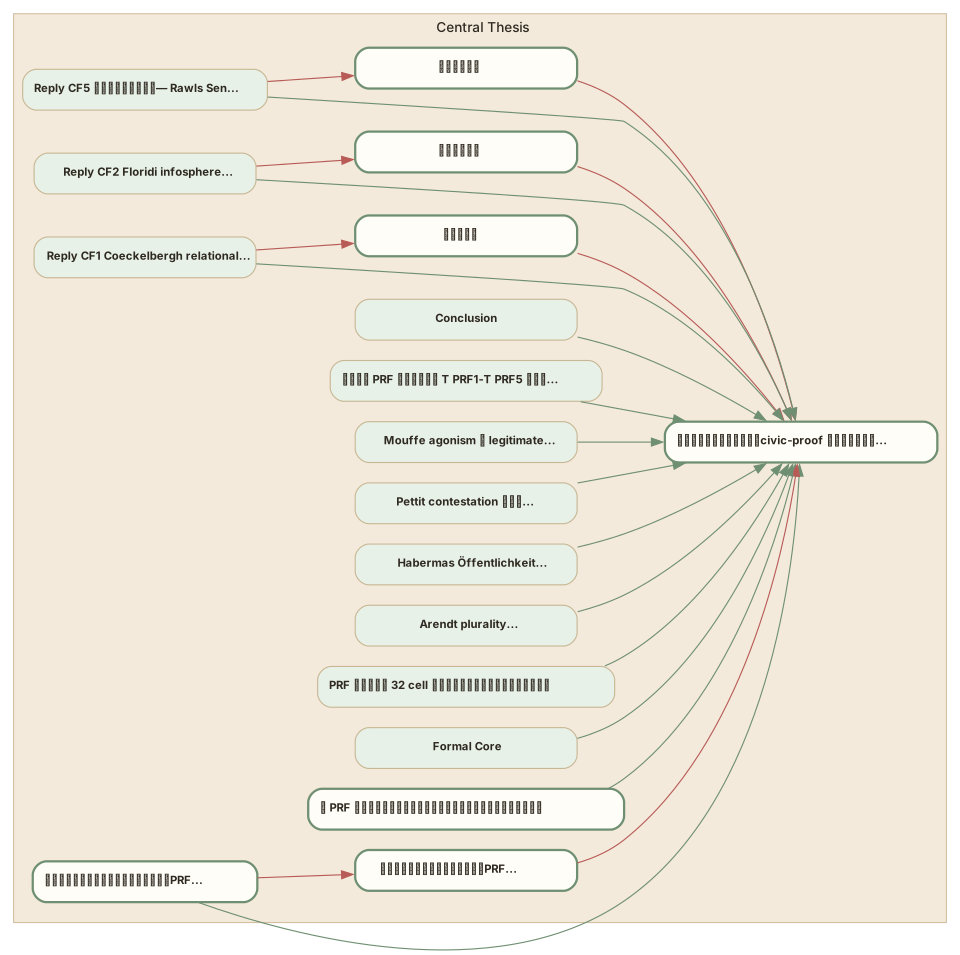
Source
===
title: 公共領域的政治哲學基礎:civic-proof 系列規範下界的 Arendt / Habermas / Pettit / Mouffe 四家合取
subTitle: Public Realm Floor (PRF) — Argument Map (v2)
slug: 2026-05-12-public-realm-political-philosophy
author: research-article-pipeline argdown export
model:
  removeTagsFromText: true
===

# Central Thesis

[Core Thesis]
  + <Formal Core>
  + [Accepted]
  + <P1>
  + <P2>
  + <P3>
  + <P4>
  + <P5>
  + <Causal Chain>
  + [Deployment Conditions]
  + <Conclusion>
  - [Rejected]
    - [Accepted]
  + [Accepted]
  - [Objection 1]
    - <Reply 1>
  + <Reply 1>
  - [Objection 2]
    - <Reply 2>
  + <Reply 2>
  - [Objection 3]
    - <Reply 3>
  + <Reply 3>

[Core Thesis]: Arendt plurality(natality mortality uniqueness 存在論三層)、Habermas Öffentlichkeit(ideal speech situation Geltungsansprüche 三聲稱 Wahrheit Richtigkeit Wahrhaftigkeit Sluice 模型)、Pettit contestation(Equally Accepted Terms Equally Accessible Influence Active Stance bearer position editorial democracy 四條件)、Mouffe agonism(legitimate adversary 三條件——相互承認 共享規則 爭議框架)四家於 civic-proof 系列場景下構成複合規範下界 PRF plurality, validity, contestation, agonism 。四家各自必要、不可化約、不可由其他三家補位(由四條形式定理 T PRF1 T PRF4 承擔) 任一分量被違反即 LegitimacyDegrade(d) θ dem 0.5(由定理 T PRF0 承擔)。系列既有 8 篇核心承擔者(A1 A3 A8 A14 A15 F1 F2 F3) 四分量構成 32 cell 承擔矩陣( 核心 18 cell 部分 9 cell — 不對應 5 cell),F1 為四分量全核心承擔者 F1 RT-ℬ AA-ℬ 兩 cell 之 Z₃-intrinsic 邊界由定理 T PRF5「PRF 下界之工程不可達引理」承擔,工程不能跨越亦不能取代。五類反論(CF1 Coeckelbergh relational personhood CF2 Floridi infosphere monism CF3 後人類主義 Braidotti Hayles CF4 數位民主樂觀派 Benkler CF5 元反論「為何選四家」)於 likelihood impact 矩陣下「削弱但不推翻」PRF 之合取下界。PRF 為複合下界非絕對唯一,開放 Rawls Sen Nussbaum Honneth 為 ceiling 或 boundary。 #thesis

<Formal Core>: Formula PRF plurality, validity, contestation, agonism (定義 3.1) PRF violated(d) i plurality, validity, contestation, agonism violation(d, PRF i) (合取下界) PRF satisfied(d) i plurality, validity, contestation, agonism satisfies(d, PRF i) LegitimacyDegrade(d) σ( β₁ violation intensity(d, plurality) β₂ violation intensity(d, validity) β₃ violation intensity(d, contestation) β₄ violation intensity(d, agonism) ) 其中 σ logistic sigmoid(與 F1 3.2 P degrade 同形),β₁ β₂ β₃ β₄ 1.0(先驗等權重,待實證校準) T PRF0 PRF violated(d) LegitimacyDegrade(d) θ dem 0.5 T PRF1 d (d satisfies validity contestation agonism) (d violates plurality) legitimate(d) (plurality 必要) T PRF2 d (d satisfies plurality contestation agonism) (d violates validity) legitimate(d) (validity 必要) T PRF3 d (d satisfies plurality validity agonism) (d violates contestation) legitimate(d) (contestation 必要) T PRF4 d (d satisfies plurality validity contestation) (d violates agonism) legitimate(d) (agonism 必要) T PRF5 (PRF 下界之工程不可達引理) engineering design d (PRF violated(d) LegitimacyDegrade(d) θ dem) F1 RT-ℬ violation(plurality) violation(validity) F1 AA-ℬ violation(contestation) violation(agonism) PRF NormativeFloors (複合下界非絕對唯一) NormativeFloors PRF, Rawls justice, Sen capability, Nussbaum dignity, Honneth recognition, ... 8 篇 4 分量承擔矩陣 (32 cell) plurality validity contestation agonism A1 可問責 A3 概念定位 — A8 FTLA A14 救濟空白 — A15 inclusion F1 委任極限 (核心承擔 4) F2 receipts (F2 9 CF1-CF5 為 agonistic 工程化升格) F3 UX 認知 核心 18 cell 部分 9 cell — 不對應 5 cell plurality 4 validity 5 contestation 4 agonism 5 Stress Test (likelihood impact,含緩解版) CF1 Coeckelbergh plurality medium-high low-medium (F1 4.1 降一檔不降兩檔) CF2 Floridi plurality medium low (範疇區分 描述 vs 規範) CF3 後人類主義 plurality contestation medium-low low (主體性條件 非 人類例外) CF4 Benkler validity agonism low low (new affordance new legitimacy) CF5 元反論 整體方法論 low-medium low (開放下界立場) Caption PRF 由四家分量合取構成複合下界 LegitimacyDegrade 為四家 violation intensity 線性組合之 sigmoid,閾值 θ dem 0.5 為分析性建議數。T PRF1-T PRF4 由「不可由其他三家補位」之 reductio 結構承擔 T PRF5 把 F1 RT-ℬ AA-ℬ 之 Z₃-intrinsic 邊界擴展至所有工程設計層,斷言任何工程承載不可繞道 PRF 下界。32 cell 承擔矩陣以 — 三類標記 8 篇 4 分量之對應強度,F1 為唯一四分量全核心承擔者,F2 9 CF1-CF5 壓力測試之 agonistic 工程化使 F2-agonism 由 — 升格為 。五類反論於含緩解版下「削弱但不推翻」PRF,最強衝擊 CF1 Coeckelbergh 對 plurality 之削弱由 F1 4.1 存在論 vs 功能論區分回應。 #formal

[Accepted]: 四家於合取下保留各自原著立場與張力,PRF 為複合規範下界(缺一即敗),工程承載為下界之具體實作(不可取代). 四家原著(Arendt 1958 The Human Condition Habermas 1962 Strukturwandel der Öffentlichkeit 1981 TKH 1992 Faktizität und Geltung Pettit 1997 Republicanism 2012 On the People s Terms Mouffe 2000 The Democratic Paradox 2013 Agonistics )各自於 civic-proof 系列前 18 篇之不同篇章承擔下界錨點,但未於系列任一篇正面承擔四家合取為系列規範下界。本文把四家合取提升為系列規範下界之正面論述,採合取(conjunction)方法論 四家於 PRF 中保留各自原著立場與張力(如 Habermas 之 consensus 立場與 Mouffe 之 agonism 立場之張力保留,兩家於「公共領域承擔人類人格性主體」一點上合取),不主張融合為新理論。合取下界之兩項蘊涵——其一,四家任一分量被違反即 PRF 整體被違反,不允許以另一家補強被違反者之 trade-off 其二,滿足 PRF 為必要條件(充分性不在主張範圍),未主張「達到上界」。PRF NormativeFloors(複合下界非絕對唯一),開放 Rawls Sen Nussbaum Honneth 為 ceiling 或 boundary 條件。 #accepted

[Rejected]: 四家可融合為新版「複合民主理論」,PRF 為民主理論候選版本之上界,工程承載可獨立承擔合法性. 把 Arendt Habermas Pettit Mouffe 四家視為可融合為新版「複合民主理論」之元素,由 syncretic-fusion 取徑消解四家原著之概念張力(如 Habermas consensus 與 Mouffe agonism 之根本分歧、Arendt 存在論 plurality 與 Pettit 共和主義 contestability 之層級差異) 只要這個分類成立,PRF 即被讀為「另一個民主理論候選版本」,與 Rawls justice、Sen capability、Nussbaum dignity、Honneth recognition 並列為可被工程實作直接優化之上界,工程承載(wallet schema、UX 設計、平台治理)可獨立承擔民主合法性。混淆下界與上界帶來三個論證代價——其一,syncretic-fusion 容易把不同層級之概念(如 Arendt 存在論 plurality 與 Mouffe 政治理論 agonism)強行合併,失去原著之概念精度 其二,四家於 civic-proof 系列前 18 篇之隱用程度最深(F1 4 三進路合取已建立 Arendt Habermas Pettit 之承擔,Mouffe 於 F1 4.2 (iii) 為輔助),把四家視為可被任一家替代之化約使 32 cell 承擔矩陣失效 其三,工程承載若可獨立承擔合法性,F1 RT-ℬ 與 AA-ℬ 之 Z₃-intrinsic 邊界(責任承擔需 first-personal mens rea、contestation bearer 需 Pettit active-stance)即被取消,PRF 下界於工程實作層被繞道。 #rejected

<P1>: Title PRF 形式骨架與 32 cell 承擔矩陣構成四家合取下界之形式表述 Section 3 — 演繹(PRF 形式定義 LegitimacyDegrade T PRF0-T PRF5 32 cell 承擔矩陣) Role 提供合取下界之形式骨架——若 PRF 函數定義、LegitimacyDegrade sigmoid、四條形式定理 T PRF1-T PRF4 與 T PRF5 工程不可達引理不形式化,「四家合取」只能停在語言層 若 8 4 32 cell 承擔矩陣不展開,「系列規範下界」只是修辭,「F1 為四分量全核心承擔者」之系列意義無從承擔。 PRF plurality, validity, contestation, agonism 採合取下界(conjunctive normative floor)定義,PRF violated(d) i violation(d, PRF i)(任一分量違反即整體違反,不允許 trade-off 補強)。PRF NormativeFloors 採開放邊界立場(複合下界非絕對唯一)。LegitimacyDegrade(d) 採 logistic sigmoid 形式(與 F1 3.2 P degrade 同形),四家等權重 β 1.0 為先驗設定 θ dem 0.5 為分析性建議數(待 V-Dem Bertelsmann Freedom House 反向校準)。T PRF0 把 PRF violated LegitimacyDegrade θ dem 形式化 T PRF1-T PRF4 把四家各自必要以「reductio 若違反該家而其餘三家滿足,則退化為 X」結構承擔——plurality 違反退化為「無共在主體之程序」(Arendt 28 共同世界)、validity 違反退化為「策略性互動」(Habermas strategisches Handeln)、contestation 違反退化為「無挑戰管道之共識」(Pettit hegemonic consensus)、agonism 違反退化為「antagonism 內戰」或「post-political consensual 儀式」(Mouffe 兩種失能)。T PRF5 把 F1 RT-ℬ (plurality validity 雙違反)與 AA-ℬ (contestation agonism 雙違反)之 Z₃-intrinsic 邊界擴展為「任何工程設計不可繞道 PRF 下界」之引理。8 4 32 cell 承擔矩陣以 — 三類標記 8 篇 4 分量對應強度,統計分布為 18 9 — 5 F1 為唯一四分量全核心承擔者(4 ),F2 9 CF1-CF5 壓力測試之 agonistic 工程化使 F2-agonism 由 — 升格為 ,最終 — cell 僅餘 A3-agonism、A14-plurality、A1-某分量等共 5 處。 Finding PRF 函數加上 LegitimacyDegrade sigmoid 加上 T PRF1-T PRF5 五條定理加上 32 cell 承擔矩陣構成本文對 civic-proof 系列規範下界之形式延伸 下游 writer 不可主張任一家可由其他三家補位(違反 T PRF1-T PRF4),亦不可主張工程承載可獨立承擔合法性(違反 T PRF5)。 Formal PRF plurality, validity, contestation, agonism PRF violated(d) i violation(d, PRF i) T PRF0 PRF violated(d) LegitimacyDegrade(d) θ dem 0.5 T PRF5 engineering d , (PRF violated(d) LegitimacyDegrade(d) θ dem) #pillar

<P2>: Title Arendt plurality 採存在論層級三層條件(natality mortality uniqueness),不可化約為 liberal pluralism Section 4 — 哲學詮釋(Arendt plurality 三層存在條件 華人「群」傳統 系列場景) Role 提供 SA1 plurality 分量之 Arendt 存在論承擔——若 plurality 被讀為「liberal pluralism 多元價值觀並存」(政治理論層級),則 F1 4.1 對 AI agent 之「無 natality 無 mortality stake 無 uniqueness disclosure」三理由失效,CF1 Coeckelbergh relational personhood 全面替代之反論即無回應空間 若華人「群」傳統與 Arendt plurality 之結構同構性未明示為「結構同構但歷史承載條件不同」之保守立場,跨文化推論被讀為類比過度。 Arendt 1958 The Human Condition 1 Prologue「the fact that men, not Man, live on the earth and inhabit the world」(諸人共在地球 單一抽象之「人」不在 Arendt 立場之內,p.7)建立 plurality 為存在論層級。三層存在條件——natality( 44 p.313-320 p.177「each man begins something new」之「能起頭」存在條件,非生物學事實描述)、mortality( 44 與 natality 對位之存在條件,行動承擔不可撤回之 stake-taking AI agent 之「重新生成」摧毀此存在基礎)、uniqueness( 24 p.175-181「The Disclosure of the Agent in Speech and Action」之 who what 區分, who 只能在行動中向他人揭露, what 是屬性層描述)。Honig 1993 把 natality 連結到「政治行動之開放性」 d Entrèves 1994、Benhabib 1996 把 who what 區分連結到政治主體性之不可化約。Arendt plurality 嚴格區分 liberal pluralism 三項——存在論層級 vs 政治理論層級、subject of disclosure vs subject of choice、 who 之共在 vs 價值觀並列。華人「群」傳統(朱雲漢 2012 對台灣公共領域多元承載者之分析 林宗弘 2020 對台灣社運與政黨「正當對手」關係 Wang Hui 2003 對中國「公」概念轉化)與 Arendt plurality 之結構同構性在「諸人共在」之存在條件,但「群」之歷史承載條件(儒家修身齊家治國平天下之 hierarchical structure)與 Arendt 存在論之 horizontal plurality 仍有差距。三個系列場景對應——A1 2 NAACP v. Alabama 等三案承擔匿名政治言論之 multiple who A15 3 對無證件者 無國籍者 流亡者經驗排除盤點承擔 enrollment 條件檢驗 F1 4.1 對 AI agent 之三層存在條件論證承擔「結構不可委任」之核心理由。 Finding plurality 採 Arendt 存在論三層條件構成 SA1 承擔骨架 CF1 Coeckelbergh 之 relational personhood 即使法律承認某種地位亦無法改變存在論結構(F1 4.1「降一檔不降兩檔」立場),CF3 後人類主義對 plurality 之擴張壓力轉為「主體性條件之檢驗」(非「人類例外」立場),華人「群」傳統與 plurality 採「結構同構但歷史承載條件不同」之保守立場。 Formal plurality Arendt(1958) natality mortality uniqueness plurality liberal pluralism (層級不同) AI agent a natality(a) mortality stake(a) uniqueness disclosure(a) plurality bearer(a) #pillar

<P3>: Title Habermas Öffentlichkeit 採三層規範性結構(ideal speech situation Geltungsansprüche 三聲稱 Sluice 模型),不可化 Section 5 — 哲學詮釋(Habermas Öffentlichkeit 三層規範性結構 Fraser counterpublics 華人「公」傳統) Role 提供 SA2 validity 分量之 Habermas 規範結構承擔——若 Öffentlichkeit 被讀為「empirical public opinion 民意調查」(實證測量),則 ideal speech situation 之 counterfactual idealization 性質失效,三聲稱 Wahrheit Richtigkeit Wahrhaftigkeit 之 normative force 退化為 platform algorithm 之 metric 若 Fraser counterpublics 補正未明示為「擴張但保留下界」立場,PRF 之單一 Öffentlichkeit 結構被讀為排他 若華人「公」傳統與 Öffentlichkeit 對應未明示歷史承載條件差距,跨文化推論被讀為類比過度。 Habermas Öffentlichkeit 概念橫貫三本錨點原著(1962 Strukturwandel 1981 TKH 1992 Faktizität und Geltung )。三層規範性結構——第一層 ideal speech situation(1981 TKH Bd. I III.3 把 kommunikatives Handeln 定義為「以達成相互理解為目標的行動」,預設四項 counterfactual 條件,所有相關方皆可參與、無權力扭曲、無時間限制、無內外部脅迫 ideal speech situation 為 counterfactual idealization 而非 empirical claim,作用是給出「合理共識」之規範性參考點) 第二層 Geltungsansprüche 三聲稱(TKH III.3 p.410-427 把言說行動拆解為 Wahrheit 真理性 Richtigkeit 正當性 Wahrhaftigkeit 真誠性,保留德文原文以避免中譯歧義) 第三層 Sluice 模型(1992 Faktizität und Geltung Kap. VII-VIII,民主立法之 legitimacy 來自「非正式意見形成」與「formal decision-making」兩層 Sluice 之溝通管道,zivilgesellschaftliche Öffentlichkeit 之非正式意見形成置於 institutional decision-making 之上游)。Öffentlichkeit 嚴格區分 empirical public opinion 三項——input 為言說行動之 rational-critical debate vs 意見 aggregation、output 為合理共識 vs 多數偏好測量、normative structure vs platform algorithm 可扭曲之 metric。Fraser 1990 Rethinking the Public Sphere 對單一性預設之批判由 Warner 2002 Publics and Counterpublics 系統化 本文採「擴張但保留下界」立場,多個 counterpublics 之並存符合 plurality,但各 counterpublic 仍須各自滿足 validity 之 normative structure。Habermas 1992 Kap. VIII 對 zivilgesellschaftliche Öffentlichkeit 之 Sluice 模型已部分回應 Fraser 批判。華人「公」傳統(Wang Hui 2003 對中國「公」概念歷史轉化 朱雲漢 2012 把「公」連結到台灣公共領域 institutional 承載 大法官釋憲、立法院運作、公投制度、地方議會、媒體監督五大承擔)與 Öffentlichkeit 之結構同構性在「normative structure 之 institutional 承擔」,但「公」之歷史承載條件(科舉、士大夫、清議)與 Habermas 18 世紀資產階級公共領域之歷史承載條件(咖啡館、沙龍、印刷品)不同。三個系列場景對應——GDPR cookie banner 八年失敗承擔 Wahrhaftigkeit 退化為 ritual 之 case、台灣 2018-2021 公投案例承擔 Öffentlichkeit 之台灣 institutional 履行、2024 美國大選 platform manipulation 承擔 Geltungsansprüche 三聲稱在 platform 中介下之承擔者位置侵蝕。 Finding validity 採 Habermas 三層規範性結構構成 SA2 承擔骨架 Fraser counterpublics 補正採「擴張但保留下界」立場(多個 counterpublics 符合 plurality,各自滿足 validity) 華人「公」傳統與 Öffentlichkeit 採「結構同構但歷史承載條件不同」之保守立場 CF2 Floridi infosphere monism 對 plurality 之本體論壓力由「描述性 ontology 與規範性下界範疇區分」回應。 Formal validity Habermas (ideal speech situation Geltungsansprüche Sluice) Geltungsansprüche Wahrheit Richtigkeit Wahrhaftigkeit validity empirical public opinion (範疇不同) counterpublics plurality extension cp counterpublics satisfies(cp, validity normative structure) #pillar

<P4>: Title Pettit contestation 採三層 first-personal 要求(Equally Accepted Terms Equally Accessible Influence Section 6 — 哲學詮釋(Pettit contestation 三層 first-personal 要求 bearer position 三層 non-domination 華人「諫議」傳統) Role 提供 SA3 contestation 分量之 Pettit 共和主義承擔——若 contestation 被讀為「異議之 input function」(被動接受意見徵詢),則 active-stance 之 first-personal 要求失效,AI agent 可作為 contestation bearer 之邏輯空間被開啟,F1 AA-ℬ 邊界被工程式繞道 若 freedom as non-domination 未嚴格區分 Berlin negative freedom(不被干預)與 republican freedom(無 arbitrary power 之可能性),Lovett 2010 三條件失能 若華人「諫議」傳統之歷史承載條件(君臣關係 士大夫倫理 家國一體)與 Pettit republican democracy(公民身份 平等政治權 institutional 制衡)差距未明示,跨文化推論被讀為類比過度。 Pettit contestation 概念橫貫兩本錨點原著(1997 Republicanism 2012 On the People s Terms )。三層 first-personal 要求——第一層 Equally Accepted Terms(2012 Ch.3「公民必須能在平等條件下接受公共政策之 terms」,此 first-personal 要求不可由 representative 替代,任何 representative 之 acceptance 須以公民自身能 first-personally 接受為條件) 第二層 Equally Accessible Influence(2012 Ch.5 Eyeball Test p.81-105「公民能與權力持有者眼神平視而不畏縮」,預設可及之影響管道,含挑戰 申訴 投票 抗議) 第三層 Active Stance(1997 Ch.6 2012 Ch.6 contestation 主體必須「主動」採取異議立場,非「被動」接受意見徵詢 此區分對 AI agent 場景之意義在於 AI 可作為意見徵詢之 input function,但不可作為 active-stance bearer)。F1 4.3 已建立 bearer position 三層檢驗(執行 execution 可委任 endorsement 條件可委任 bearer 不可委任,對應 Pitkin 1967 formal-substantive representation 區分) F1 RT-ℬ 與 AA-ℬ 邊界即第三層之不可達。Freedom as non-domination(1997 Ch.2「不被任何人或機構任意地干預」)比 Berlin negative freedom(不被干預)更強,即使無實際干預,若存在「被任意干預之可能性」仍屬 domination Lovett 2010 三條件(power 之 actual exercise dispositional capacity arbitrary character)任一缺失即 domination 狀態降級。對數位場景之蘊涵——當 wallet schema、verifier 演算法、issuer 撤銷機制等基礎設施可「任意」改變 holder 之行為條件,即使未實際干預仍為 domination F1 3.2 P degrade-TC「calibration 由 agent 自報而無外部 contestation 渠道」即此 mechanism 之具體案例。華人「諫議」傳統(中國史「諫諍」之三層結構直諫 諷諫 死諫 台灣大法官釋憲聲請制度之三層結構人民聲請 法官聲請 機關聲請)與 Pettit contestation 之結構同構性在 first-personal active stance 之承擔,但「諫議」之歷史承載條件(君臣關係 士大夫倫理 家國一體)與 Pettit republican democracy 之歷史承載條件(公民身份 平等政治權 institutional 制衡)差距較大。三個系列場景對應——台灣大法官釋憲聲請(釋字 803 791 748 號)承擔 bearer position 之具體實踐、CJEU SCHUFA C-634 21(2023)承擔 GDPR Art 22「不受自動化決策約束之權利」之 institutional 對應、SEC v. Jarkesy(2024)承擔行政程序對 fraud 案件之 jury trial 權利。 Finding contestation 採 Pettit 三層 first-personal 要求加 bearer position 三層檢驗構成 SA3 承擔骨架 freedom as non-domination 比 Berlin negative freedom 更強之 domination 機率性條件 華人「諫議」傳統與 Pettit contestation 採「結構同構但歷史承載條件不同」之保守立場 F1 RT-ℬ 與 AA-ℬ 之 Z₃-intrinsic 邊界於 T PRF5 形式化為工程不可達引理。 Formal contestation Pettit (Equally Accepted Terms Equally Accessible Influence Active Stance) bearer position three layer freedom non domination arbitrary power (Lovett 三條件) AI agent a a input function active stance bearer(a) #pillar

<P5>: Title Mouffe agonism 採 legitimate adversary 三條件(相互承認 共享規則 爭議框架),與 antagonism 之 enemy 殲滅邏輯嚴格區分 Section 7 — 哲學詮釋(Mouffe agonism antagonism 嚴格區分 legitimate adversary 三條件 Habermas Mouffe 合取 華人「諍友」傳統) Role 提供 SA4 agonism 分量之 Mouffe 對抗政治承擔——若 agonism 被讀為「antagonism 敵對」(無 legitimate adversary 預設),則 Schmitt 殲滅邏輯被引入,agonism 之規範性立場崩解 若 Habermas Mouffe 未採合取(非互斥)立場,PRF 之 validity 與 agonism 兩分量被讀為互斥 若華人「諍友」傳統之歷史承載條件(儒家倫理 士大夫關係 私人友誼 君臣對話 hierarchical 預設)與 Mouffe institutional agonism(多黨政治 公共辯論 媒體監督 公民團體 confrontation)差距未明示,跨文化推論被讀為類比過度。 Mouffe agonism 概念橫貫兩本錨點原著(2000 The Democratic Paradox 2013 Agonistics )。agonism 與 antagonism 之嚴格區分——agonism 預設 legitimate adversary(正當對手),antagonism 預設 enemy(敵人)。legitimate adversary 三條件(2000 Ch.4 p.80-107)為相互承認(mutual recognition)、共享規則(shared rules)、爭議框架(agonistic frame) 三條件之共同預設為「對手之政治表達權被承認為正當,即使其立場與自身對立」。antagonism 之 enemy 結構則否,對手之政治表達權不被承認,互動退化為殲滅邏輯。Mouffe 吸收 Schmitt 1932 The Concept of the Political 對抗政治概念,但拒絕 Schmitt 之 friend enemy 殲滅邏輯 Schmitt 為納粹法學家,引用須誠實邊界明示——Mouffe 吸收 Schmitt 對「政治本質含對抗性」之洞察,把 enemy 結構轉化為 legitimate adversary 結構。Mouffe 2000 Ch.4 p.102-105 對 Habermas deliberative consensus 之批判明示「政治不能化約為理性共識」,若把民主合法性化約為共識,會消解民主之 agonistic 維度,退化為 post-political consensual。本文採 Habermas Mouffe 合取(非互斥)立場,依賴 F1 4.2 既有方法論——兩家之合取結構在於 Habermas 之 Öffentlichkeit 與 Geltungsansprüche 三聲稱承擔「言說行動之規範結構」,Mouffe 之 legitimate adversary 三條件承擔「對抗政治之規範結構」,兩者在「政治發言要求人類人格性主體」一點上合取,在「共識 vs 對抗」之張力上保留 Norval 2007 Aversive Democracy 對 Mouffe Cavell 對話進一步把此合取系統化。華人「諍友」傳統( 論語 季氏 之「益者三友 友直、友諒、友多聞」之直言相諫 中國史韓愈 范仲淹 王安石 顧炎武等士大夫間直言相諫之傳承 宋明理學「君子和而不同」與 Mouffe legitimate adversary 三條件之語意承擔同構)與 Mouffe agonism 之結構同構性在 legitimate adversary 相互承認,但「諍友」之歷史承載條件(私人 半公領域之倫理結構)與 Mouffe institutional agonism(多黨制度之公領域結構)差距較大。三個系列場景對應——2024 台灣大選後立法院三黨不過半之「藍白合」vs「綠營小聯合」動態結構承擔 agonism 之台灣 institutional 履行、2019-2020 香港反送中運動之 agonism antagonism 邊界滑移、2024 美國大選極化政治承擔 agonism 退化為 antagonism 之衝擊。 Finding agonism 採 Mouffe legitimate adversary 三條件構成 SA4 承擔骨架 agonism antagonism 嚴格區分採規範性立場(經驗性區分不在本文承擔範圍) Habermas Mouffe 合取(非互斥)立場依賴 F1 4.2 既有方法論 華人「諍友」傳統與 Mouffe agonism 採「結構同構但歷史承載條件不同」之保守立場 Schmitt 引用限定於 agonism 之系譜性 acknowledgment(不延伸至納粹政治立場)。 Formal agonism Mouffe legitimate adversary(mutual recognition shared rules agonistic frame) agonism antagonism (殲滅邏輯被拒) Habermas Mouffe 合取於「政治發言要求人類人格性主體」(張力保留於 consensus vs 對抗) #pillar

<Causal Chain>: Title 四家概念 PRF 函數合取定義 T PRF1-T PRF5 形式化 32 cell 承擔矩陣 系列 8 篇 forward-link civic-proof 系列規範下界 D1 (deterministic) D1 四家原著概念 PRF 函數合取定義。Arendt 1958 1 24 44 plurality 三層存在條件、Habermas 1962 1981 1992 Öffentlichkeit 三層規範性結構、Pettit 1997 2012 contestation 三層 first-personal 要求、Mouffe 2000 2013 agonism legitimate adversary 三條件,於 3.1 合取為 PRF plurality, validity, contestation, agonism 。形式表述為 PRF satisfied(d) i satisfies(d, PRF i) 合取下界於 3.2 定義為 PRF violated(d) i violation(d, PRF i),PRF NormativeFloors(複合下界非絕對唯一)。 D2 (deterministic) D2 PRF 函數 T PRF0 違反蘊涵 LegitimacyDegrade sigmoid。 3.2 把 LegitimacyDegrade 形式化為四家 violation intensity 之 logistic sigmoid(與 F1 3.2 P degrade 同形),β 1.0 先驗等權重,θ dem 0.5 分析性建議數。T PRF0 把 PRF violated(d) LegitimacyDegrade(d) θ dem 形式化為條件性蘊涵 σ(β 1.0) 0.731 為單一分量完全違反、σ(β 0.5) 0.622 為單一分量中度違反、σ(0) 0.5 為基線。 D3 (deterministic) D3 T PRF0 T PRF1-T PRF4「四家各自必要」 T PRF5 工程不可達引理。 3.4 四條形式定理採「reductio 若違反該家而其餘三家滿足,則退化為 X」結構——T PRF1 plurality 違反退化為「無共在主體之程序」、T PRF2 validity 違反退化為「策略性互動」、T PRF3 contestation 違反退化為「無挑戰管道之共識」、T PRF4 agonism 違反退化為「antagonism 內戰或 post-political consensual 儀式」。T PRF5 把 F1 RT-ℬ (plurality validity 雙違反)與 AA-ℬ (contestation agonism 雙違反)之 Z₃-intrinsic 邊界擴展為「任何工程設計不可繞道 PRF 下界」之引理。 D4 (deterministic) D4 T PRF1-T PRF5 32 cell 承擔矩陣。 3.3 把系列 8 篇核心承擔者(A1 A3 A8 A14 A15 F1 F2 F3) 4 分量 32 cell 投射為承擔矩陣,採三類標記 (核心承擔,主規範主張直接落於分量) (部分承擔,間接支撐) —(不對應,無顯著關聯)。統計分布為 18 cell 9 cell — 5 cell 四分量之 cell 數量為 plurality 4 validity 5 contestation 4 agonism 5 F1 為唯一四分量全核心承擔者(4 ),F2 9 CF1-CF5 壓力測試之 agonistic 工程化使 F2-agonism 由 — 升格為 。 D5 (deterministic) D5 32 cell 矩陣 系列 8 篇 forward-link civic-proof 系列規範下界。 10 對 A1(plurality agonism 雙錨點)、A3(plurality validity 概念地景)、A8(validity contestation agonism 三家治理框架)、A14(contestation agonism 救濟空白)、A15(plurality validity contestation 三家 inclusion rights)、F1(四分量全核心 RT-ℬ AA-ℬ 邊界)、F2(validity contestation agonism 升格 receipts)、F3(validity agonism supporter UI 三層分離)八篇之規範主張回應,承擔系列規範下界之具體化。32 cell 承擔矩陣為「條件性對應」非「絕對描述」,反映前 18 篇之當前詮釋 若詮釋變動,矩陣須重做( 11 高風險主張 R7)。 T-LLM-Agent-F1 (probabilistic) T-LLM-Agent-F1 CF5 LLM-agent 補位對 F1 邊界之工程實作層延伸——2026 至 2030 LLM-agent in wallet 提供 comprehension 協助、attribute filtering 建議、決策建議三項服務時,agent 與 supporter 角色滑移使 F1 RT-ℬ AA-ℬ 邊界於工程實作層脆弱化。緩解設計為 F1 7.3.1 AgentDelegationProof presentationOrigin 標籤 comprehension attestation 與 chooser signature 分離 agent 與 supporter 密碼學區分四件設計合取維持邊界,限定於 Z₂ 範圍內延伸、不繞過 F1 RT-ℬ AA-ℬ 兩條常駐型不可委任邊界。TW DIW 進入 LLM-agent 階段之衝擊為具體案例。 T-CrossTime-Cultural (probabilistic) T-CrossTime-Cultural 跨時代與跨文化推論之 PRF 適用性壓力——四家錨點原著為 1958 至 2013 時段之西方政治哲學,本文應用於 2026 數位場景之效力依賴四家之跨時代適用性(Arendt plurality 對 LLM-agent 場景 Habermas Öffentlichkeit 對 platform 場景 Pettit contestation 對演算法治理場景 Mouffe agonism 對 polarization 場景) 跨文化推論依賴華人「群」「公」「諫議」「諍友」四傳統與四家之結構同構性。本文採「結構同構但歷史承載條件不同」之保守立場,於 11 誠實邊界明示 歷史承載條件差距於 4.3 5.4 6.4 7.3 個別說明。 #chain

[Deployment Conditions]: 把 PRF 四家合取下界翻譯為可被檢驗之承擔結構,必須通過六道條件. PRF deployable(d) V plurality(d) V validity(d) V contestation(d) V agonism(d) V method(d) V floor boundary(d) #conditions

<C1>: Title V plurality — Arendt 存在論三層(natality mortality uniqueness)不可由 functional perspectival heterog V plurality 採 Arendt 存在論三層條件合取——natality(行動者作為新開始之「能起頭」存在條件,非生物學事實描述)、mortality(行動承擔不可撤回之 stake-taking,AI agent 之「重新生成」摧毀此存在基礎)、uniqueness( who what 區分, who 只能在行動中向他人揭露)。V plurality 採 phenomenological ontology 立場,不採 informational ontology(CF2 Floridi infosphere monism 採後者立場為哲學立場選擇) 不採 liberal pluralism 之「多元價值觀並列」(subject of choice 對 subject of disclosure 之範疇不同) 不採 functional perspectival heterogeneity 之化約(AI agent 之「多視角」不等於 multiple who 之共在)。Arendt 著作之歐洲中心傾向為已知 gap( 11 誠實邊界明示),跨文化適用須結構同構檢驗。 Formal V plurality(d) d natality mortality uniqueness V plurality functional perspectival heterogeneity V plurality liberal pluralism (層級不同) #condition

<C2>: Title V validity — Geltungsansprüche 三聲稱(Wahrheit Richtigkeit Wahrhaftigkeit) reciprocal recognit V validity 採 Habermas 三層規範性結構合取——ideal speech situation(counterfactual idealization,四項條件所有相關方參與 無權力扭曲 無時間限制 無內外部脅迫)、Geltungsansprüche 三聲稱(Wahrheit 真理性對外部世界、Richtigkeit 正當性對規範世界、Wahrhaftigkeit 真誠性對內部世界,保留德文原文避免中譯歧義)、Sluice 模型(非正式意見形成 formal decision-making 兩層溝通管道,zivilgesellschaftliche Öffentlichkeit 之非正式意見形成置於 institutional decision-making 之上游)。V validity 採 normative structure 立場,不採 empirical public opinion 之 aggregation 化約 Fraser counterpublics 補正採「擴張但保留下界」立場(多個 counterpublics 之並存符合 plurality,各 counterpublic 仍須各自滿足 validity 之 normative structure) Habermas 18 世紀資產階級公共領域之歐洲中心傾向為已知 gap。 Formal V validity(d) d ideal speech situation Wahrheit Richtigkeit Wahrhaftigkeit Sluice model V validity empirical public opinion (範疇不同) counterpublics plurality extension cp satisfies(cp, V validity normative structure) #condition

<C3>: Title V contestation — Equally Accepted Terms Equally Accessible Influence Active Stance bearer V contestation 採 Pettit 三層 first-personal 要求合取——Equally Accepted Terms(公民必須能在平等條件下接受公共政策之 terms,first-personal 要求不可由 representative 替代)、Equally Accessible Influence(Eyeball Test「公民能與權力持有者眼神平視而不畏縮」,預設可及之影響管道含挑戰 申訴 投票 抗議)、Active Stance(contestation 主體必須「主動」採取異議立場,非「被動」接受意見徵詢 AI 可作為 input function 但不可作為 active-stance bearer)。bearer position 三層檢驗(執行 execution 可委任 endorsement 條件可委任 bearer 不可委任)對應 F1 4.3 既有方法論 F1 RT-ℬ 與 AA-ℬ 邊界即第三層之不可達。freedom as non-domination 採「無 arbitrary power 之可能性」立場(比 Berlin negative freedom 更強),Lovett 2010 三條件之任一缺失即 domination 狀態降級。 Formal V contestation(d) d Equally Accepted Terms Equally Accessible Influence Active Stance bearer position three layer freedom non domination arbitrary power (Lovett 三條件) AI agent a a input function active stance bearer(a) #condition

<C4>: Title V agonism — agonism vs antagonism 嚴格區分 legitimate adversary 三條件 拒絕 Schmitt 殲滅邏輯 V agonism 採 Mouffe legitimate adversary 三條件合取——相互承認(mutual recognition)、共享規則(shared rules)、爭議框架(agonistic frame)。三條件共同預設「對手之政治表達權被承認為正當,即使其立場與自身對立」。V agonism 嚴格區分 antagonism 之 enemy 殲滅邏輯(對手政治表達權不被承認、互動退化為殲滅) Mouffe 吸收 Schmitt 1932 對抗政治概念,但拒絕 Schmitt friend enemy 殲滅邏輯(Schmitt 為納粹法學家,引用限定於 agonism 系譜性 acknowledgment)。V agonism 與 V validity 採合取(非互斥)立場,依賴 F1 4.2 既有方法論——兩家於「公共領域承擔人類人格性主體」一點上合取,於「共識 vs 對抗」之張力上保留。agonism antagonism 邊界於實際政治中容易滑移(2019-2020 香港反送中 2024 美國大選極化政治為案例),規範意義上兩者嚴格不同。 Formal V agonism(d) d legitimate adversary(mutual recognition shared rules agonistic frame) V agonism antagonism (殲滅邏輯被拒) V validity V agonism 合取於「政治發言要求人類人格性主體」(張力保留於 consensus vs 對抗) #condition

<C5>: Title V method — 規範性 vs 描述性嚴格分離 合取(非綜合)方法論 V method 採兩項方法論紀律合取——其一規範性與描述性嚴格分離 PRF 主張採條件性語式「若違反 PRF 任一分量,則 LegitimacyDegrade(d) θ dem」(normative claim),不採實證描述「數位民主必然符合 PRF」(descriptive claim) PRF 不是經驗事實之歸納,四家錨點原著之 personhood 預設、Öffentlichkeit normative structure、contestability active-stance bearer、agonism legitimate adversary,皆為規範條件之形式化。其二合取(非綜合)方法論 四家於 PRF 中保留各自原著立場與張力,不主張融合為新版「複合民主理論」 合取方法論之優點在於保留四家原著之獨立詮釋空間,避免 syncretism 偽綜合容易把不同層級之概念(如 Arendt 存在論 plurality 與 Mouffe 政治理論 agonism)強行合併而失去原著之概念精度。F1 4.4 三進路合取表為方法論前例,本文擴展至四進路合取並提升為系列規範下界承擔。 Formal V method(d) normative descriptive separated(d) conjunction not synthesis(d) normative PRF conditional implication (violation LegitimacyDegrade θ dem) (PRF syncretic fusion(plurality, validity, contestation, agonism)) #condition

<C6>: Title V floor boundary — PRF 邊界與 F1 RT-ℬ AA-ℬ 邊界明示 T PRF5 工程不可達引理 V floor boundary 採 PRF 邊界與 F1 既有邊界對位明示——PRF 為規範下界(normative floor)非絕對上界(normative ceiling),不主張「達到合法性最高水準」之充分性 PRF NormativeFloors,開放 Rawls Sen Nussbaum Honneth 為 ceiling 或 boundary 條件。F1 RT-ℬ (first-personal mens rea 失能)對應 PRF plurality validity 雙分量違反 F1 AA-ℬ (contestation bearer 失能)對應 PRF contestation agonism 雙分量違反 兩者皆為 PRF 違反之強情形。T PRF5 把此邊界擴展為「任何工程設計不可繞道 PRF 下界」之引理——工程承載(wallet schema、密碼學原語、UX 工程、治理框架、法律承載)可承擔 PRF 四分量之具體實作,但不能取代四分量之規範地位。CF5 LLM-agent 補位之工程實作層延伸限定於 Z₂ 範圍內延伸(不繞過 F1 Z₃ 邊界),F3 supporter UI 三層分離為此邊界於 UX 層之具體承載。 Formal V floor boundary(d) PRF NormativeFloors T PRF5(d) T PRF5 engineering d , (PRF violated(d) LegitimacyDegrade(d) θ dem) F1 RT-ℬ violation(plurality) violation(validity) F1 AA-ℬ violation(contestation) violation(agonism) #condition

<Conclusion>: PRF 四家合取構成 civic-proof 系列規範下界 。Arendt plurality(multiple who 之存在論共在 natality mortality uniqueness 三層存在條件)、Habermas Öffentlichkeit(ideal speech situation Geltungsansprüche 三聲稱 Wahrheit Richtigkeit Wahrhaftigkeit Sluice 模型)、Pettit contestation(Equally Accepted Terms Equally Accessible Influence Active Stance bearer position 三層檢驗 editorial democracy 四條件)、Mouffe agonism(legitimate adversary 三條件——相互承認 共享規則 爭議框架)四家於 civic-proof 系列場景下構成合取下界 PRF。四家各自必要、不可化約、不可由其他三家補位(由定理 T PRF1 至 T PRF4 承擔) 任一分量被違反即 LegitimacyDegrade(d) θ dem 0.5(由定理 T PRF0 承擔)。 θ dem 0.5 為分析性建議數 ,待 V-Dem 2024 liberal democracy index 退化案例分布、Bertelsmann Transformation Index、Freedom House 年度報告反向校準。PRF NormativeFloors(複合下界非絕對唯一),開放 Rawls Sen Nussbaum Honneth 為 ceiling 或 boundary 條件。 工程不能取代規範下界 。密碼學原語(wallet、receipts、selective disclosure)、UX 設計(supporter UI 三層分離)、平台治理(FTLA 四層、跨境互認)等工程承載可承擔 PRF 四分量之具體實作,但不能取代四分量之規範地位。F1 RT-ℬ (責任承擔需 first-personal mens rea,對應 plurality validity 雙分量違反)與 AA-ℬ (contestation bearer 需 Pettit active-stance,對應 contestation agonism 雙分量違反)之 Z₃-intrinsic 邊界於定理 T PRF5 形式化為「PRF 下界之工程不可達引理」——任何工程設計不可繞道 PRF 下界。CF5 LLM-agent 補位之工程實作層延伸限定於 Z₂ 範圍內延伸(不繞過 F1 Z₃ 邊界),F3 supporter UI 三層分離為此邊界於 UX 層之具體承載。對 EUDI Wallet、TW DIW、Aadhaar 等基礎設施之規範性要求,應以 PRF 四分量為下界判準,工程承載為下界之具體實作 不主張工程承載可獨立承擔合法性。 系列 8 篇承擔矩陣為「條件性對應」非「絕對描述」 對三組讀者分立建議 。32 cell 承擔矩陣( 3.3)反映前 18 篇規範主張之當前詮釋( 18 cell 9 cell — 5 cell) F1 為唯一四分量全核心承擔者(4 ),F2 9 CF1-CF5 壓力測試之 agonistic 工程化使 F2-agonism 由 — 升格為 。若系列其他篇章詮釋更新或新增系列文章,矩陣須重做( 11 高風險主張 R7)。對 政治哲學學界 ——本文採合取(非綜合)方法論於 8.2 明示,學界後續可延伸 PRF 與其他政治哲學進路之合取關係(O3 O21)、跨文化 PRF 之對應與張力(O11 O22)、PRF 對非民主政體之描述力與規範力區分(O4 O14)。對 公民科技社群 ——32 cell 承擔矩陣為系列規範主張之承擔關係形式化,F1 RT-ℬ AA-ℬ 邊界為工程設計上界限制,supporter UI 三層分離 wallet 三重預設退化分析 跨法域救濟空白為 PRF 在工程承載之應用。對 數位身分政策學者 ——對台灣讀者警示, TW DIW 進入 LLM-agent 階段須在 DIW v1.0 規格明示「LLM-agent 補位不取代 supporter UI 三層分離之工程承擔,contestation 維度之人類民主主體承擔不可由 LLM-agent 取代」 歐盟 EUDI Wallet、印度 Aadhaar、台灣 TW DIW 等基礎設施之政策評估,可援引 PRF 四分量為規範下界判準。 Formal Coda Final form PRF plurality, validity, contestation, agonism (定義 3.1) PRF violated(d) i plurality, validity, contestation, agonism violation(d, PRF i) PRF satisfied(d) i satisfies(d, PRF i) PRF NormativeFloors (複合下界非絕對唯一) LegitimacyDegrade(d) σ( β₁ violation intensity(d, plurality) β₂ violation intensity(d, validity) β₃ violation intensity(d, contestation) β₄ violation intensity(d, agonism) ) 其中 σ logistic sigmoid(與 F1 3.2 P degrade 同形),β 1.0(先驗等權重) T PRF0 PRF violated(d) LegitimacyDegrade(d) θ dem 0.5 Definitions plurality Arendt(1958) (natality mortality uniqueness) validity Habermas(1962 1981 1992) (ideal speech Geltungsansprüche Sluice) contestation Pettit(1997 2012) (Equally Accepted Terms Equally Accessible Influence Active Stance) agonism Mouffe(2000 2013) legitimate adversary(mutual recognition shared rules agonistic frame) 四條形式定理 (各自必要) T PRF1 d (d validity contestation agonism) (d violates plurality) legitimate(d) T PRF2 d (d plurality contestation agonism) (d violates validity) legitimate(d) T PRF3 d (d plurality validity agonism) (d violates contestation) legitimate(d) T PRF4 d (d plurality validity contestation) (d violates agonism) legitimate(d) 推論 C PRF PRF satisfied(d) i satisfies(d, PRF i) T PRF5 (PRF 下界之工程不可達引理) engineering design d (PRF violated(d) LegitimacyDegrade(d) θ dem) F1 RT-ℬ violation(plurality) violation(validity) F1 AA-ℬ violation(contestation) violation(agonism) 8 篇 4 分量承擔矩陣 (32 cell) plurality validity contestation agonism A1 可問責 A3 概念定位 — A8 FTLA A14 救濟空白 — A15 inclusion F1 委任極限 (核心承擔 4) F2 receipts (F2 9 升格) F3 UX 認知 核心 18 cell 部分 9 cell — 不對應 5 cell plurality 4 validity 5 contestation 4 agonism 5 Stress Test (含緩解版 likelihood impact) CF1 Coeckelbergh plurality medium-high low-medium (F1 4.1 降一檔不降兩檔) CF2 Floridi plurality (ontology) medium low (範疇區分 描述 vs 規範) CF3 後人類主義 plurality contestation medium-low low (主體性條件 非 人類例外) CF4 Benkler validity agonism low low (new affordance new legitimacy) CF5 元反論 整體方法論 low-medium low (開放下界立場 其他進路為 ceiling) Cross-time Cross-cultural 四家原著 1958-2013 西方政治哲學 2026 數位場景 (跨時代適用性,誠實邊界明示) Arendt plurality 華人「群」傳統(朱雲漢 林宗弘) Habermas Öffent. 華人「公」傳統(Wang Hui 2003 朱雲漢 2012) Pettit contestation 華人「諫議」傳統(中國史諫諍 台灣大法官釋憲聲請) Mouffe agonism 華人「諍友」傳統( 論語 季氏 益者三友 君子和而不同) 結構同構但歷史承載條件不同( 11 誠實邊界明示) Z₂ PRF-engineering-bearer Z₃-intrinsic PRF-engineering-bearer (T PRF5 邊界) #conclusion

# Deployment Conditions

[Deployment Conditions]
  + <C1>
  + <C2>
  + <C3>
  + <C4>
  + <C5>
  + <C6>

# Objections And Replies

[Objection 1]: CF1 Coeckelbergh relational personhood 全面替代 — AI 透過關係性實踐獲得 personhood,PRF plurality 容納 AI 故四家合取下. Coeckelbergh 2020 AI Ethics Ch.4-6 與 2024 Why AI Undermines Democracy 主張 relational personhood 之擴展,使「人格性主體」邊界可包含 AI agent。若 AI 透過關係性實踐獲得 personhood,則 PRF plurality 之 multiple who 共在容納 AI、PRF validity 之 Wahrhaftigkeit 聲稱承擔者可包含 AI、PRF 之人本預設被全面替代。likelihood 評估為 medium(Coeckelbergh 2020 2024 已在華語學界與部分歐陸 AI ethics 形成結構性承擔),impact 評估為 medium-high(最強衝擊在 plurality 分量 CF5 LLM-agent 補位之工程實作層延伸亦在此反論結構內)。實證強度上,2027 至 2030 年 LLM-agent in wallet 提供 comprehension 協助、attribute filtering 建議、決策建議三項服務時,若工程社群採 Coeckelbergh relational personhood 立場為設計準則,F1 RT-ℬ AA-ℬ 邊界在工程實作層即被視為「規範外推之累贅」而被繞道。 #objection

<Reply 1>: Title CF1 Coeckelbergh relational personhood 全面替代 — AI 透過關係性實踐獲得 personhood,PRF plurality 容納 AI 故四家合取下 仔細看,CF1 觸發反向支撐「存在論 vs 功能論區分」之 F1 4.1「降一檔不降兩檔」立場——即使法律承認某種 relational personhood,第 4 plurality 之存在論論證(natality mortality uniqueness)不依賴於法律承認,法律可承認某種地位但不能改變該主體之存在論結構。plurality 分量之 Arendt 存在論定義以「multiple who 在 natality mortality 條件下之共在」為錨 AI agent 之 relational personhood 即使法律承認,仍欠缺 natality(每個個體作為新開始)與 mortality stake,故 plurality 分量仍不可承擔 AI。validity 分量之 Habermas Wahrhaftigkeit 要求說話者「真誠表達自己的意圖」 AI agent 之意圖歸屬問題在哲學上仍未解決,故 validity 分量仍不可承擔 AI。Coeckelbergh 2024 內部張力反向支撐 PRF——書中明示 AI 對民主構成威脅(deepfake、micro-targeting、opinion manipulation),呼籲人類民主主體之反擊能力,此立場與 PRF「公共領域進入條件以人類民主主體為核心」一致。contestation 與 agonism 兩分量於 CF1 壓力測試下「降一檔不降兩檔」,可能擴大 AI agent 之操作空間(如 AI 作為 contestation 之輔助 bearer),但仍不能取代人類 active-stance bearer 位置。 #reply

[Objection 2]: CF2 Floridi infosphere monism — 人與 AI 在 informational ontology 中皆為 inforg,PRF plurality 之 ontolo. Floridi 2014 The Fourth Revolution 主張 infosphere monism——人與 AI 在 informational ontology 中皆為 inforg。若 PRF plurality 分量採 informational ontology,multiple who 之共在容納所有 inforg(含 AI agent),則 PRF 之四家合取被 infosphere monism 之單一 ontology 替代。likelihood 評估為 medium(Floridi 2014 在 information ethics 與部分 AI ethics 已形成結構性承擔),impact 評估為 medium(最強衝擊在 plurality 分量之本體論基礎,但其餘三分量未提供等效替代)。實證強度上,infosphere monism 之 ontology shift 在哲學立場上可獨立爭論 若 PRF plurality 分量被 informational ontology 取代,Arendt phenomenological ontology 之 natality mortality worldliness 三層存在條件即被讀為「歷史哲學殘餘」,數位身分基礎設施可在 informational ontology 預設下繞道 plurality 分量。 #objection

<Reply 2>: Title CF2 Floridi infosphere monism — 人與 AI 在 informational ontology 中皆為 inforg,PRF plurality 之 ontolo 仔細看,CF2 觸發反向支撐「描述性 ontology 與規範性下界範疇區分」之方法論紀律——Floridi infosphere monism 主要處理「描述性 ontology」(人類與 AI 之 informational nature),與 PRF 之「規範性下界」屬不同範疇。infosphere monism 對 validity、contestation、agonism 三分量並未提供等效之替代承載 informational ontology 並未產生「正當性聲稱承擔者」「主動異議者」「正當對手」三類規範性主體之具體承載。PRF 框架於 Floridi 壓力測試下「削弱但不推翻」——plurality 分量之 ontology 選擇承擔哲學壓力(PRF 於 11.4 誠實邊界明示採 Arendt 存在論立場為哲學立場選擇,非邏輯必然),其餘三分量不受影響。範疇區分之蘊涵——PRF 不必否定 infosphere ontology 之描述力,infosphere ontology 亦不必否定 PRF 之規範力,兩者於不同範疇承擔各自之論證任務。 #reply

[Objection 3]: CF5 元反論「為何選這四家」— Rawls Sen Nussbaum Honneth 加入合取或替換四家,PRF 是否削弱或補強. 元反論——為何選 Arendt Habermas Pettit Mouffe 四家,不選 Rawls Sen Nussbaum Honneth 後期 Habermas Diskursethik 等?若 Rawls justice、Sen capability、Nussbaum dignity、Honneth recognition 加入合取或替換四家中之一,PRF 是否削弱或補強?likelihood 評估為 high(為合理之學界質疑,政治哲學社群對四家選擇判準必有挑戰),impact 評估為 low-medium(含開放邊界後挑戰下降)。實證強度上,若 PRF 之四家選擇被讀為「作者私自選擇」(無方法論判準),32 cell 承擔矩陣之合理性即被削弱,「F1 為四分量全核心承擔者」之系列意義被讀為循環論證(先選四家、再以四家詮釋 F1) 若其他進路加入合取或替換四家中之一,PRF 之具體形式需要重做。 #objection

<Reply 3>: Title CF5 元反論「為何選這四家」— Rawls Sen Nussbaum Honneth 加入合取或替換四家,PRF 是否削弱或補強 仔細看,CF5 觸發反向支撐「PRF 為複合下界非絕對唯一」與「開放其他進路為 ceiling boundary」之開放邊界立場——PRF NormativeFloors,NormativeFloors Rawls, Sen, Nussbaum, Honneth, ... 。四家選擇判準有三項——其一,四家共同承擔「公共領域進入條件」主題(Rawls 主題為分配正義 Sen 為個體能力 Nussbaum 為人類尊嚴 Honneth 為相互承認,主題與 civic-proof 系列「公民證明可被合法承擔」之對應較間接) 其二,四家於 civic-proof 系列前 18 篇之隱用程度最深(F1 4 三進路合取已建立 Arendt Habermas Pettit,Mouffe 於 F1 4.2 (iii) 為輔助,本文承擔提升 Mouffe 為獨立分量),其他進路於系列前 18 篇之隱用程度較淺 其三,四家於數位場景之衝擊最具體(Arendt natality 對 LLM 重複既有、Habermas Wahrhaftigkeit 對 deepfake、Pettit contestation 對演算法治理、Mouffe agonism 對 polarization,皆於數位場景有具體 mechanism)。CF5 反論反向支撐 PRF 框架對未來加入第五分量(如 Honneth recognition Sen capability)之開放空間——PRF 之具體承擔結構於 11.2 之 O3 O21 列為 open questions,未來研究路徑可選擇加入合取或作為 boundary 條件。 #reply